
Integrating life insurance with a digital asset strategy means using whole life cash value, indexed universal life, or private placement life insurance alongside crypto holdings to address four problems: liquidity, estate equalization, collateral stacking, and wealth transfer. Each approach carries suitability requirements, risk of loss, and regulatory conditions. Life insurance is not a guaranteed investment.
What Does "Integrating Life Insurance With Digital Assets" Mean?
Integration refers to structuring life insurance policies and digital asset holdings so they serve complementary functions in a wealth plan. The policies do not hold the crypto directly in most cases; instead, they create liquidity, death-benefit coverage, or an institutional policy wrapper that interacts with how crypto wealth is managed, transferred, or leveraged.
Four integration models are in general use among high-net-worth digital asset holders:
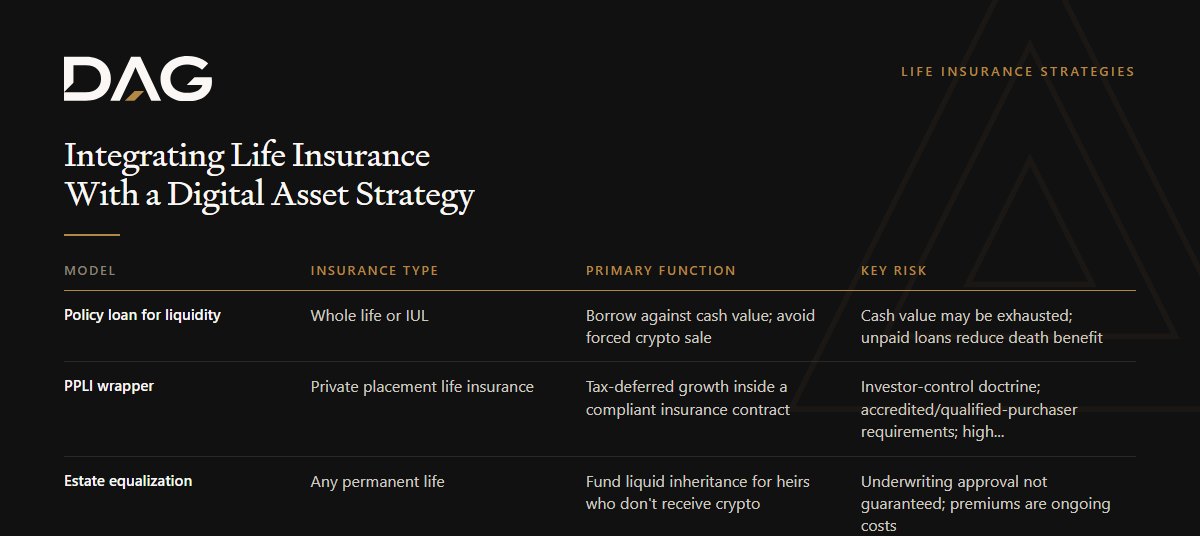
| Model | Insurance Type | Primary Function | Key Risk |
|---|---|---|---|
| Policy loan for liquidity | Whole life or IUL | Borrow against cash value; avoid forced crypto sale | Cash value may be exhausted; unpaid loans reduce death benefit |
| PPLI wrapper | Private placement life insurance | Tax-deferred growth inside a compliant insurance contract | Investor-control doctrine; accredited/qualified-purchaser requirements; high minimum |
| Estate equalization | Any permanent life | Fund liquid inheritance for heirs who don't receive crypto | Underwriting approval not guaranteed; premiums are ongoing costs |
| Premium financing | Whole life or PPLI | Use crypto or other assets as collateral to fund large premiums | Leverage amplifies loss if asset values fall or lender calls the loan |
How Can Policy Loans Create Liquidity Without Selling Crypto?
A permanent life insurance policy with accumulated cash value allows the policyholder to borrow against that cash value without a taxable event, policy loans are not treated as distributions under current federal tax law. This makes whole life and certain indexed universal life policies a potential source of liquidity when a crypto holder does not want to sell an appreciated position.
The logic: crypto holdings remain intact and continue to appreciate (or depreciate) while the policyholder accesses capital through the policy loan.
Material risks to disclose:
- Policy loans accrue interest. If loans and interest are not repaid and exceed the policy's cash value, the policy can lapse, triggering a taxable event on any gain.
- Cash value growth inside the policy is not guaranteed in most IUL contracts; it is tied to an index subject to participation rates, caps, and floors set by the carrier.
- Whole life cash value growth is contractually specified, but the policy must be structured correctly from inception. Overfunding or underfunding affects usable cash value.
- This is not a tax-free vehicle if it lapses or is surrendered.
This approach is educational, confirm structure with a licensed life insurance professional and a tax attorney familiar with IRC § 7702 before designing any policy.
What Is PPLI and Can It Hold Digital Assets?
Private placement life insurance (PPLI) is an unregistered, privately negotiated variable life insurance product issued by a carrier to a single policyholder. When it qualifies as a life insurance contract under IRC § 7702, growth inside the policy is generally income-tax-deferred, and the death benefit may be excluded from the beneficiary's gross income under IRC § 101(a). These outcomes depend on the policy meeting and continuing to meet the statutory definition; failure to comply can forfeit the tax treatment.
Suitability requirements, these are not optional thresholds:
PPLI is regulated as a securities product in some structures and as insurance in others. In the United States, it is typically only offered to accredited investors, and in many cases requires qualified purchaser status (generally $5 million or more in investable assets under the Investment Company Act, verify current definition). Carrier minimum premiums are substantial and commonly run into seven figures (illustrative; verify current figures with the carrier), which is why PPLI is not a retail product.
The investor-control doctrine is the key compliance constraint: the IRS has established through revenue rulings and case law that a policy owner cannot direct specific investments held inside the separate account. If the policyholder exercises prohibited control over investment decisions, the IRS may treat the separate account assets as directly owned by the policyholder, eliminating the tax deferral. Any PPLI structure holding alternative assets, including digital assets, must be reviewed by tax counsel for investor-control compliance.
Digital assets inside PPLI: contributing appreciated crypto to a PPLI separate account may or may not constitute a taxable realization event depending on the mechanics. Some structures involve selling the crypto and contributing cash proceeds; others may allow in-kind contribution. Tax treatment is unsettled for certain digital asset types. Require a written tax analysis before contributing.
How Does Life Insurance Help With Estate Equalization for Crypto Wealth?
Estate equalization is a planning problem: a crypto holder may own concentrated digital assets intended to remain in family custody across generations, but co-heirs who do not receive the crypto need a liquid inheritance of comparable value. Forced liquidation of crypto to divide an estate equally triggers capital gains tax and market timing risk.
A life insurance death benefit addresses this by providing liquid assets to heirs who will not inherit crypto. The policyholder structures the benefit so that beneficiaries receiving no crypto receive the insurance proceeds instead, eliminating the need to sell digital assets to equalize the estate.
For this to function:
- The policy must remain in force until death, premiums must be sustained.
- The death benefit must be sized to the anticipated value of the crypto bequest, which is uncertain given price volatility.
- The policy should be owned by an irrevocable life insurance trust (ILIT) to exclude the death benefit from the insured's taxable estate, or the three-year lookback period under IRC § 2042 will apply to transfers to an existing policy.
- Beneficiary designations must coordinate with trust and estate documents.
See crypto estate planning for high-net-worth families and crypto inheritance planning for high-net-worth families for the broader estate framework.
Can a Life Insurance Policy Be Used as Collateral for a Crypto Loan?
Some lenders will accept the cash surrender value of a permanent life insurance policy as additional collateral alongside a crypto-backed loan. The stable, contractual nature of insurance cash value may reduce the lender's perceived volatility risk compared to crypto collateral alone.
Risks specific to this structure:
- Premium financing itself is a leveraged strategy: if the collateral, crypto value, policy cash value, or both, falls below a lender's threshold, a margin call can force liquidation of assets at an inopportune time.
- Combining volatile crypto collateral with insurance collateral does not eliminate margin call risk; it may reduce it, but that depends on lender terms and the relative sizes of each collateral pool.
- Policy loans and premium finance loans are separate obligations. A policyholder can be carrying debt on both simultaneously.
- Lenders vary significantly in how they treat insurance cash value as collateral; confirm terms in writing.
This is a complex, high-risk structure. Leverage amplifies losses as well as gains. A licensed insurance professional, lender, and legal counsel should review the full structure before proceeding.
See crypto-backed loans for high-net-worth investors for the crypto loan side of this structure.
How Does Structure Coordination Work Across Insurance, Crypto, and Investment Accounts?
When a plan involves life insurance, digital asset custody, and traditional investment accounts simultaneously, ownership structure and beneficiary designations must be coordinated. Gaps create unintended tax consequences, estate inclusion, or access failures.
Key coordination points:
- ILIT ownership, if the goal is to exclude a death benefit from the taxable estate, the trust must own the policy from inception (or survive the three-year lookback for transfers of existing policies). The trust, not the insured, pays premiums or receives gifted funds to pay premiums.
- Digital asset custody, qualified custody for digital assets is distinct from insurance ownership; confirm that custodian account registration is aligned with trust or LLC ownership to avoid conflict with the insurance structure.
- Beneficiary designations, life insurance proceeds pass outside of probate to named beneficiaries. If the will or trust says one thing and the beneficiary designation says another, the designation controls. Review designations when the estate plan changes.
- Tax entity coordination, if crypto is held in a Wyoming LLC or trust, and life insurance is held in an ILIT, the relationships between entities must be documented and reviewed by a tax attorney to avoid accidental income inclusion or disqualification of the insurance tax treatment.
For the broader multi-entity planning context, see crypto wealth planning for bitcoin millionaires and digital asset wealth management for high-net-worth families.
Comparison of Life Insurance Integration Models
| Integration Goal | Best-Fit Product | Suitability Threshold | Primary Compliance Risk |
|---|---|---|---|
| Liquidity without forced crypto sale | Whole life / IUL | Any permanent-policy purchaser | Policy lapse; IRC § 7702 compliance |
| Tax-deferred portfolio growth | PPLI | Accredited investor; often qualified purchaser ($5M+) | Investor-control doctrine |
| Estate equalization | Term or permanent life | Insurable interest; underwriting approval | Underwriting denial; premium sustainability |
| Premium financing | Whole life or PPLI | Significant collateral base; lender qualification | Margin call; leverage amplification |
Related Questions
Is life insurance a guaranteed investment when used alongside crypto?
No. Life insurance is not an investment in the securities-law sense, and no version of this integration strategy guarantees returns. Whole life has a guaranteed minimum cash value element, but any dividends or illustrated values above that guarantee are not guaranteed, and the policy must remain in force for value to accumulate. PPLI and IUL returns depend on market performance, participation rates, or index performance subject to carrier-set caps, outcomes are not guaranteed. Premium financing adds leverage, which can result in losses exceeding the initial collateral. No version of this structure should be described or understood as a guaranteed outcome.
Who qualifies for PPLI?
In the United States, PPLI is typically restricted to accredited investors (under current SEC rules, generally $1 million in net worth excluding primary residence, or $200,000 individual / $300,000 joint annual income, verify current thresholds) and often requires qualified purchaser status (generally $5 million or more in investable assets). Many carriers set their own minimum premium requirements well above regulatory thresholds. PPLI is not available to retail investors and is not suitable for all accredited investors. A licensed insurance professional should conduct a full suitability review.
Does contributing crypto to a PPLI policy trigger capital gains tax?
Possibly. If an appreciated cryptocurrency is sold and the cash proceeds are contributed to the policy, a taxable realization event occurs at the time of sale. If a contribution is structured in kind (transferring the crypto directly), tax treatment depends on how the IRS characterizes the transaction and the specific mechanics of the carrier's separate account. This is an unsettled area of law for many digital asset types. Obtain a written tax opinion from qualified tax counsel before contributing any appreciated digital asset to a PPLI structure.
What happens to PPLI if the crypto inside it drops significantly in value?
PPLI policies carry ongoing insurance charges and investment management fees regardless of separate account performance. A sharp decline in the value of digital assets held inside the policy may reduce the policy's cash value below the accumulated cost of insurance charges. If the policy lapses, any gain that was tax-deferred may become immediately taxable. PPLI is generally illiquid and difficult to unwind without tax and penalty consequences. This risk is a principal reason why minimum asset thresholds and long time horizons are prerequisites for suitable PPLI candidates.
Sources
- IRC § 7702. Life Insurance Contract Defined: https://www.law.cornell.edu/uscode/text/26/7702
- IRC § 101(a). Exclusion of Life Insurance Proceeds from Gross Income: https://www.law.cornell.edu/uscode/text/26/101
- IRC § 2042. Proceeds of Life Insurance (estate inclusion rules): https://www.law.cornell.edu/uscode/text/26/2042
- IRS Revenue Ruling 2003-91 (investor-control doctrine): https://www.irs.gov/pub/irs-drop/rr-03-91.pdf
- IRS, Frequently Asked Questions on Virtual Currency Transactions: https://www.irs.gov/individuals/international-taxpayers/frequently-asked-questions-on-virtual-currency-transactions
- SEC, Accredited Investor Definition (Rule 501, Regulation D): https://www.sec.gov/education/capitalraising/building-blocks/accredited-investor
- SEC, Definition of Qualified Purchaser under the Investment Company Act: https://www.sec.gov/rules/final/ia-1731.htm
Compliance Note
This page is for educational purposes only. It does not constitute legal, tax, investment, or insurance advice. Life insurance products, including whole life, indexed universal life, and private placement life insurance, are complex financial instruments. PPLI is available only to investors who meet suitability and eligibility requirements; it is not suitable for all accredited investors. Premium financing involves leverage and can result in losses that exceed the initial collateral. No return, tax benefit, or outcome described on this page is guaranteed. Actual results depend on policy structure, holding period, carrier terms, tax law, and individual circumstances, which vary materially. All illustrative figures, thresholds, or cost ranges should be verified with a licensed insurance professional, qualified attorney, and CPA before any action is taken. Estate, trust (including ILIT), and entity structuring are legal services; the firm coordinates with your licensed attorney and does not provide legal advice. Advisory services are provided by DAG Wealth, an SEC-registered investment adviser. Registration does not imply a certain level of skill or training. DAG Insurance is the brand for insurance-related planning services. Insurance products are offered through licensed insurance professionals. This page does not constitute an offer to sell or solicitation to buy any insurance or investment product.