
Private placement life insurance (PPLI) is a privately placed variable life insurance policy for accredited investors and, at many carriers, qualified purchasers, one of the core crypto life insurance structures for high-net-worth digital asset holders. It holds investments inside an insurance contract under the policy's tax rules, but carries strict IRS requirements and large premium minimums, and loses that treatment if rules break. Funding a policy with XRP may itself trigger taxable events.
What Is Private Placement Life Insurance?
PPLI functions like a variable universal life policy with one key difference: instead of choosing from a retail mutual-fund menu, the policyholder directs investments into a separately managed account inside the policy. All growth compounds tax-deferred; policy loans may access cash value without triggering income tax; and the death benefit generally passes to heirs income-tax-free under current law.
The structure is privately placed, meaning it is offered as a security exempt from public registration, rather than sold through standard retail insurance channels. That exemption is why eligibility is restricted to accredited investors (generally, individuals with net worth above $1 million excluding a primary residence, or income above $200,000/$300,000 for two years) and, at many carriers, qualified purchasers (generally, individuals with at least $5 million in investments; thresholds are illustrative, verify current figures).
Why does PPLI have large premium minimums?
PPLI policies are custom-built and carrier-priced to cover the cost of insurance plus bespoke investment infrastructure. Most carriers illustrate minimums in the $2 million–$5 million premium range (figures are illustrative; verify current carrier requirements, they change). Below that level, the additional fees typically exceed the tax benefit. This is not a retail-insurance decision; it requires side-by-side modeling of expected tax savings against policy costs over the intended holding period.
What IRS Rules Govern PPLI?
Two rules determine whether a PPLI policy retains its tax treatment:
Investor-control doctrine. The policyholder cannot control or direct specific investment decisions inside the policy the way they would a personal brokerage account. The insurance carrier, not the insured, must retain ultimate control over the investment manager. If the IRS concludes the policyholder effectively controls the assets, the policy is disregarded as an insurance contract and all income becomes currently taxable. This is a gray area with limited formal guidance; consult tax counsel before structuring.
§817(h) diversification. The assets inside the policy's separate account must meet specific diversification requirements under IRC §817(h) and Treasury Regulation §1.817-5. A policy funded with a single concentrated position, including a single cryptocurrency, will fail this test and lose tax-advantaged status. The separate account must hold a diversified portfolio meeting the five-or-fewer-issuer and percentage limits set out in the regulations.
Failure on either rule forfeits the tax treatment retroactively. This is not a recoverable mistake.
How Can XRP Holders Fund a PPLI Policy?
XRP holders face a structural problem: contributing XRP directly to a PPLI policy's separate account is unlikely to satisfy §817(h) diversification on its own, and the IRS has not issued definitive guidance on whether digital assets held in a policy separate account meet the "look-through" rules required for regulated investment companies. The practical approaches used in practice involve:
Option 1: Collateral-backed premium financing
The XRP position stays in qualified custody while the holder borrows against it through a crypto-backed lending facility. Loan proceeds fund the insurance premium in cash. This avoids a sale, and the capital gains event that would accompany one, but borrowing costs must be factored into the policy economics. The XRP position remains subject to market volatility and margin-call risk.
Option 2: Entity contribution + diversified fund investment
XRP may be contributed to an entity (such as a trust-owned LLC) that then subscribes to a diversified fund meeting §817(h) requirements. The policy's separate account holds the fund interest, not XRP directly. Contributing XRP to the entity is itself a potentially taxable disposition, the transfer must be valued at fair market value at the time of contribution. This approach requires coordination among insurance counsel, a tax attorney, and a qualified digital asset custodian.
Option 3: Sell, fund, hold diversified portfolio inside the policy
The most structurally clean approach: liquidate a portion of the XRP position, pay any capital gains tax on the sale, fund the premium in cash, and invest the policy's separate account in a diversified portfolio. Future appreciation on the replacement portfolio compounds tax-deferred. This does not avoid the tax on the XRP gain, it accepts it in exchange for future tax efficiency inside the wrapper.
No approach eliminates all tax risk. Contributing appreciated XRP, whether to an entity or a policy, may constitute a taxable exchange under IRS Notice 2014-21 and subsequent guidance treating digital assets as property. Valuation at time of contribution must be documented. Consult a qualified tax attorney before executing any of these structures.
What Does a Compliant PPLI Structure Require?
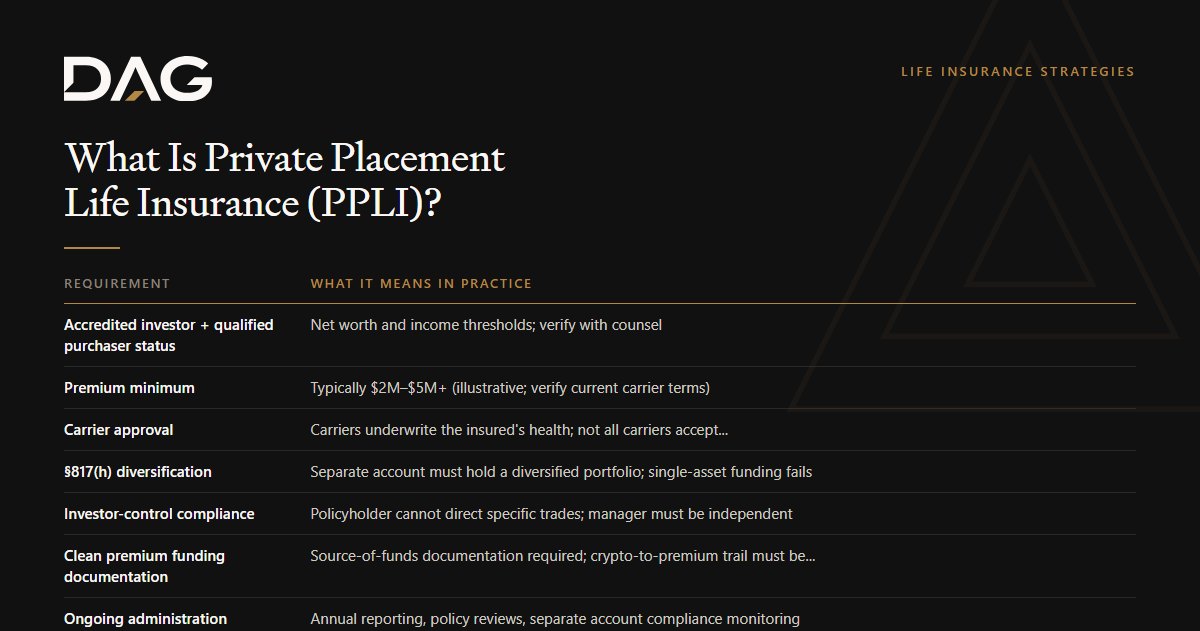
| Requirement | What it means in practice |
|---|---|
| Accredited investor + qualified purchaser status | Net worth and income thresholds; verify with counsel |
| Premium minimum | Typically $2M–$5M+ (illustrative; verify current carrier terms) |
| Carrier approval | Carriers underwrite the insured's health; not all carriers accept crypto-funded premium sources |
| §817(h) diversification | Separate account must hold a diversified portfolio; single-asset funding fails |
| Investor-control compliance | Policyholder cannot direct specific trades; manager must be independent |
| Clean premium funding documentation | Source-of-funds documentation required; crypto-to-premium trail must be documented |
| Ongoing administration | Annual reporting, policy reviews, separate account compliance monitoring |
For high-net-worth digital asset holders coordinating custody, estate planning, and tax strategy around a PPLI structure, this moves into digital asset family office territory, the number of professional relationships that must coordinate is large.
Related Questions
Does contributing XRP to fund a PPLI policy trigger a taxable event?
Almost certainly yes in most structures. The IRS treats digital assets as property (Notice 2014-21). Selling XRP for cash to pay premiums is a taxable sale. Transferring XRP to an entity or in-kind to a fund may also be a taxable disposition at fair market value on the transfer date. There is no "rollover" or deferral mechanism analogous to a 1031 exchange for digital assets funding an insurance policy. Document the cost basis and fair market value at every step. See crypto tax planning for HNW investors for related considerations.
Can a trust own a PPLI policy?
An irrevocable life insurance trust (ILIT) is a common PPLI ownership structure. Trust ownership may remove the death benefit from the taxable estate if structured correctly, but requires careful compliance with the three-year lookback rule under IRC §2035 and ongoing Crummey notice requirements. The trust is a separate legal entity that owns the policy; the insured is not the owner. See trust structures for crypto wealthy individuals for broader trust-holding considerations.
What is the difference between PPLI and a standard variable life insurance policy?
Standard variable life insurance is a registered security sold retail, with a limited fund menu, retail-grade pricing, and no investor-control issue because the policyholder cannot direct to individual securities. PPLI is privately placed, unregistered, available only to accredited/qualified-purchaser investors, allows access to institutional investment managers, and carries significantly higher premium minimums. The tax structure is similar; the flexibility, cost, and eligibility requirements are not.
What happens if my PPLI policy fails the investor-control or diversification test?
Tax-advantaged status is forfeited, potentially retroactively. All deferred income may become currently taxable, and penalties may apply. The IRS has challenged PPLI structures that gave policyholders too much investment direction. There is no administrative cure once the test is failed. This risk makes upfront legal and insurance counsel non-negotiable, not optional.
Sources
- IRS Notice 2014-21 (digital assets as property): https://www.irs.gov/irb/2014-16_IRB#NOT-2014-21
- IRC §817(h) and Treasury Regulation §1.817-5 (diversification requirements for variable contracts): https://www.law.cornell.edu/uscode/text/26/817
- IRC §2035 (three-year lookback rule for life insurance transfers): https://www.law.cornell.edu/uscode/text/26/2035
- SEC Regulation D (private placement exemption framework): https://www.sec.gov/regulation-d
- IRS Revenue Ruling 2003-91 and related investor-control guidance (consult primary source; landmark ruling on investor-control doctrine in variable contracts)
Compliance Note
This page is educational only and does not constitute legal, tax, investment, or insurance advice. Private placement life insurance involves complex regulatory requirements, large financial minimums, and the real risk of forfeiting tax treatment if structural requirements are not met. PPLI policies are not FDIC-insured, are not guaranteed by any government agency, and are not suitable for most investors. Insurance policies are not guaranteed investments. Past performance of assets held inside a policy does not guarantee future results.
Contributing digital assets such as XRP to fund a PPLI structure may itself constitute a taxable event. No statement on this page should be read as a promise of tax-free treatment, specific returns, or guaranteed outcomes.
Eligibility thresholds, premium minimums, and carrier requirements cited on this page are illustrative only and subject to change. Verify all figures with a licensed insurance professional and qualified tax counsel before taking any action.
DAG Insurance provides insurance-related services and coordinates with outside professionals; it does not provide legal or tax advice. Entity formation, trust and estate drafting, and operating-agreement work are legal services handled by licensed attorneys. Advisory services involving securities are provided by DAG Wealth, an SEC-registered investment adviser. Registration does not imply a certain level of skill or training. Not all services are available in all states. Consult a licensed insurance professional, qualified tax attorney, and registered investment adviser before implementing any strategy discussed here.