
Crypto custody for family offices is the process of selecting and governing how digital assets are held, accessed, moved, reported, and protected across the family enterprise. It typically spans multiple owners and entities, so the work is as much about written controls and approval roles as about the custodian itself. Custody choices carry market, operational, and tax risk, and outcomes generally depend on the family's facts.
What Crypto Custody for Family Offices Means
Custody is who holds the keys to digital assets and under what controls. For a family office, that rarely means one account. Holdings often sit across individuals, trusts, LLCs, foundations, and advisor-managed portfolios, each with its own owner, signer set, and reporting needs. A qualified custodian is an entity (such as a bank, trust company, or registered broker-dealer) that meets the standards contemplated by the SEC custody rule, including segregation of client assets and independent verification. For background on how custody fits the broader picture, see the Digital Asset Custody Hub, and for the precise legal test see What Is a Qualified Crypto Custodian?.
Custody Questions for Family Offices
Use this checklist when mapping holdings and controls:
- Which assets are held personally, by trusts, by LLCs, or by other entities?
- Which custodians or wallets are approved, and who maintains that list?
- Who can initiate a transfer, and who must approve it (and at what dollar threshold)?
- Are private keys, MPC controls, or multi-signature policies documented in writing?
- Does the provider publish a current SOC 1 or SOC 2 report, and does it carry custody insurance?
- Can the provider produce statements and tax records, including support for Form 1099-DA reporting?
- What happens when a trustee, manager, or signer changes?
A written transfer rule and an address-verification step prevent the most common loss events. See Crypto Transfer Approval Policy and Crypto Address Verification Policy for the control language.
Qualified Custody vs Self-Custody
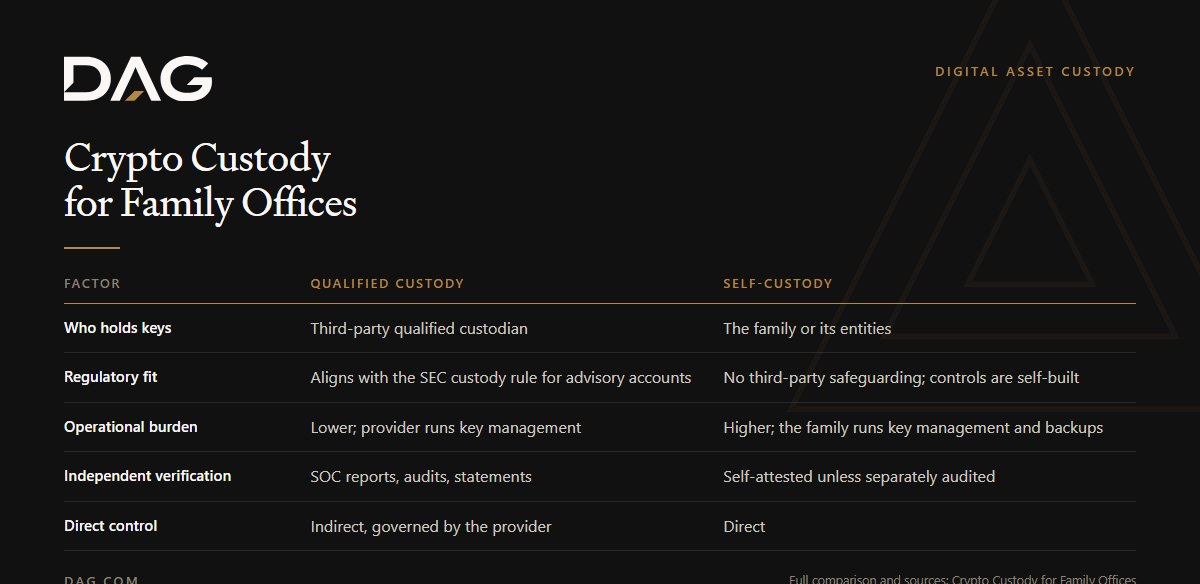
The two models trade control against operational burden and regulatory fit. Neither removes market, custody, or tax risk.
| Factor | Qualified Custody | Self-Custody |
|---|---|---|
| Who holds keys | Third-party qualified custodian | The family or its entities |
| Regulatory fit | Aligns with the SEC custody rule for advisory accounts | No third-party safeguarding; controls are self-built |
| Operational burden | Lower; provider runs key management | Higher; the family runs key management and backups |
| Independent verification | SOC reports, audits, statements | Self-attested unless separately audited |
| Direct control | Indirect, governed by the provider | Direct |
Some family offices run a hybrid: qualified custody for advisor-managed and long-term holdings, self-custody for smaller operational balances. For a deeper comparison see Qualified Custody vs Self-Custody for Crypto Wealth and the entity-specific guides for trusts and LLCs.
Policy Recommendation
A family office should maintain a written crypto custody policy covering approved providers, accounts, transfer-approval procedures, address verification, reporting, signer succession, and emergency access. The policy is the artifact an adviser, auditor, or successor trustee can follow when the people who set it up are unavailable.
Related Questions
Do family offices need a qualified custodian for crypto?
It depends on the facts. Where an SEC-registered adviser has custody of client crypto, the custody rule generally points toward a qualified custodian. A family office holding only its own assets has more latitude, but qualified custody can still reduce operational and key-management risk. Consult qualified counsel on your structure.
Can one custodian hold assets for trusts, LLCs, and individuals together?
Many institutional custodians support multiple legal entities under one relationship with segregated sub-accounts, but capabilities vary by provider and by entity type. Confirm onboarding requirements and statement separation before consolidating. Using more than one custodian can also reduce concentration risk.
Does using a regulated custodian guarantee my crypto is safe?
No. Registration or regulated status indicates a provider meets certain standards; it does not guarantee skill, performance, or that assets are immune from loss. Custody insurance is typically limited in scope, and crypto holdings are generally not covered by FDIC or SIPC insurance. Review SOC reports, insurance terms, and audited controls.
Sources
Compliance Note
This article is educational and does not provide legal, tax, investment, fiduciary, compliance, or custody advice. Family offices should review custody decisions with qualified professionals. Registration does not imply a certain level of skill or training.