
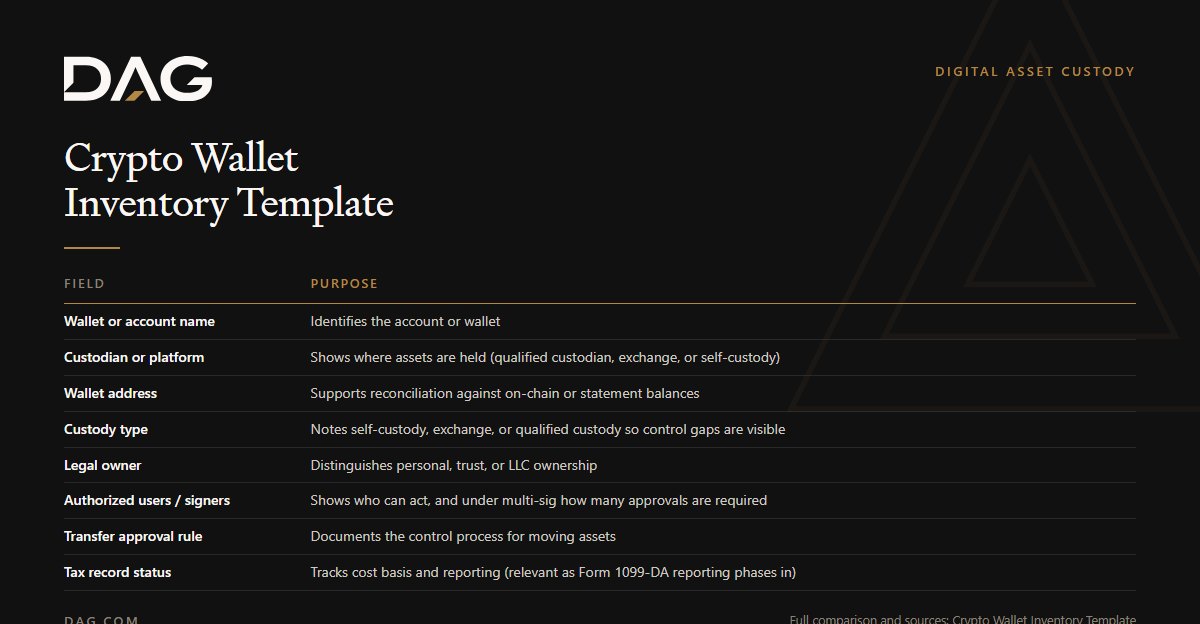
A crypto wallet inventory template is a structured document that records where digital assets are held, who legally owns each one, and who has authority to act on it, without exposing private keys or seed phrases. It gives investors, family offices, trustees, and advisors a single reference for reconciliation, tax records, and estate access, so no holding goes untracked.
What a Crypto Wallet Inventory Template Is
The inventory is a record-keeping tool, not a key store. It catalogs each wallet or account by name, custodian, legal owner, and access procedure so a fiduciary or adviser can locate and reconcile every position. Done well, it documents access procedures, where the instructions live and who is authorized, rather than the secrets themselves. Keeping seed phrases and private keys out is the point; their absence is what makes the document safe to share with the people who need it.
A complete inventory underpins several controls discussed across the Digital Asset Custody Hub: it feeds a crypto custody policy, supports a transfer approval policy, and gives a signer succession policy something concrete to govern.
Suggested Fields
| Field | Purpose |
|---|---|
| Wallet or account name | Identifies the account or wallet |
| Custodian or platform | Shows where assets are held (qualified custodian, exchange, or self-custody) |
| Wallet address | Supports reconciliation against on-chain or statement balances |
| Custody type | Notes self-custody, exchange, or qualified custody so control gaps are visible |
| Legal owner | Distinguishes personal, trust, or LLC ownership |
| Authorized users / signers | Shows who can act, and under multi-sig how many approvals are required |
| Transfer approval rule | Documents the control process for moving assets |
| Tax record status | Tracks cost basis and reporting (relevant as Form 1099-DA reporting phases in) |
| Estate access instruction location | Points fiduciaries to the access process, not the keys |
What Not to Include
Do not place seed phrases, private keys, passwords, or unrestricted login credentials in a general inventory document. The inventory may point to where those secrets are secured, a hardware wallet, a sealed instruction, a custodian's onboarding record, but it should not contain them. A document that lists holdings and names owners is far less dangerous than one that hands an attacker the ability to move funds. For the transition from self-held keys to a third party that holds them under the SEC custody framework, see how to move from self-custody to qualified custody.
How to Use the Template: An Evaluation Checklist
Use this checklist to confirm an inventory is complete and safe before relying on it:
- Every wallet and account is listed, including dormant or low-balance ones
- Each row names a single legal owner (individual, trust, or LLC) with no ambiguity
- Custody type is recorded so self-custody concentration is visible
- Authorized signers and any multi-sig approval threshold are documented
- The transfer approval rule for each holding is written down, not assumed
- Tax record status notes where cost-basis records live for each position
- Estate and incapacity access instructions are referenced by location, not reproduced
- No seed phrase, private key, or password appears anywhere in the file
- Storage and sharing of the document itself are access-controlled
Review Cadence
Update the inventory after any event that changes who holds what or who can act: new wallets, account openings, transfers, trustee changes, LLC changes, custodian changes, or major tax events. A stale inventory is a common failure point, see common crypto custody mistakes for family offices. Pairing the update with a custodian annual review keeps both the record and the relationships current.
Related Questions
Should a crypto wallet inventory include private keys or seed phrases?
No. An inventory should identify assets, owners, and access procedures, but keeping secrets out of it is what makes the document safe to store and share. Record where the keys are secured rather than the keys themselves, and protect the inventory file with its own access controls.
How often should I update a crypto asset inventory?
Generally, after any event that changes holdings or authority, new accounts, transfers, custodian or trustee changes, or significant tax events, and on a fixed annual cadence regardless. The right frequency depends on your facts; a qualified adviser or fiduciary can help set one.
Who needs access to the wallet inventory?
Typically the legal owner, authorized signers, and the fiduciaries or advisers responsible for the assets. Access should be limited to those who need it, since the document maps an estate's digital holdings. Consult an estate planning or custody professional on appropriate distribution.
Sources
Compliance Note
This article is educational and does not provide legal, tax, fiduciary, investment, security, or custody advice. A wallet inventory is a record-keeping tool; it does not by itself reduce market, custody, or tax risk, and no record-keeping practice guarantees the safety of digital assets. Wallet inventories should be reviewed with qualified professionals.