
Private placement life insurance (PPLI) allows you to fund a policy with liquidity-event proceeds, grow assets inside a tax-deferred insurance wrapper, and distribute policy loans, potentially income-tax-free, to your parents on a recurring basis, without selling your core holdings or triggering gift-tax filing requirements each year.
What Is PPLI and Why Does It Matter After a Liquidity Event?
Private placement life insurance (PPLI) is a variable life insurance product issued outside the registered securities market and available only to accredited investors or qualified purchasers. The policy owner funds the contract with a lump sum or series of contributions. Assets held inside the policy wrapper grow tax-deferred; properly structured policy loans are generally received by the borrower free of income tax. The death benefit passes to named beneficiaries income-tax-free.
After a significant liquidity event, whether from a crypto exit, business sale, or token unlock. PPLI can serve as a coordinated income source for aging parents, replacing or supplementing direct cash gifts that would otherwise erode your lifetime gift-tax exemption.
Why Monthly Cash Gifts Create Problems at Scale
Direct recurring transfers to parents above the annual exclusion ($18,000 per recipient in 2024; $19,000 in 2025, indexed for inflation) require a Form 709 gift-tax return and consume your lifetime exemption. At $10,000–$20,000 per month per parent, you can reach meaningful exemption erosion within one to three years.
A second problem: if you fund those gifts by liquidating appreciated digital assets, each sale is a taxable event. Capital gains compound on top of the transfer-tax exposure.
How a PPLI Structure Can Generate Income for Parents
1. Fund the Policy Post-Close
At or shortly after a liquidity event, allocate a defined portion of after-tax proceeds into a PPLI policy. Minimum funding thresholds typically begin at $1–$5 million depending on the carrier and jurisdiction. Contributions must satisfy IRC §7702 definition-of-life-insurance tests (CVAT or GPT) to preserve the tax benefits; funding too aggressively relative to the death benefit risks reclassification as a modified endowment contract (MEC), which alters the tax treatment of loans and distributions.
2. Invest Inside the Insurance Wrapper
The policy's separate account is professionally managed by a third-party investment manager (not DAG Insurance directly). The policyholder has some influence over investment allocation strategy within compliance constraints, but cannot self-direct into personal crypto wallets or commingled accounts. Investment managers must be unrelated parties under IRS investor-control rules. Assets grow tax-deferred inside the wrapper.
3. Access Cash Value Through Policy Loans
Once sufficient cash value accumulates, policy loans can be taken. Under current law, properly structured policy loans are generally not treated as taxable income. Your parents receive funds; the loan balance accrues interest against future policy proceeds. The remaining cash value continues compounding. At death, the outstanding loan balance is netted against the death benefit before proceeds pass to beneficiaries.
4. Name Parents as Beneficiaries
The policy can designate parents as death-benefit beneficiaries, providing a safety net if the policy owner dies before parents.
Illustrative Cash-Flow Scenario
| Year | Assumed Policy Value | Annual Loan Drawn | Cumulative Loan Balance |
|---|---|---|---|
| 1 | $5,400,000 | $200,000 | $200,000 |
| 3 | $6,200,000 | $200,000 | $620,000 |
| 7 | $8,500,000 | $200,000 | $1,460,000 |
| 10 | $10,800,000 | $200,000 | $2,200,000 |
Illustrative only. Assumes 8% gross annual growth inside the wrapper, no policy expenses or mortality charges shown, no guarantee of any return. Actual values will differ. Not a projection or promise of investment performance.
Key Compliance and Suitability Considerations
- MEC risk: Over-funding relative to the death benefit converts the policy to a modified endowment contract. MEC loans are taxable and subject to a 10% penalty before age 59½. Structuring must be coordinated with a licensed insurance professional and tax counsel.
- Investor-control doctrine: IRS Revenue Ruling 2003-91 and 2003-92 require that the policyholder not have direct or indirect control over specific investment decisions. If the IRS determines the policyholder effectively controls investments, inside buildup may lose its tax-deferred status.
- Suitability: PPLI is appropriate only for accredited investors and qualified purchasers with long time horizons, adequate liquidity outside the policy, and tolerance for illiquidity within it.
- State regulation: PPLI is issued under state insurance law. Availability, permitted investment strategies, and disclosure requirements vary by state. Some states restrict offshore PPLI issued by non-admitted carriers. Confirm jurisdiction before structuring.
- Policy loans are not "tax-free" unconditionally: The income-tax-free character of policy loans depends on the policy remaining in force and not lapsing. If the policy lapses with an outstanding loan, the loan amount may be treated as a distribution and become taxable. Surrender charges during early years can be significant.
How This Compares to Direct Gifting
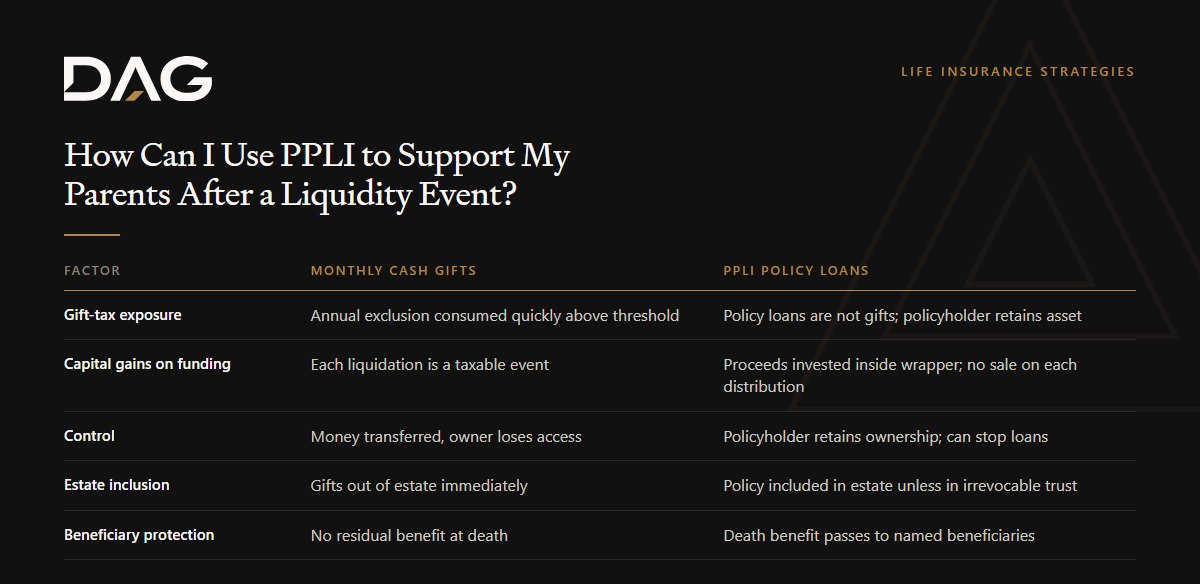
| Factor | Monthly Cash Gifts | PPLI Policy Loans |
|---|---|---|
| Gift-tax exposure | Annual exclusion consumed quickly above threshold | Policy loans are not gifts; policyholder retains asset |
| Capital gains on funding | Each liquidation is a taxable event | Proceeds invested inside wrapper; no sale on each distribution |
| Control | Money transferred, owner loses access | Policyholder retains ownership; can stop loans |
| Estate inclusion | Gifts out of estate immediately | Policy included in estate unless in irrevocable trust |
| Beneficiary protection | No residual benefit at death | Death benefit passes to named beneficiaries |
Coordinating PPLI With Digital Asset Holdings
If significant crypto positions remain alongside the PPLI structure, custody separation matters. Assets inside a PPLI policy are held in a separately managed insurance account, not commingled with personal crypto wallets or exchange accounts. Crypto wealth planning for bitcoin millionaires covers broader coordination of insurance and digital asset holdings. For overall post-liquidity wealth strategy, see what should I do after a large crypto gain and crypto liquidity planning after a token sale.
If you are coordinating trust structures alongside the PPLI, for example, placing the policy inside an irrevocable life insurance trust (ILIT) to remove the death benefit from your taxable estate, trust structures for crypto wealthy individuals outlines the structural options.
Timing Matters: Structure Before Conversion, Not After
PPLI must be in place, and premiums funded, before the assets you intend to contribute have already triggered taxable gains. Funding a PPLI policy with cash that represents already-realized gain does not shelter the past gain. The value of the structure lies in directing unrealized-appreciation assets (or fresh liquidity) into the wrapper so future growth is tax-deferred. Setting up the structure post-close with proceeds is valid; attempting to recapture past gains via PPLI is not.
Related Questions
Can I fund a PPLI policy with cryptocurrency directly?
Most PPLI carriers do not accept digital assets as in-kind contributions because the policy's separate accounts are structured for traditional institutional investment managers. In practice, the crypto is sold (creating a taxable event) and the cash proceeds are contributed. Some offshore structures may accommodate digital asset exposure through managed accounts, but U.S. investor-control rules still apply. Confirm with the carrier and qualified tax counsel before structuring.
What happens to the policy loans if I stop taking them?
If you stop taking loans, the outstanding loan balance continues to accrue interest inside the policy. The cash value continues to grow alongside the loan balance. As long as the cash value remains greater than the loan balance, the policy stays in force and no tax event occurs. If the loan balance approaches the cash value, typically due to poor investment performance or sustained heavy borrowing, the carrier will issue a warning. If the policy lapses with loans outstanding, a taxable distribution may result.
Does the PPLI death benefit count against my estate?
If you own the policy outright, yes, the death benefit is included in your gross estate under IRC §2042. To remove the policy from your estate, it must be owned by an irrevocable life insurance trust (ILIT) from inception, or you must transfer it to an ILIT and survive three years after the transfer under IRC §2035. Coordinate ownership structure with estate counsel before the policy is issued.
Is PPLI available to non-U.S. parents receiving the loans?
Policy loans are taken by the U.S. policyholder, not by the parents directly. The policyholder then transfers funds to parents. Gift-tax rules apply to transfers to anyone (U.S. or non-U.S.) from a U.S. person. If the parents are non-U.S. citizens, the annual gift-tax exclusion for transfers to a non-citizen spouse is higher ($185,000 in 2024), but for non-citizen, non-spouse parents, standard annual exclusion limits apply.
Sources
- IRS, Revenue Ruling 2003-91 (investor control doctrine, separate account PPLI): https://www.irs.gov/pub/irs-drop/rr-03-91.pdf
- IRS, Revenue Ruling 2003-92 (investor control, annuity): https://www.irs.gov/pub/irs-drop/rr-03-92.pdf
- IRC §7702 (definition of life insurance contract): https://uscode.house.gov/view.xhtml?req=granuleid:USC-prelim-title26-section7702
- IRC §7702A (modified endowment contract rules): https://uscode.house.gov/view.xhtml?req=granuleid:USC-prelim-title26-section7702A
- IRC §2042 (life insurance in gross estate): https://uscode.house.gov/view.xhtml?req=granuleid:USC-prelim-title26-section2042
- IRC §2035 (3-year rule for transferred life insurance): https://uscode.house.gov/view.xhtml?req=granuleid:USC-prelim-title26-section2035
- IRS, Gift Tax Annual Exclusion, Publication 559 and Rev. Proc. 2023-34 (2024 adjustments): https://www.irs.gov/pub/irs-drop/rp-23-34.pdf
- NAIC, Private Placement Life Insurance: state regulatory considerations (general reference; confirm current rules by state): https://content.naic.org/
Compliance Note
This page is published by DAG Insurance, a service line of Digital Ascension Group, for educational purposes only. It does not constitute legal, tax, insurance, or investment advice. PPLI is a complex, regulated insurance product available only to accredited investors and qualified purchasers. Tax treatment depends on proper policy structuring, investment manager independence, and compliance with IRC §7702 and the investor-control doctrine; tax results are not guaranteed. Policy loans are generally income-tax-free only when the policy remains in force and is not a modified endowment contract, lapse or surrender with outstanding loans can trigger taxable income. All illustrations are hypothetical and do not represent a projection, guarantee, or promise of any investment return. PPLI availability, investment options, and regulatory treatment vary by state and carrier; offshore structures carry additional regulatory and compliance considerations. Consult qualified legal, tax, and licensed insurance counsel before implementing any strategy described here.