
For a US person, offshore vs domestic PPLI is not a choice between a taxed and a tax-free policy. Both must satisfy the same federal tax rules. IRC §7702 to qualify as life insurance and §817(h) diversification plus the investor-control doctrine, to keep their tax treatment. The real difference is jurisdiction, carrier flexibility, cost, and an added offshore reporting and PFIC compliance layer. US tax still applies either way.
What Is the Difference Between Offshore and Domestic PPLI?
Domestic PPLI is issued by a US-licensed carrier and regulated under state insurance law and federal securities law. Offshore PPLI is issued by a carrier in a foreign jurisdiction (commonly Bermuda, the Cayman Islands, or similar). The structural mechanics of the policy, premium funding, separate account, death benefit, look similar. What changes is the regulator, the menu of available investment managers and asset classes, the cost structure, and the US reporting that attaches to owning a foreign policy.
The single most important point for a US taxpayer: a US person is taxed on worldwide income regardless of where the policy sits. An offshore policy is not a way out of US tax. If the policy fails §7702 or §817(h), or violates the investor-control doctrine, it loses its insurance tax treatment whether it is domestic or offshore. The offshore label does not relax any of those rules, it adds obligations on top of them.
For the underlying policy rules these pages assume, start with private placement life insurance. For how PPLI compares to a retail product, see PPLI vs IUL.
Why People Confuse the Two
Offshore PPLI is often marketed as more flexible, a wider universe of investment managers, the ability to accommodate alternative and digital-asset-linked strategies, and sometimes lower carrier minimums. That flexibility is real, but it gets confused with tax advantage, which it is not. A compliant offshore policy and a compliant domestic policy deliver the same core US tax treatment, because both are governed by the same Internal Revenue Code sections. The offshore version simply trades some US carrier constraints for foreign-account reporting duties and PFIC exposure inside the policy.
To keep the favorable tax treatment, many offshore policies make a §953(d) election, which lets a foreign insurer elect to be treated as a US taxpayer for these purposes, one of the mechanisms used to keep an offshore policy on US-compliant footing. This is technical drafting territory for specialized counsel.
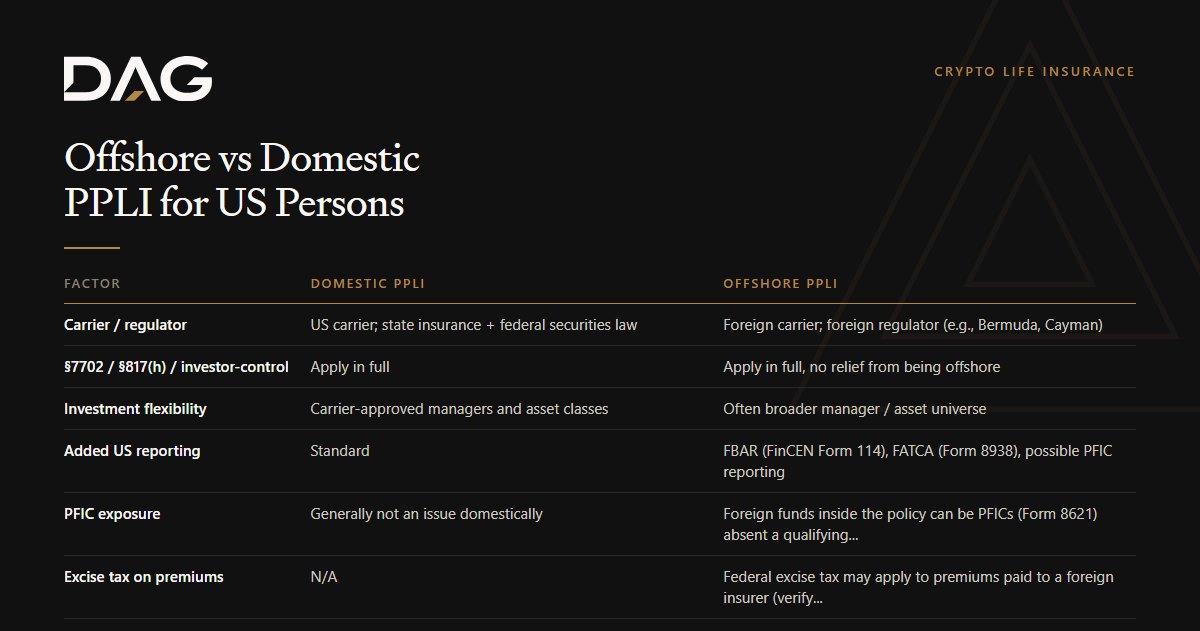
Offshore vs Domestic PPLI: Side-by-Side
| Factor | Domestic PPLI | Offshore PPLI |
|---|---|---|
| Carrier / regulator | US carrier; state insurance + federal securities law | Foreign carrier; foreign regulator (e.g., Bermuda, Cayman) |
| §7702 / §817(h) / investor-control | Apply in full | Apply in full, no relief from being offshore |
| Investment flexibility | Carrier-approved managers and asset classes | Often broader manager / asset universe |
| Added US reporting | Standard | FBAR (FinCEN Form 114), FATCA (Form 8938), possible PFIC reporting |
| PFIC exposure | Generally not an issue domestically | Foreign funds inside the policy can be PFICs (Form 8621) absent a qualifying election |
| Excise tax on premiums | N/A | Federal excise tax may apply to premiums paid to a foreign insurer (verify current rate) |
| Typical complexity / cost | High | Higher, added cross-border compliance |
Factors are illustrative and depend on the specific carrier, jurisdiction, and policy design. Verify current thresholds, forms, and rates with qualified cross-border tax counsel.
The Added Offshore Compliance Layer: PFIC, FBAR, FATCA
This is the part that distinguishes offshore PPLI for a US person, and it is where things go wrong without specialized counsel.
- FBAR (FinCEN Form 114). A US person with foreign financial accounts exceeding the reporting threshold (illustrative; verify the current figure with FinCEN) generally must file an FBAR annually. A foreign insurance policy with cash value can be a reportable foreign account.
- FATCA (IRS Form 8938). Specified foreign financial assets above the applicable threshold must be reported on Form 8938 with the income tax return. A foreign life policy with cash value can be a specified foreign financial asset. Thresholds vary by filing status and residence; verify current figures.
- PFIC (IRS Form 8621). If the offshore policy's separate account holds foreign pooled funds, those funds can be passive foreign investment companies. PFIC treatment can be punitive. A properly structured, §817(h)-compliant insurance contract may mitigate PFIC issues at the policy level, but the analysis is fact-specific and must be done by counsel, do not assume the insurance wrapper neutralizes PFIC exposure automatically.
- Penalties. Failure to file FBAR or Form 8938 carries significant penalties, separate from any tax owed. Reporting is not optional.
For crypto holders this overlaps directly with the broader expat and foreign-reporting picture covered in US expat crypto tax: FBAR, FATCA & Form 8938. The crypto funding the premiums and the offshore policy holding them can both create foreign-reporting obligations.
Related Questions
Does offshore PPLI let a US person avoid US tax?
No. A US person is taxed on worldwide income regardless of where a policy is issued. A compliant offshore policy gets the same US tax treatment as a compliant domestic one, because both must satisfy IRC §7702 and §817(h) and avoid the investor-control doctrine. Offshore status adds FBAR, FATCA, and potential PFIC reporting, it does not remove US tax. Anyone selling an offshore policy as a way out of US tax is describing something that does not exist.
What extra forms does an offshore PPLI policy create?
Commonly an FBAR (FinCEN Form 114) for the foreign account, Form 8938 under FATCA for the specified foreign financial asset, and potentially Form 8621 for PFIC reporting if the separate account holds foreign pooled funds. A federal excise tax may also apply to premiums paid to a foreign insurer. The exact filings depend on the structure and your facts; confirm with cross-border tax counsel.
Is offshore PPLI better for holding crypto-linked strategies?
Offshore carriers sometimes offer a broader universe of investment managers and asset classes, which can make alternative or digital-asset-linked strategies easier to accommodate. That flexibility is a structuring consideration, not a tax advantage, and it comes with the offshore compliance layer above. Whether the added flexibility justifies the added complexity is a suitability question for licensed insurance and tax professionals.
Which is right for a high-net-worth crypto holder?
It depends on the carrier options, the assets involved, the investor's reporting tolerance, and the cost difference, not on a blanket rule. For some, a domestic policy is simpler and sufficient; for others, an offshore carrier's flexibility is decisive. The decision should be modeled with counsel and coordinated with the rest of the plan via the Crypto Life Insurance Hub.
Sources
- Cornell LII: 26 U.S. Code §7702. Life insurance contract defined
- Cornell LII: 26 U.S. Code §817. Treatment of variable contracts (§817(h))
- Cornell LII: 26 U.S. Code §1291 et seq.. Passive foreign investment companies (PFIC)
- IRS: About Form 8938, Statement of Specified Foreign Financial Assets
- IRS: About Form 8621 (PFIC reporting)
- FinCEN: Report of Foreign Bank and Financial Accounts (FBAR)
- IRC §953(d) election (foreign insurer treated as US taxpayer), name only; verify current text on irs.gov.
Compliance Note
This page is educational only and does not provide legal, tax, insurance, or investment advice, and is not an offer or solicitation for any insurance or securities product. A US person is taxed on worldwide income; offshore PPLI does not avoid US tax and is not a tax-free structure. Both offshore and domestic PPLI must satisfy IRC §7702 and §817(h) diversification and avoid the investor-control doctrine; failing those rules can forfeit the policy's tax treatment. Offshore policies add FBAR, FATCA (Form 8938), and potential PFIC (Form 8621) reporting, with significant penalties for noncompliance. Thresholds, forms, and excise-tax rates cited are illustrative and change; verify current figures with qualified cross-border tax counsel. Cross-border insurance structuring is a licensed professional and legal service. DAG Insurance coordinates these services and does not provide legal or tax advice. Advisory services are offered through DAG Wealth, an SEC-registered investment adviser. Registration does not imply a certain level of skill or training.