
Section 7702 and MEC rules set the line between a life insurance policy that gets favorable tax treatment and one that does not. IRC §7702 defines what qualifies as life insurance for tax purposes; IRC §7702A and its "7-pay test" decide whether a policy is overfunded into a Modified Endowment Contract (MEC). A MEC is still life insurance, but loans and withdrawals lose their favorable tax treatment. For crypto holders funding large policies, this is the rule that governs how fast you can pay in.
What Is Section 7702?
IRC §7702 is the federal definition of a life insurance contract for tax purposes. A contract must pass one of two tests, the cash value accumulation test or the guideline premium and corridor test, which limit how much cash value a policy can hold relative to its death benefit. The purpose is to keep life insurance from being used as a pure tax-deferred investment account with a thin insurance veneer. If a contract fails §7702 entirely, it is not treated as life insurance at all, and the inside buildup becomes currently taxable.
Passing §7702 is what earns a policy its core tax features: tax-deferred growth of cash value and a generally income-tax-free death benefit under IRC §101(a). PPLI, IUL, and whole life all have to satisfy §7702. For how those policy types differ, see PPLI vs IUL.
What Is a Modified Endowment Contract (MEC)?
A Modified Endowment Contract is a life insurance policy that was funded too quickly. IRC §7702A applies a 7-pay test: it compares the premiums actually paid in the first seven years against the premiums that would have been needed to fund the policy with seven level annual payments. Pay in more than that limit, and the policy becomes a MEC.
A MEC is still a valid life insurance contract, the death benefit is generally still income-tax-free. What changes is the treatment of living distributions:
- Loans and withdrawals are taxed last-in, first-out (LIFO). Gains come out first and are taxable as income, instead of the more favorable basis-first treatment a non-MEC policy enjoys.
- A 10% penalty generally applies to taxable distributions before age 59½.
- The classification is permanent. Once a policy is a MEC, it stays a MEC, and a material change can restart the 7-pay clock.
This is why funding sequence matters as much as funding amount. The MEC line exists precisely to stop people from dumping a large lump sum into a policy to use it as a tax shelter.
§7702 Qualification vs. MEC Status
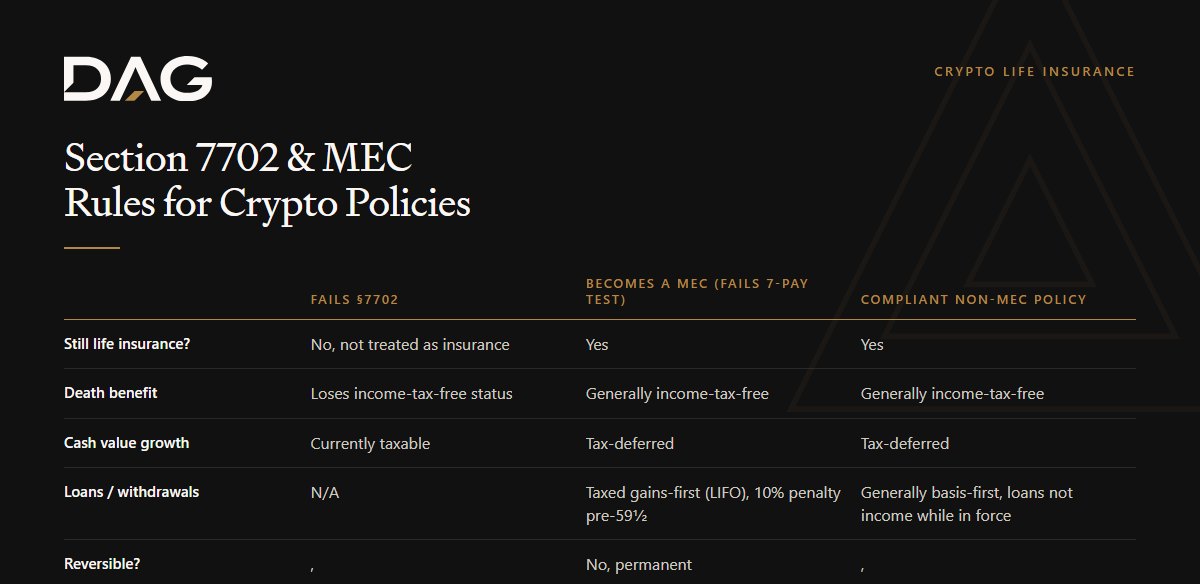
| Fails §7702 | Becomes a MEC (fails 7-pay test) | Compliant non-MEC policy | |
|---|---|---|---|
| Still life insurance? | No, not treated as insurance | Yes | Yes |
| Death benefit | Loses income-tax-free status | Generally income-tax-free | Generally income-tax-free |
| Cash value growth | Currently taxable | Tax-deferred | Tax-deferred |
| Loans / withdrawals | N/A | Taxed gains-first (LIFO), 10% penalty pre-59½ | Generally basis-first, loans not income while in force |
| Reversible? | , | No, permanent | , |
Educational summary; tax treatment depends on individual facts and current law. Verify with qualified tax counsel.
Why This Matters for Crypto-Funded Policies
For a high-net-worth crypto holder, the instinct after a liquidity event is to fund a policy quickly and heavily. The MEC rules push directly against that:
- Lump-sum funding triggers MEC status. If you raise a large amount from a token sale or a premium financing arrangement with crypto collateral and pour it in fast, you can blow past the 7-pay limit and convert the policy to a MEC, surrendering the favorable loan and withdrawal treatment that often motivated the purchase.
- Strategies that rely on tax-favored loans care most. Cash-value access plans, including infinite banking life insurance with crypto, depend on non-MEC status so policy loans stay outside income. A MEC undermines the whole point.
- PPLI is not exempt. PPLI must satisfy §7702 in addition to its §817(h) diversification and investor-control rules. The funding pace is a separate constraint layered on top of eligibility. See private placement life insurance.
- Design controls the outcome. A larger death benefit raises the 7-pay limit, allowing more premium before MEC status; spreading premiums over years instead of a single lump can keep a policy compliant. These are design choices made with a licensed insurance professional before funding, not fixes applied after.
If the goal is purely the death benefit for estate liquidity, see life insurance estate liquidity for crypto. MEC status matters less, because the death benefit stays income-tax-free either way. MEC status bites hardest when the plan relies on tax-favored living access to cash value. For how funding limits fit alongside eligibility and structure, see the Crypto Life Insurance Hub.
Related Questions
What is the 7-pay test?
The 7-pay test under IRC §7702A measures whether cumulative premiums paid in the policy's first seven years exceed the amount needed to pay the policy up with seven level annual premiums. Exceed that limit and the policy becomes a Modified Endowment Contract. A material change to the policy can restart the seven-year measuring period. The exact limit depends on the policy's death benefit, the insured's age, and carrier factors, and is calculated by the insurer.
Is a MEC still life insurance?
Yes. A MEC remains a valid life insurance contract and its death benefit is generally still received income-tax-free. What changes is the tax treatment of living distributions: loans and withdrawals are taxed gains-first (LIFO) and may carry a 10% penalty before age 59½. If you only want the death benefit and never plan to draw cash value, MEC status may not matter much; if your plan relies on tax-favored policy loans, it matters a great deal.
Can a policy that became a MEC be fixed?
Generally no. MEC classification is permanent once it applies. There is a limited correction window after an inadvertent excess premium in which a carrier may refund the overage to keep the policy out of MEC status, but this is time-sensitive and handled by the insurer. The reliable approach is to design and fund the policy so it never crosses the 7-pay limit in the first place. Confirm any correction options with the carrier and qualified tax counsel.
Does crypto have anything special to do with §7702 or MEC?
No, §7702 and the MEC rules apply to the policy regardless of how the premiums were funded. Crypto matters only because crypto holders often have a large lump sum available after a liquidity event and may be tempted to fund fast, which is exactly what triggers MEC status. The asset funding the premium does not change the test; the pace and amount of premium do.
Sources
- Cornell LII: 26 U.S. Code §7702. Life insurance contract defined
- Cornell LII: 26 U.S. Code §7702A. Modified endowment contract defined
- Cornell LII: 26 U.S. Code §101. Certain death benefits
- Cornell LII: 26 U.S. Code §72. Annuities; certain proceeds (distribution taxation)
Compliance Note
This page is educational only and does not provide legal, tax, insurance, or investment advice, and is not an offer or solicitation for any insurance or securities product. IRC §7702 and the §7702A 7-pay test are technical rules whose application depends on the specific policy, the insured's facts, and current law; figures and limits are calculated by the carrier and should be verified with qualified tax counsel. A Modified Endowment Contract is permanent and changes the tax treatment of policy loans and withdrawals (taxed gains-first, with a possible 10% pre-59½ penalty); no tax-free outcome is guaranteed. Life insurance is not a guaranteed investment. Policy design and funding decisions are made with a licensed insurance professional before funding. DAG Insurance coordinates these services and does not provide legal or tax advice. Advisory services are offered through DAG Wealth, an SEC-registered investment adviser. Registration does not imply a certain level of skill or training.