
A small number of credit cards that pay XRP rewards credit the coin directly, while broader crypto-rewards cards pay Bitcoin or platform tokens you can convert to XRP, often for a fee. Native-XRP cards have offered roughly 1–2% back on qualifying purchases (illustrative; verify current terms with each issuer). Reward value fluctuates, and both receipt and disposal are taxable. Integrating reward accumulation into a broader digital asset plan is covered in the crypto wealth management hub.
What Does "Crypto Cashback" Actually Mean?
Crypto-cashback credit cards operate like traditional rewards cards except that the issuing platform deposits reward value as cryptocurrency rather than cash or points. The two main reward structures are:
- Native-crypto rewards, the card credits a specific coin (e.g., XRP or Bitcoin) directly to your account on the platform.
- Points-to-crypto conversion, the card earns platform points redeemable for a selection of cryptocurrencies, including XRP where the platform supports it.
Neither structure is riskless. The value of crypto rewards fluctuates after you receive them, and every reward receipt and every subsequent conversion or disposal is a separate tax event (see the Tax Obligations section below).
What Card Categories Currently Exist?
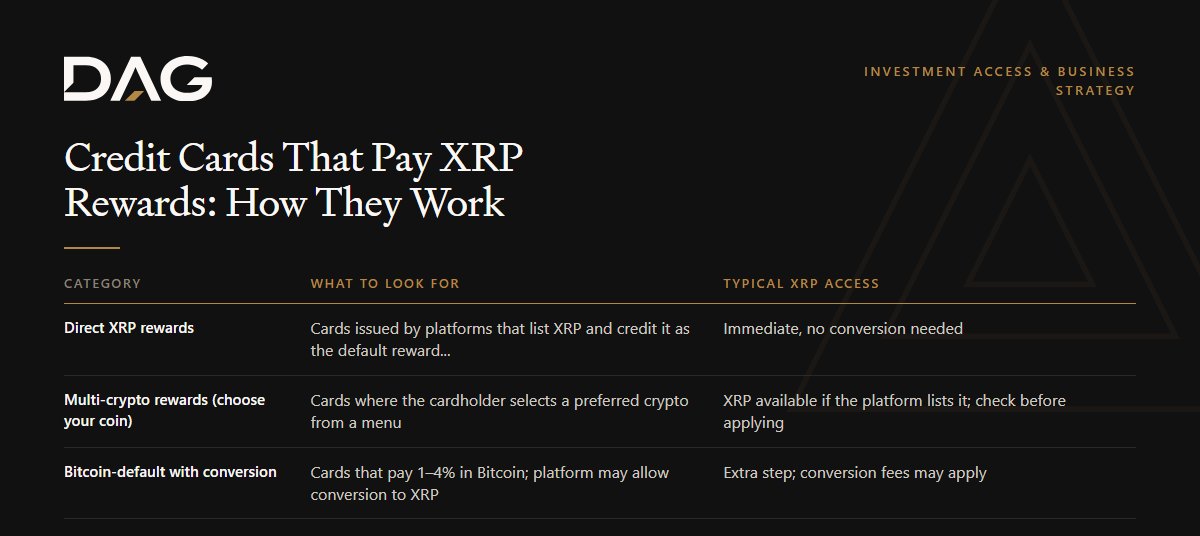
Card availability and reward terms change frequently. Rather than naming a fixed best-card list, the categories below describe what to look for:
| Category | What to look for | Typical XRP access |
|---|---|---|
| Direct XRP rewards | Cards issued by platforms that list XRP and credit it as the default reward currency | Immediate, no conversion needed |
| Multi-crypto rewards (choose your coin) | Cards where the cardholder selects a preferred crypto from a menu | XRP available if the platform lists it; check before applying |
| Bitcoin-default with conversion | Cards that pay 1–4% in Bitcoin; platform may allow conversion to XRP | Extra step; conversion fees may apply |
| Points redeemable for crypto | Traditional rewards cards that let you redeem points for crypto through a partner | Conversion rate and coin availability vary; XRP not always included |
Always verify current reward rates, eligible purchase categories, annual fees, and supported coins directly with the card issuer before applying. Card programs change or discontinue without notice.
How to Use Everyday Spending to Accumulate XRP
- Identify which card category fits your spending pattern. A card with higher rewards on groceries and gas may outperform a flat-rate crypto card if your spending is concentrated there.
- Confirm XRP is a supported reward or conversion target. Check the platform's current coin list, not just its marketing page.
- Check for auto-convert or auto-credit settings. Some platforms credit crypto instantly; others batch rewards monthly. Understand the timing so you can track cost basis accurately.
- Record each reward receipt. The fair market value of crypto at the moment it is credited to you is ordinary income. Log the date, amount of XRP received, and price at receipt.
- Decide on a custody sweep schedule. Leaving crypto on the card platform exposes you to platform risk (exchange insolvency, account freezes). Moving rewards to a hardware wallet, monthly or quarterly, depending on accumulated volume, reduces that exposure. See crypto custody options compared for a framework.
- Coordinate with your tax records system before year-end. Each sweep, conversion, or sale is a separate reportable event. Review crypto tax records checklist before tax season.
Tax Obligations You Cannot Ignore
Crypto rewards from credit cards are treated as ordinary income by the IRS under current guidance. The key points:
- Receipt may be an income event. When the card credits XRP to your account, that amount is generally reported as ordinary income at fair market value on that date. The IRS has not issued a ruling specifically on credit card crypto rewards; this treatment draws on general property principles (Notice 2014-21) and is sometimes compared to the IRS position on staking rewards (Rev. Rul. 2023-14), though that analogy is imperfect because staking and card rewards arise from different activities. Some practitioners also argue ordinary cashback can resemble a non-taxable purchase rebate until disposal. Confirm current treatment with a tax professional.
- Later disposal = capital gain or loss event. When you sell, convert, or spend that XRP, you recognize a capital gain or loss based on the difference between your cost basis (the FMV at receipt) and the proceeds.
- Basis tracking is your responsibility. Crypto-cashback programs do not always issue 1099s, and even when they do, the forms may be incomplete. Keeping your own records is essential.
- Conversion fees reduce proceeds. If you pay fees to convert rewards to XRP, those fees reduce the net proceeds of the conversion and affect your gain/loss calculation.
For a detailed treatment of these mechanics, see common crypto tax record mistakes and crypto cost basis cleanup for HNW investors.
When Crypto Rewards Become Part of a Larger Strategy
At higher asset levels, credit card XRP rewards are a small accumulation stream rather than a primary position-building tool. The strategic questions shift:
- Position sizing: does the XRP accumulated via rewards fit within a deliberate crypto diversification strategy, or is it adding unplanned concentration?
- Custody architecture: rewards that accumulate on retail card platforms need a path into institutional or cold storage as balances grow. Review cold storage vs qualified custody to understand when the upgrade makes sense.
- Tax integration: accumulating crypto income across multiple streams, card rewards, staking, holdings, requires coordinated record-keeping and potentially estimated tax payments. A fiduciary advisor who understands crypto tax planning for HNW investors can model the combined liability.
DAG provides wealth management coordination that integrates digital asset accumulation, including passive income streams from card rewards, into a cohesive financial picture, including custody planning, tax oversight, and multi-generational estate considerations. Advisory services are provided by DAG Wealth, an SEC-registered investment adviser. Registration does not imply a certain level of skill or training. This content is educational only and is not legal, tax, or investment advice. Consult a qualified professional for guidance specific to your situation.
Related Questions
Are crypto credit card rewards taxable?
Generally, yes, though the IRS has not issued guidance specifically on credit card crypto rewards. Cryptocurrency received as a reward or incentive is commonly reported as ordinary income at fair market value on the date received, with capital gain or loss recognized when you later sell or convert it. Treatment can depend on whether a reward looks more like income or a purchase rebate, so consult a tax professional, as IRS guidance on digital assets continues to evolve.
Can I earn XRP through spending without using a card?
Some platforms offer crypto-back shopping portals or referral programs denominated in XRP or convertible crypto, but the mechanics differ from credit card rewards. Staking XRP through supported wallets or platforms may also generate XRP-denominated yields, though staking and card rewards have different income and tax treatment. Verify current program terms before relying on any specific platform.
What happens to my XRP rewards if the card platform shuts down?
If the platform that issues your card ceases operations, crypto held in your rewards account may be subject to bankruptcy proceedings or become inaccessible. This is a meaningful platform risk distinct from the price risk of XRP itself. Moving rewards to self-custody or qualified custody on a regular schedule reduces this exposure. See what happens if a crypto custodian fails for context on custodial risk more broadly.
Do I need a financial advisor to use a crypto rewards card?
Not necessarily for basic card use, but as rewards accumulate into a meaningful balance, or when they combine with other crypto holdings, professional guidance adds value. A fiduciary advisor can help with cost basis tracking, tax planning, custody decisions, and integrating digital assets into a broader wealth plan. See what is a crypto fiduciary advisor for what to look for.
Sources
- IRS Notice 2014-21, cryptocurrency treated as property for federal tax purposes: https://www.irs.gov/pub/irs-drop/n-14-21.pdf
- IRS Rev. Rul. 2023-14, staking rewards treated as gross income upon receipt (cited only as an imperfect analogy; it does not address credit card crypto rewards): https://www.irs.gov/pub/irs-irs-drop/rr-23-14.pdf
- IRS Virtual Currency FAQs (periodically updated): https://www.irs.gov/businesses/small-businesses-self-employed/virtual-currencies
Compliance Note
This page is for educational purposes only. It does not constitute legal, tax, investment, or financial advice and should not be relied upon as such. Credit card reward rates, coin availability, program terms, and platform risk profiles change frequently, verify all details directly with the issuing platform before making any financial decision. Crypto rewards are subject to ordinary income tax at receipt and capital gains tax upon disposal under current IRS guidance; consult a qualified tax professional for advice specific to your situation. XRP and other cryptocurrencies are volatile assets; past reward rates are not indicative of future value. DAG Wealth is a brand of Digital Ascension Group. The SEC-registered investment adviser in this advisory relationship is DAG Wealth; registration does not imply a certain level of skill or training.