
DAG Wealth's digital asset purchase guidance is educational and coordination support for clients entering crypto markets, covering on-ramp setup, cold-storage custody, safe transfer practices, and tax-aware recordkeeping from day one. This page describes that general scope; it does not constitute investment advice or recommend any specific asset, exchange, or price target. For a full overview of how digital asset strategy fits within a wealth plan, see the crypto wealth management hub.
What does "digital asset purchase guidance" actually cover?
Most first-time digital asset buyers encounter the same cluster of mistakes: leaving holdings on an exchange after purchase, sending funds to an unverified address, and failing to track transactions for tax purposes from day one. Coordinated support addresses each of those failure points before they become expensive.
General guidance in this area typically spans four phases:
1. On-Ramp Selection
Regulated exchanges, those operating under KYC/AML programs and subject to U.S. financial oversight, provide the most reliable fiat-to-crypto conversion for new buyers. The relevant characteristics to evaluate include regulatory standing, asset availability, fee structure, and withdrawal policy. DAG Wealth can help clients assess these factors in the context of their broader financial picture; it does not endorse or recommend specific platforms.
2. Custody Setup
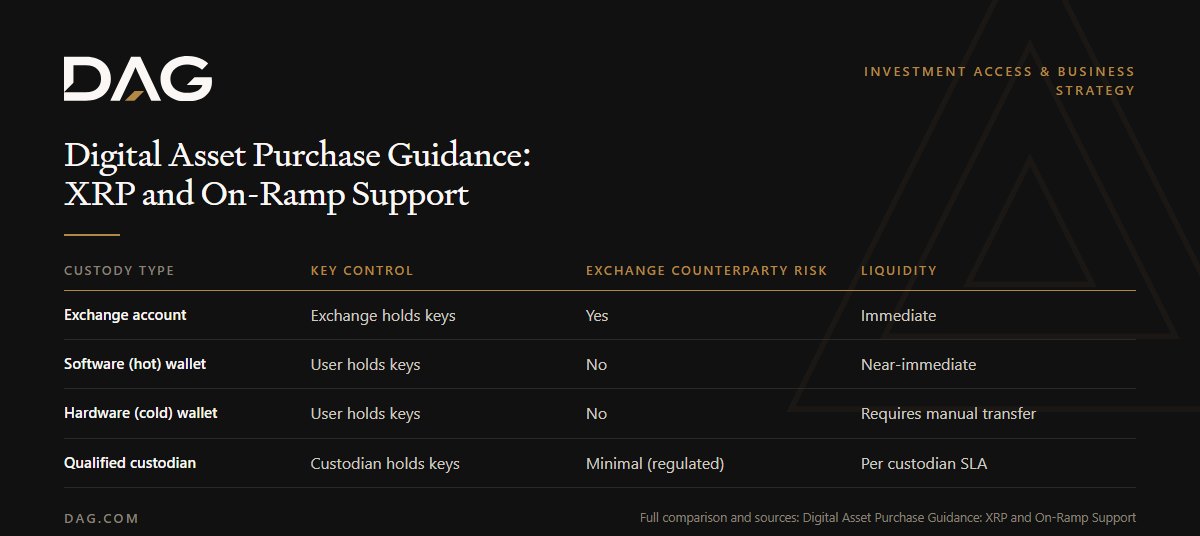
Leaving digital assets on an exchange after purchase means a third party controls the private keys. Exchange accounts can be frozen, hacked, or subject to platform insolvency. Self-custody via hardware (cold) wallets places key control directly with the asset holder, eliminating exchange counterparty risk for holdings that are not actively being traded. The tradeoff is personal responsibility for seed phrase security and transfer accuracy.
| Custody type | Key control | Exchange counterparty risk | Liquidity |
|---|---|---|---|
| Exchange account | Exchange holds keys | Yes | Immediate |
| Software (hot) wallet | User holds keys | No | Near-immediate |
| Hardware (cold) wallet | User holds keys | No | Requires manual transfer |
| Qualified custodian | Custodian holds keys | Minimal (regulated) | Per custodian SLA |
For clients holding meaningful digital asset positions, cold storage vs. qualified custody covers the tradeoffs in detail. Larger or multi-entity portfolios may warrant institutional crypto custody arrangements.
3. Transfer Safety
Crypto transactions are irreversible. A send to the wrong address, whether through a typo, clipboard hijack, or network mismatch, cannot be reversed by any customer service process. Safe transfer practice includes address verification protocols, small test sends before large transfers, and confirmation that the receiving network matches the sending network. Crypto address verification policy outlines the procedural standard.
4. Tax-Aware Recordkeeping From Day One
Every disposition of a digital asset, selling for dollars, trading one asset for another, or using crypto for a purchase, is generally treated as a taxable event under current IRS guidance, triggering capital gains calculations. Cost basis tracking begins at acquisition; retroactive reconstruction is difficult and sometimes impossible. Clients who establish clean records at the start avoid common crypto tax record mistakes that compound over time.
How does DAG Wealth's support differ from a standard brokerage?
DAG Wealth approaches digital assets through a crypto wealth management lens rather than a transactional one. That means digital asset exposure is considered alongside the client's full financial picture, existing portfolio, tax situation, estate structure, and risk tolerance, rather than evaluated in isolation.
Advisory services are provided by DAG Wealth, an SEC-registered investment adviser. The fiduciary standard applies: guidance reflects the client's interest, not a product sale. Clients should review the Form ADV for a full description of services, fees, and conflicts. Registration does not imply a certain level of skill or training.
For high-net-worth clients managing complex holdings across traditional investments, real estate, and digital assets, coordination may extend into digital asset wealth management for high-net-worth families and multi-generational planning frameworks.
Related Questions
Does DAG Wealth recommend specific exchanges or wallets?
No. General guidance covers the criteria relevant to evaluating on-ramps and custody solutions in the context of a client's situation. Platform-specific picks are outside the scope of fiduciary advice, and exchange conditions change. Clients make their own platform decisions.
At what portfolio size does more formal crypto wealth coordination make sense?
There is no fixed threshold, but complexity tends to increase when holdings span multiple wallets or exchanges, when digital assets represent a material share of net worth, or when estate and tax coordination are needed. When do you need a crypto wealth manager? addresses this question directly.
How do I avoid tax problems when first buying digital assets?
The primary error is not tracking acquisition date, cost basis, and transaction type from the first purchase. The IRS treats digital assets as property; each taxable event requires a gain or loss calculation. Crypto tax planning for HNW investors covers the planning layer, and Form 8949 for crypto investors explains the reporting mechanics.
What if I already bought crypto without tracking records?
Reconstruction is possible but resource-intensive. Exchange transaction histories, blockchain explorers, and specific identification elections can recover most records if the exchanges are still accessible. How to reconstruct crypto cost basis outlines the process.
Sources
- IRS Notice 2014-21. Virtual Currency Guidance (property treatment, taxable events): https://www.irs.gov/pub/irs-drop/n-14-21.pdf
- IRS Rev. Rul. 2023-14. Staking income recognition: https://www.irs.gov/pub/irs-irs-drop/rr-23-14.pdf
- SEC, "Framework for 'Investment Contract' Analysis of Digital Assets" (2019): https://www.sec.gov/corpfin/framework-investment-contract-analysis-digital-assets
- FinCEN. Guidance on Application of FinCEN's Regulations to Persons Administering, Exchanging, or Using Virtual Currencies (FIN-2013-G001): https://www.fincen.gov/sites/default/files/shared/FIN-2013-G001.pdf
- IRS Publication 544. Sales and Other Dispositions of Assets (capital gains treatment): https://www.irs.gov/publications/p544
Compliance Note
This page is educational only and does not constitute investment, tax, or legal advice. No specific digital asset, exchange, wallet, or investment strategy is recommended here. Digital assets carry significant risks including price volatility, illiquidity, regulatory uncertainty, and the irreversible loss of assets through custody or transfer error. Past market behavior does not indicate future results. Consult a qualified financial, tax, and legal professional before making any digital asset purchase or custody decision. Advisory services referenced on this page are provided by DAG Wealth, an SEC-registered investment adviser. Registration does not imply a certain level of skill or training.