
An LLC does not grant LLC pre-IPO investment access on its own. Most private placements and pre-IPO deals are restricted to accredited investors under Reg D, and sponsors look through the LLC to its individual members to verify qualification. The entity helps with custody and tax reporting after you already qualify, not before. For context on how digital asset access and structuring decisions fit together, see the crypto wealth management hub.
What Is the "Look-Through" Rule for Accreditation?
When a sponsor screens investors for a Regulation D private placement, they do not stop at the entity level. The SEC's look-through principle requires that all equity-owners of a pass-through entity, such as an LLC, independently meet accreditation thresholds, or the entity as a whole must meet the $5 million in assets standard (with additional requirements, including that the entity was not formed specifically to make the investment).
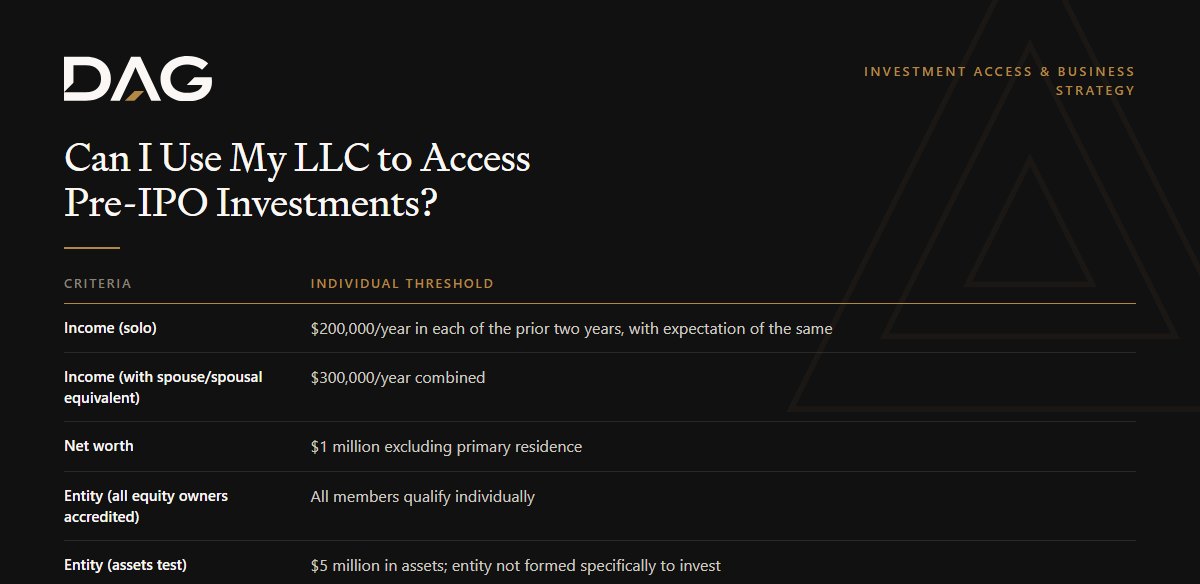
Accreditation thresholds (SEC Rule 501, current as of 2026, verify before relying):
| Criteria | Individual threshold |
|---|---|
| Income (solo) | $200,000/year in each of the prior two years, with expectation of the same |
| Income (with spouse/spousal equivalent) | $300,000/year combined |
| Net worth | $1 million excluding primary residence |
| Entity (all equity owners accredited) | All members qualify individually |
| Entity (assets test) | $5 million in assets; entity not formed specifically to invest |
Meeting one of these thresholds is required before any private placement is available. LLC or not. These dollar figures are set by regulation and can change; confirm current standards with SEC Rule 501 or qualified counsel before relying on them.
Where an LLC Actually Adds Value
An LLC is a structural tool, not an access credential. Once you are already qualified, it can serve real functions:
- Consolidated custody. All investments sit under a single entity, simplifying account titling and statements across multiple deals.
- Simplified tax reporting. Pass-through income flows to a single Schedule K-1 rather than multiple personal schedules. Crypto tax reporting for LLCs covers the reporting mechanics in more detail.
- Liability separation. Losses or disputes within one investment are isolated from your personal assets to the extent the LLC maintains proper separateness (no commingling, documented contributions).
- Partner structuring. If you are co-investing with others, an LLC provides a formal operating agreement structure for allocations, decisions, and exits.
- Estate and succession planning. LLC interests can be transferred, gifted, or placed into a trust as part of a broader plan. See should a trust own a Wyoming LLC for crypto assets? for a related structure.
None of these functions change your accreditation status. They operate after you qualify.
How Should I Think About Structure vs. Deal-Hunting?
Structure first, then deals. Trying to retrofit an LLC or other entity after you have found a specific deal is slower, can create complications with the sponsor's subscription documents, and sometimes costs you the allocation entirely.
A useful sequence:
- Confirm your accreditation status with a qualified attorney or fiduciary advisor.
- Decide whether a standalone LLC, a trust-owned LLC, or holding investments personally is appropriate for your situation.
- Establish proper custody arrangements, keep investments separate from the entity providing advice. Crypto custody for LLCs explains how this works for digital asset holdings specifically.
- Document the LLC correctly (operating agreement, contribution records, separate bank/brokerage account).
- Then evaluate specific private placement or pre-IPO opportunities.
A fiduciary advisor who works under the Investment Advisers Act can help you sequence this correctly. That is different from a broker-dealer, who works under a suitability standard and may have different incentives when recommending private placements.
Risk Disclosures: What Pre-IPO and Private Placements Actually Involve
Pre-IPO investments and private placements carry significant risks that are not present in publicly traded securities:
- Illiquidity. There is typically no secondary market. Capital may be locked for years with no guarantee of a liquidity event.
- Information asymmetry. Private companies are not subject to the same public disclosure requirements as registered securities. Due diligence depends on what the company chooses to share.
- High failure rates. The majority of venture-stage companies do not return capital. Diversification within private markets requires substantial capital.
- No return guarantees. Past performance of a sponsor, fund, or company category does not predict future results. There are no guaranteed returns in private placements.
- Regulatory restrictions. Participation requires ongoing compliance with the terms under which you accessed the investment; resales of unregistered securities are restricted.
Understanding these risks before structuring an entity around them is essential. An LLC operating agreement checklist can help ensure the governance documents reflect the investment activity correctly.
Related Questions
Does my LLC itself qualify as an accredited investor?
An LLC can qualify as an accredited investor under SEC Rule 501 if (a) all of its equity owners are individually accredited, or (b) it holds more than $5 million in assets and was not formed specifically for the purpose of making the investment in question. If either condition is met, the entity qualifies, but the individual look-through test applies if the entity does not meet the assets threshold.
Can I form an LLC just to pool money with friends for pre-IPO deals?
An LLC formed specifically to make a single investment generally cannot use the $5 million entity assets test for accreditation. In that case, all members must individually qualify as accredited investors. Beyond accreditation, pooling investor money can trigger broker-dealer registration requirements or fall under the definition of an investment company under the Investment Company Act of 1940. Consult a securities attorney before pooling capital.
Does using an LLC for private placements affect my taxes?
An LLC treated as a pass-through does not alter when income is recognized, gains from a private placement exit generally remain taxable in the year of the liquidity event. However, holding period, character of gain (ordinary vs. capital), and state tax treatment can vary depending on how the LLC is structured and taxed. See crypto tax planning for HNW investors for relevant context on entity-level tax coordination.
What happens if I co-invest with family members through an LLC?
Each family member who is an equity owner must independently qualify as accredited unless the entity meets the $5 million assets test. An LLC operating agreement that allocates profits and losses among family members should be reviewed by legal counsel to confirm it reflects the actual arrangement and does not inadvertently create a security requiring separate registration.
Sources
- SEC Regulation D, Rule 501. Accredited investor definitions: https://www.sec.gov/education/smallbusiness/exemptofferings/regdoverview
- SEC Release No. 33-10824. Modernizing the accredited investor definition (Aug. 26, 2020): https://www.sec.gov/rules/final/2020/33-10824.pdf
- Investment Company Act of 1940, Section 3(c)(1) and 3(c)(7), exemptions relevant to private funds: https://www.govinfo.gov/content/pkg/COMPS-1879/pdf/COMPS-1879.pdf
- SEC Investor Bulletin: Regulation D Exemptions (verify current): https://www.investor.gov/introduction-investing/investing-basics/glossary/regulation-d-offerings
Compliance Note
This page is educational only and does not constitute legal, tax, or investment advice. Private placements and pre-IPO investments are high-risk, illiquid, and generally restricted to accredited investors under Reg D. An LLC does not by itself confer accredited investor status, sponsors apply look-through rules to individual members. There are no guaranteed returns in private markets; most early-stage companies do not return capital. Accreditation thresholds, entity qualification rules, and regulatory requirements change; verify current standards with the SEC and qualified legal counsel. Entity formation and operating-agreement drafting are legal services; DAG coordinates with your attorney and does not provide legal advice. Nothing here should be relied upon for a specific investment decision. Consult a licensed attorney, CPA, and fiduciary investment adviser before investing in any private placement.
Advisory services are provided by DAG Wealth, an SEC-registered investment adviser. Registration does not imply a certain level of skill or training.