
A crypto LLC operating agreement checklist is the set of provisions an agreement should cover so the entity actually governs its digital assets: definitions, authorized wallets and custodians, private-key and signing authority, multi-signature rules, staking, forks, airdrops, DeFi activity, tax records, transfer restrictions, and successor-manager authority. It translates how digital assets work into enforceable rules.
What a Crypto LLC Operating Agreement Is
An operating agreement is the internal contract that governs how an LLC is run: who has authority, how decisions are made, how members transfer interests, and what happens at succession. A crypto LLC operating agreement adds the asset-specific layer most templates skip, because the entity's core holdings are private keys and on-chain positions rather than bank accounts or inventory. If you are still deciding whether to form the entity at all, start with whether to put crypto in a Wyoming LLC and the broader Crypto Wealth Management Hub.
Why This Matters
Most operating agreements assume ordinary business assets: bank accounts, contracts, inventory, or operating revenue. Digital assets raise different questions. If the agreement never mentions wallets, keys, custodians, or protocol activity, the entity can exist without clear rules for controlling the very assets it was formed to hold. That gap shows up at the worst moments: a manager change, an audit, or a dispute over who could move funds.
The Checklist
Review a crypto LLC operating agreement for each of these provisions:
- Definition of digital assets, a clear definition that covers tokens, NFTs, staked positions, and assets received from forks or airdrops, so later provisions have something specific to reference.
- Authorized wallets, custodians, and accounts, which qualified custodians, exchange accounts, and self-custody wallets the LLC may use, and who opens or closes them.
- Private-key control and signing authority, who may sign transactions and under what limits. Address authority and control; do not embed secret keys or seed phrases in a document that gets circulated.
- Multi-signature or MPC rules, signing thresholds (for example, 2-of-3), who holds each key share, and how a lost or compromised share is replaced. See whether a crypto LLC should have a multi-sig policy.
- Manager authority and limitations, what the manager can do alone versus what needs member approval, and any dollar or asset thresholds.
- Staking and validator activity, who approves staking, which assets are eligible, and how rewards are recorded.
- Forks, airdrops, and rewards, how unexpected assets are claimed, custodied, and documented for tax.
- DeFi or protocol participation, whether the LLC may interact with smart contracts, and any approval or risk limits.
- Transaction records and tax reporting, the recordkeeping standard supporting basis tracking and reporting (the IRS generally treats digital assets as property, and Form 1099-DA reporting is being phased in).
- Member transfer restrictions, limits on transferring membership interests, which also support charging-order protection.
- Successor-manager authority, who acts if a manager dies or is incapacitated, and how that successor gains control of keys and custody accounts.
- Coordination with trusts or estate documents, how the agreement aligns with any trust that owns the LLC and with estate-planning documents.
Evidence Standard
This article is a checklist, not legal drafting advice, and it does not include sample clauses. Naming custodians or tools here is descriptive only and is not a judgment that any provider is better or worse than another.
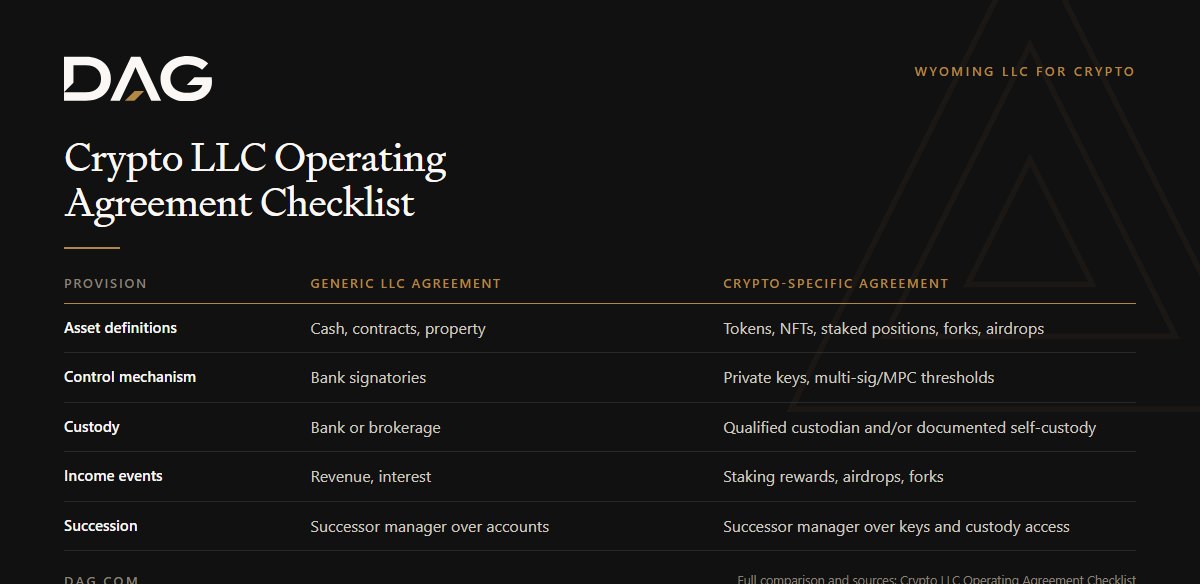
Comparison: Generic vs Crypto-Specific Operating Agreement
| Provision | Generic LLC agreement | Crypto-specific agreement |
|---|---|---|
| Asset definitions | Cash, contracts, property | Tokens, NFTs, staked positions, forks, airdrops |
| Control mechanism | Bank signatories | Private keys, multi-sig/MPC thresholds |
| Custody | Bank or brokerage | Qualified custodian and/or documented self-custody |
| Income events | Revenue, interest | Staking rewards, airdrops, forks |
| Succession | Successor manager over accounts | Successor manager over keys and custody access |
When It May Help
- An LLC will hold digital assets.
- A trust owns or may own the LLC, see crypto LLC vs trust for how those structures interact.
- The LLC uses institutional custody or self-custody, where a crypto LLC owning the wallet needs documented authority.
- The assets may be staked or participate in protocols.
- The family wants a successor manager to act without confusion.
When It May Not Be Enough
A checklist does not replace legal drafting. Operating agreements must be tailored to the facts, state law, tax classification, ownership, and custody workflow. A well-drafted agreement also does not remove market, custody, or tax risk; it clarifies authority and documentation, not investment outcomes.
Related Questions
Should the operating agreement mention private keys?
It should address authority and control over signing, but it should not expose secret keys or seed phrases inside documents that may be circulated. How that authority is structured depends on the facts; consult qualified counsel.
Should a crypto LLC be manager-managed?
A manager-managed structure can make authority clearer, but the right answer generally depends on ownership, tax, custody, and succession goals. See whether a crypto LLC should be manager-managed.
Should the agreement address staking?
If staking may occur, the agreement should generally cover who can approve it and how rewards are documented for tax. Staking carries its own market and protocol risks and offers no guaranteed yield.
How does the agreement handle records and contributions?
It should set a recordkeeping standard so contributions and distributions are documented; pair it with how a crypto LLC should document contributions.
Bottom Line
A crypto LLC operating agreement should not be a generic template. It should translate digital-asset control into legal and operational rules, then be reviewed by counsel against your actual custody and ownership setup.
Sources
- Wyoming Limited Liability Company Act
- Wyoming digital asset statutes, Title 34 Chapter 29
- IRS digital assets guidance
Compliance Note
This article is for general educational purposes and is not legal or tax advice. Operating agreements should be drafted or reviewed by qualified counsel.