
A Wyoming LLC can own a crypto wallet, but the on-chain address alone does not establish legal ownership. The entity controls the wallet only when its operating agreement, custody account title, capital contribution records, tax filings, and transaction history all point to the LLC. Wallet keys show control; paperwork shows who legally owns the assets.
What "LLC ownership of a wallet" means
A crypto wallet is a key pair, not a registered title document. Whoever holds the private key can move the assets, but the blockchain records an address, not an owner. For a Wyoming LLC to own a wallet, the entity's governance documents and accounting must establish that the keys are held on the LLC's behalf and that the underlying assets sit on the LLC's books. Wyoming's digital asset statutes (Title 34, Chapter 29) recognize direct property rights in digital assets, which gives an LLC a clearer legal footing than a bare address, but recognition under state law does not replace the need for internal records. This is one building block within broader crypto wealth management planning.
Why This Matters
Crypto ownership can be operationally obvious to the person holding the keys but legally unclear to everyone else. If an LLC is supposed to own the assets, the records should make that clear to a custodian, CPA, attorney, trustee, family member, or court. A gap between who controls the keys and who the documents say owns the assets is exactly what creates disputes during an audit, a succession event, or litigation. Keeping personal and entity holdings separate matters here; see what happens if you mix personal and LLC crypto.
How It Works
- Form the LLC and confirm the operating agreement authorizes digital asset ownership and sets signing authority.
- Open a custody account titled in the LLC's name, or place a self-custody wallet under documented LLC authority. For institutional accounts, see whether a Wyoming LLC can use a qualified custodian.
- Contribute or acquire the assets through the LLC, recording the contributions with dates, values, and cost basis.
- Log each transaction with transaction IDs, fair-market values, basis, and the approval that authorized it.
- Document successor manager or trust ownership so control passes cleanly.
A self-custody wallet adds a layer most custody accounts handle internally: key storage, signing rules, and recovery. A multi-signature setup, where more than one key is required to move funds, can reduce single-point-of-failure risk and create a governance record, though the right configuration depends on the assets and the people involved. See whether a crypto LLC should have a multi-sig policy.
Self-custody wallet vs. custody account
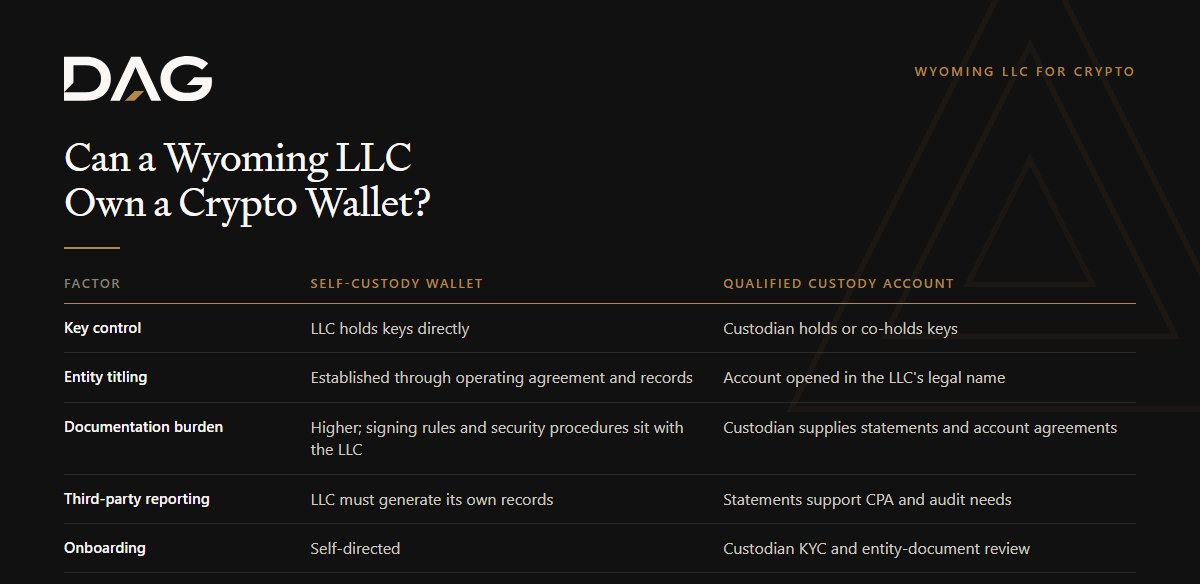
| Factor | Self-custody wallet | Qualified custody account |
|---|---|---|
| Key control | LLC holds keys directly | Custodian holds or co-holds keys |
| Entity titling | Established through operating agreement and records | Account opened in the LLC's legal name |
| Documentation burden | Higher; signing rules and security procedures sit with the LLC | Custodian supplies statements and account agreements |
| Third-party reporting | LLC must generate its own records | Statements support CPA and audit needs |
| Onboarding | Self-directed | Custodian KYC and entity-document review |
Neither path is inherently better; the choice depends on asset mix, governance needs, and whether an institutional custodian is required. Custody, self-custody, and multi-sig all carry distinct security and operational risks that documentation does not eliminate.
Evidence Standard
This article provides a general structure and does not advise on a specific transfer or wallet setup. Where a custodian or provider is named, that reference is descriptive, not an endorsement or a comparison of one provider against another.
When It May Help
- A crypto holder wants entity-level ownership rather than holding in a personal name.
- A trust may own the LLC; compare structures in crypto LLC vs trust.
- An institutional custodian requires entity documents.
- The family wants clearer succession and governance.
- A CPA needs entity-level records for tax reporting.
When It May Not Be Enough
Sending tokens to a wallet controlled by an LLC manager is not enough if the legal and tax records do not match. If the operating agreement is silent on digital assets, the account is titled to an individual, or contributions were never recorded, the on-chain activity can undercut the claim that the LLC owns the assets. Records and titling have to agree before the wallet structure does any real work.
Related Questions
Can an LLC have a self-custody wallet?
Generally yes, but the LLC needs written authority in the operating agreement, defined signing rules, security and recovery procedures, and records tying the keys to the entity. Self-custody shifts the operational and security burden onto the LLC, so the documentation has to be more thorough, not less.
Can an LLC open a custody account?
Many custodians support entity accounts, though requirements vary by provider and typically include KYC review, entity formation documents, and the operating agreement. Approval and available services depend on the provider's own onboarding, so confirm specifics before assuming an account can be opened.
Should the wallet be multi-sig?
Often, multi-party controls can strengthen governance and reduce single-key risk, but the right model depends on the assets, the number of authorized signers, and custody needs. A multi-sig policy is a control choice, not a guarantee against loss or compromise.
Does owning a wallet through an LLC change the tax treatment?
Not by itself. The IRS generally treats digital assets as property regardless of whether an individual or an entity holds them, so contributions, dispositions, and income still need to be tracked and reported. How an LLC is taxed depends on its elections and facts, so consult a qualified tax professional.
Bottom Line
A Wyoming LLC can be part of a crypto wallet structure, but legal ownership, wallet control, and records need to point in the same direction. Forming the entity and authorizing custody alone does not remove market, custody, or tax risk, and no wallet configuration guarantees against loss. Consult a qualified attorney and tax professional for your specific facts.
Sources
- Wyoming Limited Liability Company Act
- Wyoming digital asset statutes, Title 34 Chapter 29
- IRS digital assets guidance
Compliance Note
This article is for general educational purposes and is not legal, tax, custody, or investment advice.