
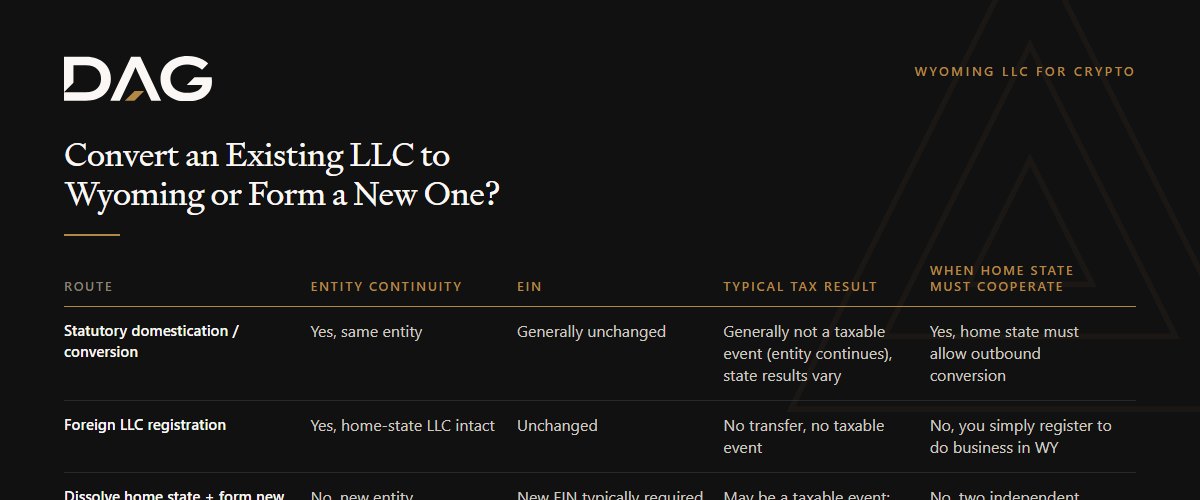
To convert an LLC to Wyoming, you generally have three paths: statutory domestication (the same entity continues under Wyoming law), foreign registration (keep your home-state LLC and register it in Wyoming), or dissolve-and-reform (form a fresh Wyoming LLC). The right choice depends on whether entity continuity, existing contracts, or tax outcome matters most, all considerations that fit into crypto LLC formation, and whether your home state permits outbound conversion.
What Is LLC Domestication (Statutory Conversion)?
Domestication, sometimes called statutory conversion or redomestication, is a legal process that changes an LLC's state of formation without dissolving and re-forming it. The same legal entity continues; only the governing law changes. Wyoming expressly authorizes inbound domestication under the Wyoming Limited Liability Company Act (Wyo. Stat. §§ 17-29-1001–1007).
Key point: because the entity continues, the EIN generally does not change and the transfer is generally not treated as a taxable event for federal income-tax purposes, but state-level tax consequences vary, and the mechanics of any asset reallocation inside the entity can still have tax results. Consult a qualified CPA before proceeding.
What Are My Options? A Comparison
| Route | Entity continuity | EIN | Typical tax result | When home state must cooperate |
|---|---|---|---|---|
| Statutory domestication / conversion | Yes, same entity | Generally unchanged | Generally not a taxable event (entity continues), state results vary | Yes, home state must allow outbound conversion |
| Foreign LLC registration | Yes, home-state LLC intact | Unchanged | No transfer, no taxable event | No, you simply register to do business in WY |
| Dissolve home state + form new Wyoming LLC | No, new entity | New EIN typically required | May be a taxable event; asset transfers to new entity trigger gain recognition analysis | No, two independent filings |
This table is educational only, not legal or tax advice. Outcomes depend on entity classification, home-state rules, and specific asset types. Consult a qualified attorney and CPA.
How Does Wyoming Domestication Work?
Step 1. Confirm your home state allows outbound conversion
Some states (e.g., California) have limited or no statutory outbound conversion mechanism. If your home state does not allow it, domestication is not available; your realistic options are foreign registration or dissolve-and-reform.
Step 2. File articles of conversion / withdrawal in the home state
You notify the home state that the LLC is converting away. Filing fees and processing times differ by state, some process in days, others take weeks.
Step 3. File articles of domestication in Wyoming
Wyoming's Secretary of State accepts the inbound filing under the continuance/domestication provisions of the Wyoming LLC Act (Wyo. Stat. §§ 17-29-1001–1007). Current state filing fees are set by the Wyoming Secretary of State (see Sources below).
Step 4. Amend the operating agreement
The operating agreement must be updated to reflect Wyoming's LLC Act. For crypto LLC operating agreement checklist requirements specific to digital assets, that means adding digital-asset governance, wallet-custody provisions, and manager authority over private keys.
Step 5. Notify banks, exchanges, and custodians
The entity's legal home has changed. Every institution holding accounts, exchanges, custodians, lenders, needs updated formation documents. This is operationally non-trivial and is often the most time-consuming part of domestication.
When Does Dissolve-and-Reform Make More Sense?
If your home state does not support outbound conversion, or if the existing LLC carries historical liabilities or mixed assets you want to cleanly separate, forming a fresh Wyoming LLC is straightforward and avoids two-state coordination complexity.
For Wyoming digital asset LLC structures holding only crypto, a new entity is often faster: Wyoming formation typically completes in days, and transferring crypto into an LLC with proper contribution documentation is operationally clean.
The trade-off: dissolving the original entity and contributing assets to the new LLC is a distinct transaction that may trigger gain recognition depending on asset type and how the transfer is structured. A qualified CPA should model this before you proceed.
What About Foreign LLC Registration?
Foreign registration, registering your home-state LLC to do business in Wyoming, preserves the original entity entirely. It does not give you Wyoming's charging-order protections or digital-asset statutory framework because your LLC remains governed by its home state's law. If the reason you want Wyoming is its charging order protection for crypto or its digital-asset statutes, foreign registration does not deliver that.
Foreign registration is appropriate when you have genuine business operations in Wyoming but want your LLC to remain governed by another state.
Does Domestication Affect My EIN or Tax Classification?
Because statutory domestication treats the entity as continuous, the IRS generally does not require a new EIN when only the state of organization changes. Tax classification (sole-member disregarded entity, partnership, S-corp, etc.) is also generally unchanged.
However, if the domestication is paired with a membership change, a change in number of members, or an asset transfer to a separate entity, different rules apply. Tax classification elections tied to the original EIN may need to be reviewed. State-level income, franchise, or transfer taxes may apply depending on the home state. These are fact-specific questions, state generally here, not definitively.
Related Questions
Can I register my existing LLC as a foreign LLC in Wyoming instead of converting it?
Yes. Foreign registration keeps your home-state LLC intact and lets it operate in Wyoming. But it does not give you Wyoming's charging-order protections or digital-asset statutes, because your entity remains governed by its home state. For most digital-asset use cases, this is the least useful option.
Does Wyoming allow a multi-member LLC to domesticate from another state?
Wyoming's domestication provisions (Wyo. Stat. §§ 17-29-1001–1007) do not restrict inbound domestication by member count. Both single-member and multi-member LLCs can domesticate, provided the home state allows outbound conversion. Multi-member domestication requires member approval under the existing operating agreement, check your current agreement's voting requirements before initiating the process.
If I form a new Wyoming LLC, does my old LLC automatically dissolve?
No. Your old LLC continues in its home state until you formally dissolve it and wind up its affairs. If you form a new Wyoming LLC, you must separately file dissolution documents in the original state to avoid ongoing annual fees and filing requirements there.
Should I put my Wyoming LLC inside a trust?
That question is separate from the conversion/formation choice but often arises at the same time. Should a trust own a Wyoming LLC for crypto assets? covers the layered-structure analysis, including charging-order protection stacking and estate-planning considerations.
Internal Links
- Should I put my crypto in a Wyoming LLC?, threshold question before choosing a conversion route
- Wyoming LLC vs Delaware LLC for crypto, state comparison relevant to home-state LLC holders weighing the move
- Crypto LLC operating agreement checklist, what the amended or new operating agreement must cover
- How to transfer crypto into an LLC, mechanics of funding the entity after formation or conversion
- Should a trust own a Wyoming LLC for crypto assets?, layered structure planning
- Crypto tax reporting for LLCs, ongoing tax obligations once the entity is in place
Sources
- Wyoming Limited Liability Company Act. Conversion and Continuance: Wyo. Stat. §§ 17-29-1001 through 17-29-1007. Wyoming Legislature, https://wyoleg.gov/statutes/compress/title17.pdf (current session).
- Wyoming Secretary of State. Business Division, LLC Formation and Domestication Filings and Fees: https://sos.wyo.gov/Business/FilingFees.aspx (accessed 2026-06-02).
- Internal Revenue Service. Publication 1635, "Understanding Your EIN," including entity conversion guidance: https://www.irs.gov/pub/irs-pdf/p1635.pdf (accessed 2026-06-02).
- IRS Revenue Ruling 2004-86 (state-law conversion of entity and federal tax treatment) and related guidance, consult a CPA for application to your specific entity classification.
Readers should verify current statutory text and filing fees directly with the Wyoming Secretary of State, as statutes and fee schedules are subject to change.
Compliance Note
This page is for educational purposes only. It does not constitute legal, tax, or investment advice. LLC domestication, conversion, and dissolution involve multi-state legal and tax consequences that vary by home state, entity type, asset composition, and individual circumstances. Consult a qualified attorney licensed in your relevant states and a CPA before initiating any conversion, domestication, or dissolution. DAG Wealth does not provide legal services.