
Choosing between an LLC and a trust for digital assets depends on whether your priority is operational liability protection, estate succession, or both. An LLC can shield personal assets during active crypto operations; a trust can bypass probate and direct your holdings after death or incapacity. Many families use both in a layered design, with the trust owning the LLC.
What Each Structure Does
A crypto LLC is a state-registered limited liability company whose operating agreement defines who can move assets, sign with custodians, manage wallets, and maintain records. It is an operational tool.
A crypto trust is a fiduciary arrangement where a trustee holds and administers assets for beneficiaries under the trust terms. It is a succession and continuity tool.
The two structures answer different questions, which is why they are often paired rather than chosen against each other.
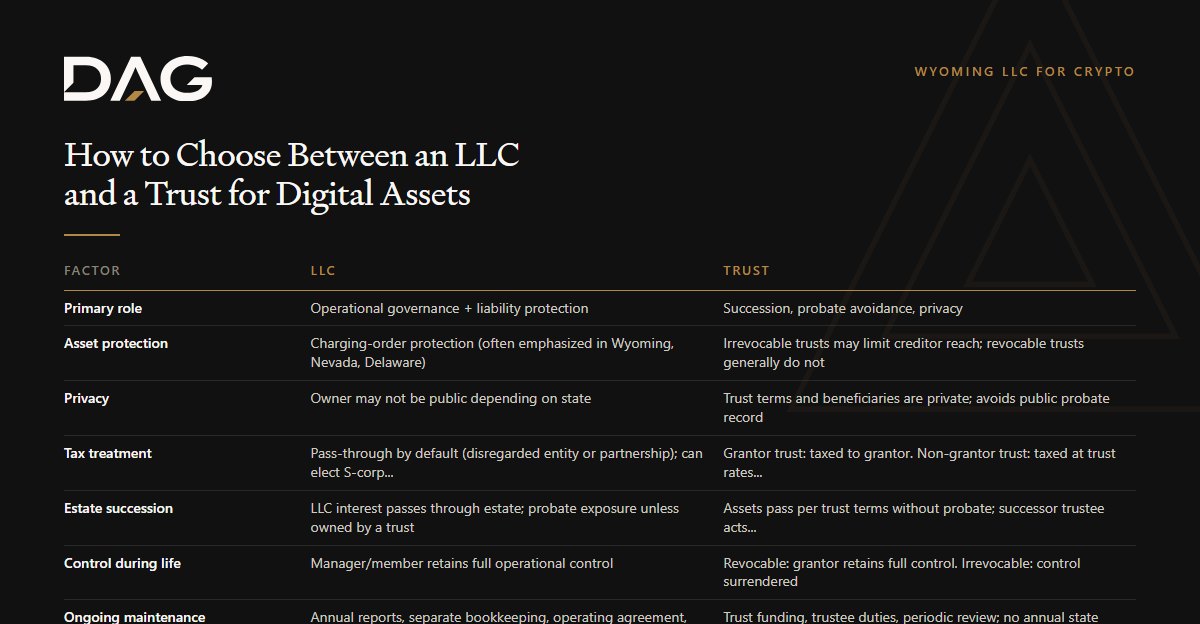
LLC vs Trust for Digital Assets: Comparison Table
| Factor | LLC | Trust |
|---|---|---|
| Primary role | Operational governance + liability protection | Succession, probate avoidance, privacy |
| Asset protection | Charging-order protection (often emphasized in Wyoming, Nevada, Delaware) | Irrevocable trusts may limit creditor reach; revocable trusts generally do not |
| Privacy | Owner may not be public depending on state | Trust terms and beneficiaries are private; avoids public probate record |
| Tax treatment | Pass-through by default (disregarded entity or partnership); can elect S-corp or C-corp | Grantor trust: taxed to grantor. Non-grantor trust: taxed at trust rates (compressed brackets) |
| Estate succession | LLC interest passes through estate; probate exposure unless owned by a trust | Assets pass per trust terms without probate; successor trustee acts immediately |
| Control during life | Manager/member retains full operational control | Revocable: grantor retains full control. Irrevocable: control surrendered |
| Ongoing maintenance | Annual reports, separate bookkeeping, operating agreement, registered agent | Trust funding, trustee duties, periodic review; no annual state filing in most cases |
| Best for active trading / business | Yes, designed for ongoing operations | Awkward; trusts are not ideal for high-frequency trading or business activity |
| Combined use | LLC holds and administers digital assets | Trust owns the LLC membership interest |
What an LLC Does, and Doesn't Do
An LLC is designed to separate your personal assets from your crypto activities. If a creditor, counterparty, or lawsuit targets your crypto operations, a properly maintained LLC can confine the claim to the LLC rather than your personal bank accounts, home, or other investments. That protection depends on maintaining the entity correctly and is never absolute.
LLCs suit active crypto operations: trading, staking for others, mining, node operation, or any business generating liability exposure. The privacy benefit is real: depending on the state, the owner's name may not appear in public records.
Tax flexibility is a genuine advantage. A single-member LLC is a disregarded entity by default, income flows to your personal return with no separate entity tax. You can elect S-corp or C-corp treatment if the economics justify it.
What an LLC does not do: it is not an estate planning tool. Your LLC ownership is part of your probate estate unless held in a trust. LLCs require maintenance, annual filings, separate records, operating agreement, and courts can pierce the veil if you treat the LLC like a personal account. Ongoing cost and complexity are real; they are worth it when liability exposure exists and not worth it when it does not.
What a Trust Does, and Doesn't Do
A trust is an estate planning tool. Assets properly transferred into it generally pass to beneficiaries under the trust terms at death without going through probate, which keeps the transfer off the public court record and lets a successor trustee act without waiting on a court.
For digital assets specifically, a trust solves the access problem at death or incapacity. The trust can document custody arrangements, wallet access procedures, and succession instructions for a successor trustee, without exposing seed phrases in a public filing.
Revocable living trusts are common: you retain full control while alive, can amend or revoke at any time, and the trust passes assets outside probate at death. They offer no asset protection during life because you can take assets back out.
Irrevocable trusts are more restrictive. Once assets are transferred in, you generally cannot reclaim them. This makes the assets harder for creditors to reach, but you have surrendered control. States such as South Dakota, Nevada, and Delaware have favorable asset protection trust statutes worth evaluating for larger holdings.
What a trust does not do well: active trading or business operations. Running a crypto business through a trust is operationally awkward. Trusts also require proper setup with digital-asset-specific language, generic templates that say "all my property" do not tell a successor trustee where the wallets are, how custody is arranged, or how to access private keys. And a trust that is never funded is worthless; signing the document is not the same as transferring ownership.
When to Use Which Structure
Use an LLC if:
- You are running a crypto business, mining operation, or staking for others
- You are actively trading and want liability protection
- You want to separate your personal identity from on-chain activity
- You have liability exposure that justifies ongoing maintenance costs
Skip the LLC if:
- You are purely buying and holding with no business operations
- You have no meaningful liability exposure
- You are unwilling or unable to maintain the formalities
Use a trust if:
- You want to avoid probate and ensure private, fast transfer at death
- You need a succession plan for incapacity as well as death
- You have significant holdings you want to pass to heirs with specific instructions
- You want to keep beneficiary arrangements private
Skip the trust if:
- Your holdings are modest and the setup cost exceeds the benefit
- You have no estate planning concerns and no heirs to protect
- You need active operational flexibility without fiduciary constraints
The Hybrid Approach: Trust Owns the LLC
Many families with significant crypto use both structures in a layered design. The LLC handles operations; the trust owns the LLC membership interest.
While you are alive, you act as trustee of the trust (which owns the LLC) and as manager of the LLC (which holds the crypto). You retain full operational control. At death or incapacity, your successor trustee automatically controls the trust, which controls the LLC, which holds the assets, without probate, without court involvement, without delay.
This structure combines:
- Liability protection and operational flexibility from the LLC
- Probate avoidance and privacy from the trust
- Immediate succession without court intervention
- Business continuity through both layers
The tradeoff is complexity and cost: two structures, two sets of documents, more accounting, more formalities. This layered approach makes sense for significant holdings or active operations. It is unnecessary for someone holding a small amount of crypto with no business activity.
State and Tax Considerations
For LLCs: Wyoming, Delaware, and Nevada are popular for crypto LLCs due to favorable asset protection statutes, privacy protections, and digital-asset-specific legislation (Wyoming's Wyoming Digital Asset LLC framework, for example). Your home state may work adequately or may have gaps worth understanding before formation.
For trusts: South Dakota, Nevada, and Delaware are commonly selected for asset protection trusts. Trust situs affects governing law, which affects creditor protection, dynasty trust provisions, and trustee flexibility.
Tax complexity: An LLC taxed as a disregarded entity or partnership passes income through to your personal return. Trust income may be taxed to you as grantor, to the trust at compressed trust brackets, or to beneficiaries, depending on trust type and circumstances. Crypto adds another layer: every disposition is a potential taxable event, and staking rewards, airdrops, and hard forks all generate income. The structure must support proper record-keeping at each layer.
See Crypto Tax Reporting for LLCs and Crypto Tax Reporting for Trusts for entity-specific tax mechanics.
Documentation Requirements
Both structures require thorough documentation of crypto holdings, and trusts require a successor-trustee access plan on top of that.
Your LLC needs records of what it owns: purchase dates, amounts, cost basis, wallet addresses, and transaction IDs. This establishes ownership and supports tax reporting.
Your trust needs records of holdings and, critically, instructions for how a successor trustee can actually access the assets: where wallets are held, which custodians have accounts, how custody authentication works. Do not put private keys or seed phrases in the trust document itself; create separate access instructions stored securely and referenced in the trust.
The most common failure mode: perfect legal structures, undocumented crypto. Heirs know assets exist; nobody can find or access them. Structure without documentation is not protection.
See Digital Asset Estate Planning Checklist and Seed Phrase Storage for Estate Planning for implementation checklists.
Common Mistakes
- Creating the entity but never funding it. The LLC or trust exists on paper but owns nothing.
- Using generic templates. Trust documents that say "all my property" without digital-asset provisions leave a successor trustee with authority but no practical access.
- Picking the wrong structure for the situation. An LLC for someone who just needs estate planning, or a trust for someone who needs business liability protection, solves the wrong problem.
- Failing to maintain the structure. Missing annual filings, mixing personal and LLC funds, and ignoring record-keeping requirements can all result in the LLC's liability protection being disregarded.
- Choosing the wrong successor trustee or manager. Legal authority over crypto is worthless if the person holding it cannot operate a wallet or coordinate with a custodian.
- Not updating as circumstances change. A structure built for $50,000 in Bitcoin may be inadequate once holdings reach $5 million, active operations begin, or family circumstances shift.
How DAG Wealth Can Help
DAG Wealth reviews your holdings, activity, risk profile, and goals to help you weigh whether an LLC, a trust, a layered hybrid, or a different approach may fit your situation. Working with qualified attorneys, the team can help coordinate entity documents that address digital-asset specifics, operating agreements covering wallet governance and key control, trust instruments that give successor trustees practical access procedures, and the funding steps so assets actually transfer into the entities.
For questions that require legal or investment advice, DAG coordinates with qualified attorneys and with DAG Wealth, the affiliated SEC-registered investment adviser.
Related Questions
Should the trust own the LLC, or should the LLC own the trust?
The trust should own the LLC, not the reverse. The LLC holds and operates digital assets; the trust owns the LLC membership interest and governs succession. Putting the LLC inside a trust means your successor trustee inherits operational control without probate. Putting a trust inside an LLC has no practical benefit for most crypto holders.
Does an LLC protect crypto from lawsuits?
It may. LLCs in Wyoming, Nevada, and Delaware offer charging-order protection, which limits a creditor's remedy to distributions from the LLC rather than seizure of the underlying assets. The protection is strongest when the LLC is properly maintained, separate accounts, documented records, no commingling. See Does a Wyoming LLC Protect Crypto From Lawsuits? for a fuller analysis. No structure guarantees protection; consult a qualified attorney.
Can a trust hold Bitcoin and other digital assets directly?
Generally yes, but it requires custody arrangements the trustee can actually use and trust language that addresses digital assets explicitly. A trustee cannot administer assets they cannot access. See Can a Trust Hold Bitcoin, Ethereum, or Other Digital Assets? and Crypto Custody for Trusts for implementation requirements.
What is the tax difference between holding crypto in an LLC versus a trust?
A single-member LLC is a disregarded entity by default; all gains and income pass through to your personal return as if the LLC did not exist. A grantor trust is also taxed to you personally. A non-grantor trust pays tax at compressed trust tax brackets, which can be punishing on capital gains. The right structure depends on asset size, distribution plans, and whether shifting income to beneficiaries is advantageous. Consult a CPA with digital asset experience before choosing on tax grounds alone.
How much crypto do I need before an LLC or trust makes sense?
There is no universal threshold. An LLC makes sense when liability exposure exists from business operations, regardless of portfolio size. A trust for estate planning is worth evaluating once your holdings are large enough that probate delay, cost, or publicity would cause real harm to your heirs. For many crypto holders, a trust becomes relevant at six figures; a hybrid structure at seven figures or above. Holdings, activity level, family situation, and state law all affect the answer.
What happens if I create the structure but never fund it?
The entity provides no protection. An unfunded LLC owns nothing; an unfunded trust controls nothing. Transferring crypto into an LLC requires creating entity-owned wallets or accounts and documenting the contribution. Transferring assets into a trust requires retitling or re-registering them in the trust's name. Most structure failures trace back to this step being skipped.
Sources
- Wyoming Limited Liability Company Act (Wyoming Secretary of State)
- IRS: Digital Assets (tax treatment of cryptocurrency)
- IRS Rev. Rul. 2023-14 (staking rewards as income)
- Uniform Trust Code (Uniform Law Commission)
Compliance Note
This article is for general educational purposes only and does not constitute legal, tax, investment, asset-protection, or custody advice. Entity structure decisions depend on individual facts, state law, and tax circumstances. Consult a qualified attorney, CPA, and financial adviser before forming or funding an LLC or trust for digital assets. Registration does not imply a certain level of skill or training.