
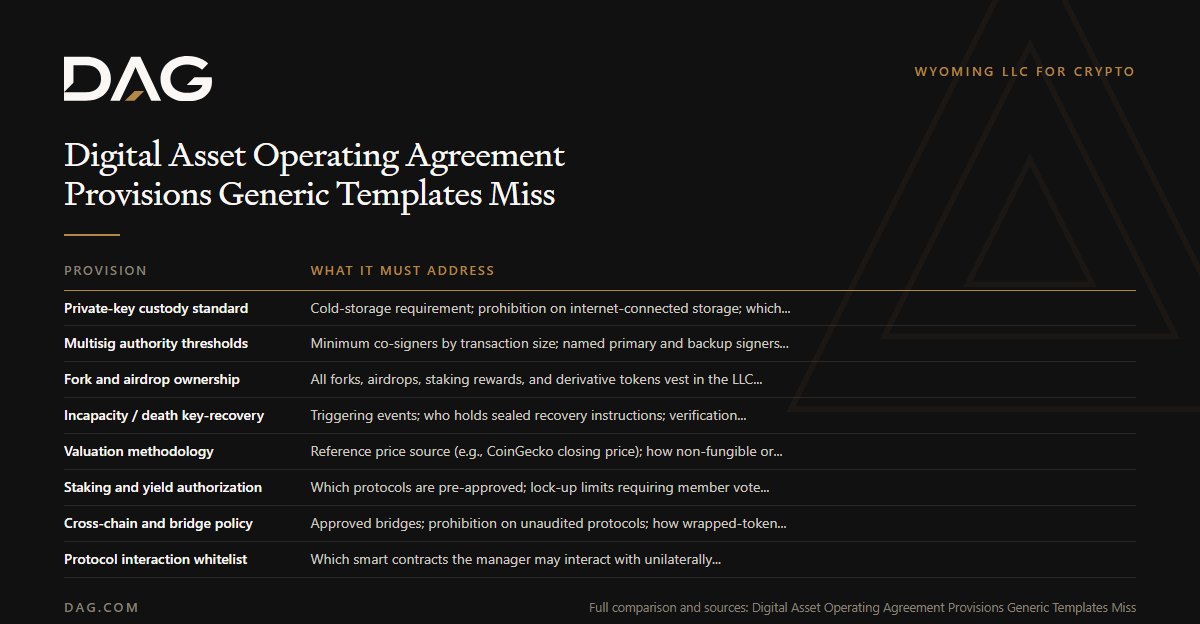
A digital asset operating agreement needs five provisions generic templates omit: private-key control standards, multisig authority thresholds, fork and airdrop ownership, incapacity and death key-recovery, and a digital-asset valuation methodology. These provisions are among the most important differentiators in crypto LLC formation. Standard LLC templates assume assets sit in a bank account verifiable by statement, so they address none of these crypto-specific governance questions.
What Is a "Digital Asset Operating Agreement Provision"?
A digital-asset-specific provision is any clause that addresses custody, governance, or succession for assets held on a blockchain, where ownership is controlled by cryptographic keys rather than by title documents or financial-institution records. Wyoming's Digital Assets Act (W.S. 34-29-101 et seq.) explicitly recognizes digital assets as property and permits LLCs to hold them, but the statute does not write your governance rules for you.
Why Generic Templates Fail for Cryptocurrency
Generic templates were designed for businesses whose assets are verifiable by bank statement. They have no concept of custody architecture, key holder succession, or derivative-asset ownership. An LLC that holds cryptocurrency and relies on a generic template may face:
- Paralysis when the key holder dies or becomes incapacitated and no one has legal authority to access funds
- Disputes over whether an airdrop or fork belongs to the LLC or to the member who was holding the wallet
- No governance rule on whether the manager can stake, bridge, or lend assets unilaterally
- Valuation ambiguity that complicates capital-account maintenance and tax reporting
The crypto LLC operating agreement checklist covers the baseline structure. This page focuses on the provisions generic templates leave out entirely.
Crypto-Specific Provisions a Digital Asset Operating Agreement Needs
Extractable Checklist: What Generic Templates Miss
| Provision | What It Must Address |
|---|---|
| Private-key custody standard | Cold-storage requirement; prohibition on internet-connected storage; which member(s) hold hardware devices |
| Multisig authority thresholds | Minimum co-signers by transaction size; named primary and backup signers; wallet addresses subject to multisig |
| Fork and airdrop ownership | All forks, airdrops, staking rewards, and derivative tokens vest in the LLC automatically; members may not claim them personally |
| Incapacity / death key-recovery | Triggering events; who holds sealed recovery instructions; verification required before release; timeline for access |
| Valuation methodology | Reference price source (e.g., CoinGecko closing price); how non-fungible or illiquid assets are valued; frequency of capital-account reconciliation |
| Staking and yield authorization | Which protocols are pre-approved; lock-up limits requiring member vote; treatment of staking rewards |
| Cross-chain and bridge policy | Approved bridges; prohibition on unaudited protocols; how wrapped-token exposure is tracked |
| Protocol interaction whitelist | Which smart contracts the manager may interact with unilaterally; due-diligence standard for new protocols |
| Exchange account limits | Maximum balance held on custodial exchanges; mandatory security settings (2FA, withdrawal whitelist) |
| Tax-record maintenance | Designated accounting software or methodology; cost-basis tracking standard; reconciliation frequency |
How to Draft Each Core Provision
Private-Key Custody: What the OA Should Say
The operating agreement should state the custody standard in operational terms: cold storage required for holdings above a defined threshold, hardware devices prohibited from connecting to internet-connected machines for signing, and seed-phrase storage in physical (not digital) form in a specified type of secure location. It should name the current key-holder role, not embed specific device serial numbers or addresses, which change.
Security note: The operating agreement should reference a separately-secured control schedule or custody framework rather than reciting actual seed phrases, private keys, or wallet addresses in the document itself. The OA is a legal record that may be produced in litigation or passed to successors, so it should name roles and standards, not secrets.
Multisig Authority Thresholds
Tiered approval scales risk to transaction size. A common structure:
- Transfers below a defined threshold: single authorized signer
- Mid-range transfers: two of three named signers
- Transfers above a higher threshold: full manager approval or member vote
The OA should name the three (or more) individuals who may serve as signers, designate backup signers, and specify which wallets are subject to multisig governance versus which operational wallets may use single-key control. Private key succession planning addresses what happens when a signer leaves the LLC.
Fork and Airdrop Ownership
This is the provision most generic templates omit entirely. When a blockchain forks, the new tokens appear in whatever wallet held the original asset, which may be controlled by one member. Without an explicit LLC-ownership clause, that member may argue the tokens are personal property.
The OA should state that all derivative assets, including hard forks, soft forks, airdrops, staking rewards, protocol incentive tokens, and liquidity-pool returns, generated by assets owned by the LLC belong to the LLC and must be transferred into LLC-controlled custody within a defined number of days. It should also specify whether distributing a fork requires a member vote when the forked asset exceeds a materiality threshold.
For tax treatment of airdrops received at the LLC level, see crypto airdrop tax reporting.
Incapacity and Death: Key-Recovery Provisions
This is where most crypto LLC structures fail in practice. The operating agreement needs a succession mechanism that does not rely on the incapacitated or deceased key holder volunteering information.
Two approaches that can be written into the OA:
Escrow with triggering events. A trusted third party (typically an attorney) holds sealed instructions for accessing the recovery framework. The OA specifies which events trigger release (death certificate, court-issued incapacity order, or similar), who may request release, and what verification is required. The escrow holder never holds the keys, only the instructions for how successors access the separately-secured control framework.
Periodic check-in with automated handoff. The key holder performs a defined check-in (quarterly, semi-annual) with the LLC's designated successor. If the check-in lapses, the successor gains access to recovery instructions under procedures defined in the OA.
Hardware wallet estate planning and what happens if I die with crypto in a hardware wallet cover the estate-planning side of this same problem.
Valuation Methodology
Capital-account maintenance under Wyoming Title 17 requires tracking each member's economic interest. For traditional assets that is straightforward. For digital assets the OA should specify:
- The reference price source and time (e.g., spot price on a named exchange at 11:59 PM UTC on the last day of each quarter)
- How to value assets with no liquid market (NFTs, illiquid DeFi positions, locked tokens)
- Whether unrealized gains adjust capital accounts on a mark-to-market basis or only on realization
- Who is responsible for reconciling on-chain transaction records to accounting software
Crypto tax reporting for LLCs addresses the downstream reporting requirements these valuation decisions create.
Staking, Yield, and Protocol Operations
Generic templates have no concept of yield-generating operations on owned assets. The OA should:
- Pre-authorize staking on a named list of established protocols without requiring a member vote
- Require a member vote (or supermajority) before committing assets to lock-up periods longer than a defined threshold
- Specify that staking rewards vest in the LLC automatically (reinforcing the fork/airdrop clause)
- Set risk parameters for DeFi protocol interaction: audited-only, no more than a defined percentage of LLC assets in any single protocol, etc.
Can a Wyoming LLC stake crypto covers the statutory authority; the OA translates that authority into governance rules.
How This Page Differs From the General Customization Guide
The companion page on customizing operating agreements for digital assets covers the overall process, why you need custom drafting, how DAG coordinates with your attorney, and the general categories of modifications. This page focuses narrowly on the specific provisions themselves: the exact clauses generic templates omit and what each one must address. If you are deciding whether to customize, start there. If you are working through what the customized provisions need to say, this page is the reference.
Related Questions
Does a standard Wyoming LLC operating agreement cover cryptocurrency?
No. Wyoming's LLC Act (Title 17) provides the statutory foundation, and the Wyoming Digital Assets Act (W.S. 34-29-101 et seq.) recognizes digital assets as property an LLC may hold. But neither statute writes governance rules into your operating agreement. A standard template leaves private-key custody, fork ownership, multisig governance, and succession completely unaddressed.
Can the operating agreement itself store seed phrases or private keys?
It should not. The OA is a legal record that may be filed, produced in litigation, or transferred to successors who are not yet known. It should define roles, custody standards, and recovery procedures, and reference a separately-secured control framework. The actual cryptographic material belongs in a secured, access-controlled document or physical location outside the OA.
How often should digital-asset OA provisions be reviewed?
Annually at minimum, and any time the LLC's holdings change materially, for example, when adding a new blockchain network, moving to multisig custody, beginning staking operations, or when a named key holder or signer changes. Protocol and custody landscapes shift faster than traditional asset classes; the governance document should keep pace.
Do these provisions differ for a trust-owned LLC versus a direct-member LLC?
Yes, materially. When a trust is the LLC's sole or majority member, trustee duties and the trust instrument's terms layer on top of the OA's provisions. Key-recovery procedures, for instance, must account for both the OA's succession rules and the trust's succession rules, they need to be coordinated. Should a trust own a Wyoming LLC for crypto assets addresses the structural question; what trust provisions should cover digital assets covers the parallel drafting needed on the trust side.
Sources
- Wyoming Limited Liability Company Act, Wyo. Stat. §§ 17-29-101 et seq. (current version at wyoleg.gov. Accessed 2026-06-02.
- Wyoming Digital Assets Act, Wyo. Stat. §§ 34-29-101 et seq. (enacted 2019, subsequently amended; current version at wyoleg.gov. Accessed 2026-06-02.
- IRS Notice 2014-21 (foundational guidance on cryptocurrency as property for federal tax purposes); Rev. Rul. 2023-14 (staking rewards as gross income in year received).
Compliance Note
This page is educational only and does not constitute legal, tax, or investment advice. Operating agreement drafting is a legal service; DAG coordinates the process with qualified attorneys but does not provide legal advice directly. The rules governing digital asset LLCs, including Wyoming's Digital Assets Act and IRS crypto guidance, continue to evolve. Consult a licensed attorney admitted in your state and a qualified CPA before forming an LLC or drafting operating agreement provisions for digital assets. Investment advisory services referenced in connection with DAG are provided by DAG Wealth, an SEC-registered investment adviser; registration does not imply a particular level of skill or training.