
Earning yield on XRP and digital assets in custody generally happens three ways: institutional lending programs, automated market maker (AMM) liquidity pools, and third-party yield programs at select custodians. XRP is not natively staked, so its yield comes from lending or platform programs, not proof-of-stake rewards. Each method carries counterparty, smart-contract, lockup, and regulatory risk. See the crypto lending and yield hub for the full cluster covering yield, lending, and borrowing strategies.
What Does "Earning Yield in Custody" Actually Mean?
Yield is income generated by putting an asset to work, through lending, liquidity provision, or participation in a yield-bearing program. For digital assets, it is distinct from price appreciation.
Staking refers to locking tokens in a proof-of-stake network to validate transactions and earn protocol rewards. Ethereum and Solana are staked natively. XRP operates on a federated consensus protocol, it is not natively staked and does not generate consensus rewards.
Custody-preserving yield means the asset remains with a regulated or institutional custodian, not transferred to an unrelated third-party protocol, while participating in a yield arrangement. The custodian holds keys and manages the lending or program mechanics on the investor's behalf.
Lending means temporarily transferring economic use of assets to a borrower in exchange for interest. During the loan period, the investor typically faces counterparty exposure to the borrower.
What Yield Options Are Available for XRP and Other Digital Assets?
What can XRP holders do to generate yield?
Because XRP lacks native staking, the primary custody-compatible options are:
- Institutional lending programs, a custodian or platform lends XRP to institutional borrowers and passes a share of interest to the asset holder. Some qualified custodians have at various times offered institutional lending or yield programs; availability, terms, and rates vary by provider and asset and are subject to change.
- AMM liquidity pools on XRPL, the XRP Ledger has a built-in DEX with AMM functionality. Providing liquidity generates trading-fee income but introduces impermanent loss risk.
- Third-party yield platforms, some centralized platforms offer yield on XRP deposits. These generally involve transferring assets off self-custody to the platform, which materially changes the risk profile.
What yield options exist for Ethereum, Bitcoin, and other digital assets?
For assets that do support native staking:
- ETH staking (post-Merge), validators lock ETH and earn protocol rewards. Solo staking requires 32 ETH and technical infrastructure; liquid staking protocols (Lido, Rocket Pool) lower the barrier but introduce smart-contract risk and varying degrees of custody change.
- Bitcoin lending. BTC has no native staking. Yield on BTC is generally available only through lending programs or custody-based yield products, all of which involve counterparty exposure.
- Stablecoin lending, higher nominal yields are available through DeFi lending protocols or centralized platforms, with commensurate smart-contract and platform risk.
Yield Method Comparison
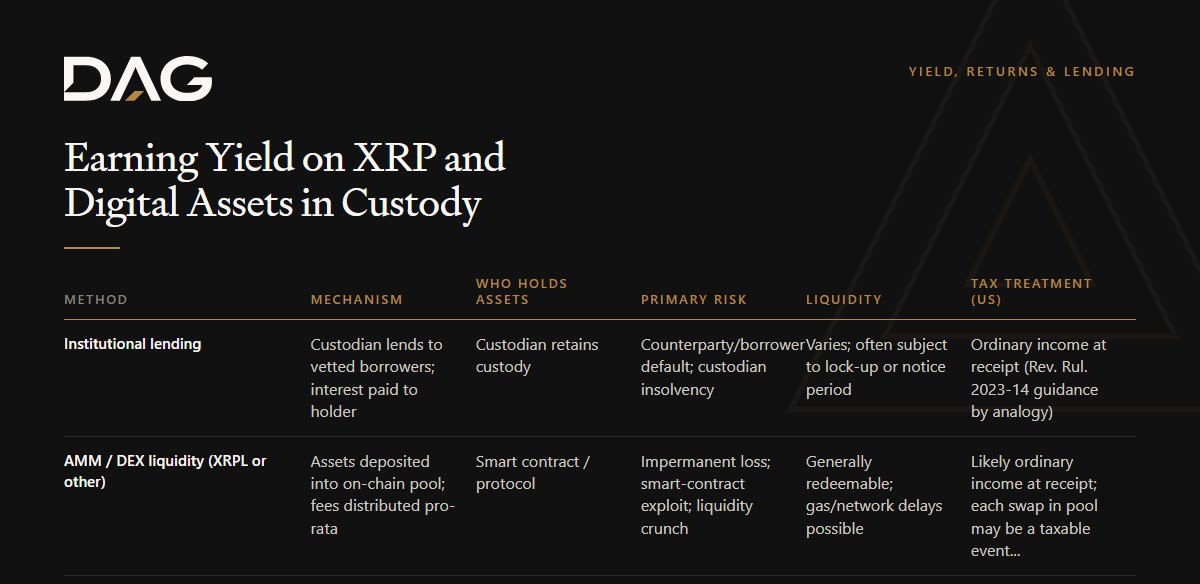
| Method | Mechanism | Who Holds Assets | Primary Risk | Liquidity | Tax Treatment (US) |
|---|---|---|---|---|---|
| Institutional lending | Custodian lends to vetted borrowers; interest paid to holder | Custodian retains custody | Counterparty/borrower default; custodian insolvency | Varies; often subject to lock-up or notice period | Ordinary income at receipt (Rev. Rul. 2023-14 guidance by analogy) |
| AMM / DEX liquidity (XRPL or other) | Assets deposited into on-chain pool; fees distributed pro-rata | Smart contract / protocol | Impermanent loss; smart-contract exploit; liquidity crunch | Generally redeemable; gas/network delays possible | Likely ordinary income at receipt; each swap in pool may be a taxable event, consult a CPA |
| Native ETH staking (liquid) | ETH locked with validators; liquid staking token issued | Validator / protocol | Slashing; smart-contract risk; peg deviation (liquid token vs ETH) | Liquid staking tokens tradeable; underlying may have exit queue | Staking rewards: ordinary income at receipt (Rev. Rul. 2023-14) |
| Native ETH staking (solo/direct) | Validator operated by holder or custodian | Holder or custodian | Slashing; validator downtime; 32 ETH minimum | Subject to unbonding/exit queue | Ordinary income at receipt |
| Third-party yield platform (centralized) | Assets transferred to platform; platform allocates to yield strategies | Platform (not custodian) | Platform insolvency; fraud; regulatory shutdown | Platform-dependent; may be restricted or halted | Ordinary income at receipt; platform may issue 1099 |
Note: Yield rates across all categories are variable, are not guaranteed, and can drop to zero. Past rates are not indicative of future returns. Yield-bearing arrangements may be characterized as securities under applicable law. This table is for educational comparison only, it is not a recommendation to enter any particular arrangement.
What Are the Key Risks to Understand Before Participating?
Counterparty and insolvency risk
When assets are lent or transferred to a platform, the holder becomes an unsecured creditor if the borrower or platform becomes insolvent. The 2022–2023 crypto lending collapses, several centralized crypto lenders that failed during that period, demonstrated that yield products can result in total loss of principal in insolvency.
Smart-contract and protocol risk
AMM pools and liquid staking protocols are governed by on-chain code. Exploits, governance failures, and oracle manipulation have caused material losses across major DeFi protocols.
Lockup and liquidity risk
Many lending programs and staking arrangements impose lock-up periods or notice requirements. If market conditions deteriorate rapidly, holders may be unable to exit.
Regulatory risk
The SEC has treated some retail staking-as-a-service and yield-bearing crypto programs as securities offerings, including a February 2023 settlement requiring a major exchange to end its U.S. retail staking-as-a-service program. Regulatory positions can restrict or terminate programs with limited notice. Investors should confirm the regulatory status of any program before participation.
Tax risk
Under Rev. Rul. 2023-14, staking rewards are generally treated as ordinary income at the time of receipt. The same principle is applied by most practitioners to lending interest and AMM fee income. Yield received in crypto is taxable at the fair market value on the date of receipt, even if not sold. Each disposition of the received tokens is a separate taxable event. Consult a qualified tax professional before participating.
How Does Custody Structure Affect Yield Options?
Institutional crypto custody provides a governance layer that some self-directed platforms do not. A qualified custodian holds assets under operational controls, key management, insurance, SOC 2 audits, and any lending or yield program is layered on top of that custody relationship rather than replacing it. This does not eliminate risk, but it changes the risk profile compared to transferring assets to an unrelated platform.
For high-net-worth investors, understanding how to choose a crypto custodian is a prerequisite to evaluating yield programs. Not all custodians offer yield programs, and those that do structure them differently. The due diligence question is not only "what yield can I earn?" but "what happens to my assets if the custodian or its lending counterparty fails?"
Cold storage vs qualified custody matters for yield decisions: self-custodied assets in cold storage generally cannot participate in institutional lending programs. Moving from self-custody to a qualified custodian is required for custodian-managed yield.
How Should High-Net-Worth Investors Approach Yield?
A portfolio allocation framework applied to yield decisions:
- Separate core holdings from yield-eligible allocation. Assets designated for preservation should not be deployed in yield programs. Only assets allocated to this purpose should be considered.
- Understand who holds the assets at all times. In a custody-based lending program, the custodian retains keys and manages the lending relationship. In a third-party platform, the platform holds assets, a materially different risk.
- Evaluate the counterparty. Who are the borrowers? What collateralization standards apply? What happens in default?
- Review the terms for lockup and exit. Under what conditions can participation be terminated? How quickly can assets be returned?
- Coordinate tax implications before entering. Yield income accrues throughout the year; estimated tax obligations may arise at receipt.
- Document the arrangement within the overall wealth structure. For assets held in an LLC or trust, confirm the entity's governing documents permit yield-bearing arrangements. See crypto governance for family offices for governance policy considerations.
For investors using an RIA, qualified custody for RIAs managing digital assets addresses how advisors should handle yield-bearing custody arrangements in the context of their fiduciary obligations.
Related Questions
Does XRP staking exist?
XRP does not use proof-of-stake consensus and has no native staking mechanism. Yield on XRP is generated through lending programs, where a custodian or platform lends XRP to institutional borrowers, or through XRPL AMM liquidity provision. Any service marketing "XRP staking" is using the term loosely to describe a lending or yield program; understand the actual mechanism before participating.
Can a trust or LLC participate in digital asset lending programs?
Yes, in principle, but the governing documents must authorize it. A trust's investment policy and trustee powers must permit participation in yield-bearing arrangements. An LLC operating agreement should address whether the manager has authority to enter lending programs and what oversight is required. The tax treatment may also differ depending on entity type. See can a trust receive staking rewards for trust-specific considerations, and can a Wyoming LLC stake crypto for LLC-specific treatment.
How does DeFi yield compare to institutional lending programs on a risk-adjusted basis?
DeFi protocols generally offer higher nominal yields, but introduce smart-contract risk, protocol governance risk, and the need to self-manage positions and tax reporting. Institutional lending programs typically offer lower yields, but with a custodian as an intermediary providing operational controls. Neither is inherently superior, the appropriate choice depends on the investor's risk tolerance, tax situation, and operational capacity.
Are yield-bearing crypto products securities?
Some may be. The SEC has taken the position in enforcement matters that certain retail staking-as-a-service and yield-bearing crypto programs are unregistered securities offerings. The regulatory status of any specific program depends on its structure and applicable law. Consult qualified legal counsel before participating in any yield arrangement.
What happened to centralized crypto lenders that failed in 2022–2023?
Several centralized crypto lenders that failed in 2022 offered yield on digital assets by deploying customer assets into lending and DeFi strategies. When credit conditions tightened and counterparty defaults occurred, the platforms became insolvent. Customers became unsecured creditors in bankruptcy proceedings and in many cases received only partial recovery of assets. These cases illustrate that yield and principal are not insulated from each other in lending arrangements.
Sources
- IRS Revenue Ruling 2023-14 (staking rewards as ordinary income): https://www.irs.gov/pub/irs-drop/rr-23-14.pdf (2023)
- Ethereum Foundation, staking documentation: https://ethereum.org/en/staking/ (accessed 2026-06-01)
Compliance Note
This page is for educational purposes only. It is not legal, tax, investment, or financial advice. Yield on digital assets is variable, not guaranteed, and can decline to zero. Lending and yield programs expose participants to counterparty risk, platform insolvency risk, smart-contract risk, lockup risk, and regulatory risk. Past performance and historical yield rates are not indicative of future results. Yield-bearing digital asset arrangements may be characterized as securities under applicable law, consult qualified legal counsel before participating. Under Rev. Rul. 2023-14 and current IRS guidance, staking rewards and, by common practitioner application, lending interest and AMM fee income are generally treated as ordinary income at receipt; consult a qualified tax professional regarding your specific situation. Nothing on this page constitutes a recommendation to enter any specific yield arrangement or custody program. DAG provides wealth coordination and planning services; investment advisory services in connection with digital asset management are provided by DAG Wealth, an SEC-registered investment adviser. Registration does not imply a certain level of skill or training.