
FTSO delegation on Flare lets you earn variable rewards on FLR without locking your tokens, one of several on-chain crypto lending and yield strategies available to digital asset holders. You assign voting power, not custody, to signal providers who submit price data to Flare's oracle. Your FLR stays in your wallet, free to move anytime, and you receive a share of provider rewards each epoch.
What Is the FTSO and How Does Delegation Work?
Flare Time Series Oracle (FTSO) is Flare Network's decentralized price-feed system. Smart contracts on Flare need accurate external price data for collateral ratios, liquidations, and trading pairs. FTSO signal providers submit price data every few minutes; the network calculates a median price and rewards providers whose submissions fell within an acceptable range of that median.
Delegation means assigning your FLR voting weight to a signal provider. You are not transferring tokens, your wallet retains full ownership. Because there is no lockup, you can sell or move FLR immediately at any time.
FLR is Flare Network's native token. WFLR (Wrapped FLR) is the ERC-20 form used in some DeFi interactions on Flare; both can be delegated. The two terms appear interchangeably in Flare's own documentation.
How Do Rewards Work?
Reward calculations happen every epoch (approximately 3.5 days on Flare). Providers that submitted accurate price data during an epoch earn rewards proportional to their delegated voting weight. They keep a percentage (their fee) and distribute the remainder to delegators in proportion to each delegator's share.
Rewards are not automatic. You must claim them manually through the Flare Portal or a compatible wallet. Unclaimed rewards expire after 90 days.
Key variables affecting your share:
- Provider accuracy, providers closer to the final median earn more
- Provider fee, ranges roughly 5–25%; lower fees mean more flows to delegators
- Total delegation to that provider, heavily over-delegated providers split rewards more ways, reducing each delegator's share
- Your delegation amount, larger delegations earn proportionally more; there is no stated minimum
Rewards from FLR delegation are variable and not guaranteed. The rate you earn depends on total network delegation, provider performance, and protocol mechanics, all of which change over time. For current figures, check the live delegation data on the Flare Portal rather than relying on any quoted projection.
Why FTSO Delegation Differs From Traditional Staking
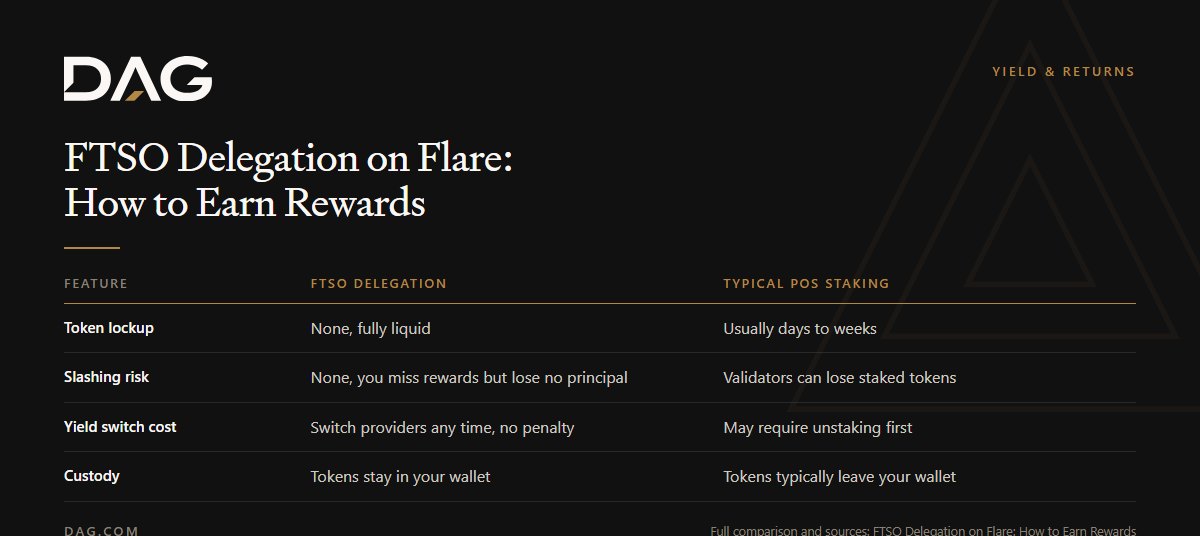
| Feature | FTSO Delegation | Typical PoS Staking |
|---|---|---|
| Token lockup | None, fully liquid | Usually days to weeks |
| Slashing risk | None, you miss rewards but lose no principal | Validators can lose staked tokens |
| Yield switch cost | Switch providers any time, no penalty | May require unstaking first |
| Custody | Tokens stay in your wallet | Tokens typically leave your wallet |
The tradeoff: FTSO yields are generally lower than high-risk staking options. Liquidity comes at a cost relative to protocols that lock capital to secure consensus.
How to Choose Signal Providers
Flare allows delegation to up to two providers simultaneously. Most experienced delegators use both slots.
Accuracy rate, look for providers above 85% accuracy over the prior 30–90 days on flaremetrics.io or the Flare Portal. Sustained accuracy below 80% often indicates technical problems.
Fee percentage, a provider charging 20% needs to outperform a 5% provider by a significant margin to deliver the same net yield. Compare net-of-fee results, not gross accuracy.
Reward history, review actual distributions over several months, not headline figures. Some providers submit aggressive price data that occasionally scores high but frequently misses.
Delegation concentration, if a provider already holds 30%+ of total network voting weight, additional delegation earns diminishing per-token returns. Solid performers with moderate concentration often deliver better outcomes.
Diversification, splitting delegation across two providers reduces the impact of any single provider's downtime or underperformance in a given epoch.
How to Delegate FTSO on Flare: Step-by-Step
Acquire FLR and set up a compatible wallet. MetaMask works with the Flare Network RPC added manually. Bifrost Wallet is built specifically for Flare. Hardware wallets support Flare through MetaMask. Exchange-held FLR generally cannot be delegated unless the exchange explicitly passes rewards through to users, most do not. See qualified custody vs self-custody for crypto for a framework on wallet choice when holding larger positions.
Research signal providers. Go to flaremetrics.io or the Flare Portal delegation page. Review accuracy rates, fee percentages, and reward history over at least 90 days. Build a shortlist of 2–3 candidates.
Execute delegation. Connect your wallet to the Flare Portal. Select your chosen providers, enter the percentage of your FLR to delegate to each (up to 100% total), and confirm. Gas fees on Flare are typically a small fraction of a cent.
Claim rewards regularly. Set a calendar reminder to claim every 2–3 weeks. Rewards expire after 90 days with no extension. Claimed FLR can be re-delegated immediately to compound returns.
Monitor and rebalance. Check provider accuracy monthly. If a provider falls below 80% accuracy across multiple consecutive epochs, consider switching. Rebalance delegation percentages if concentration or fee changes shift relative value.
Common Mistakes
Ignoring the 90-day expiration. Unclaimed rewards are permanently forfeited. Calendar reminders are the most practical safeguard.
Chasing recent performance. One strong month may reflect favorable market conditions rather than provider skill. Evaluate 3–6 month trends.
Overlooking fees. A 20%-fee provider with 95% accuracy may net less than a 5%-fee provider at 90% accuracy. Run the math on net-of-fee yield, not gross.
Using custodial wallets for delegation. FLR held on most exchanges is ineligible for FTSO rewards unless the exchange explicitly shares them with users.
Delegating to a single provider. A technical outage or poor epoch from one provider means zero rewards for that period. Two providers substantially reduces this risk.
Setting and forgetting. Provider quality changes. Operators that performed well six months ago may have degraded infrastructure today.
Tax Implications of FTSO Rewards
As of June 2026, the closest published IRS guidance is Rev. Rul. 2023-14, which treats staking-type rewards as ordinary income at the fair market value of the tokens when the holder gains control of them. FTSO delegation rewards likely fall under the same general principle, but the IRS has not directly addressed oracle-delegation rewards, so this is an open question rather than settled law. ****
Practical considerations for U.S. holders:
- Each reward claim may be a separate taxable event. Claiming every two weeks produces approximately 26 events per year.
- Track the USD value of FLR at each claim date, this becomes cost basis for future sales.
- Some holders batch monthly claims rather than optimizing frequency, to reduce record-keeping complexity.
- When rewards are later sold, the gain or loss is measured from that original claim-date basis.
For a broader overview of how yield and staking income is reported, see crypto staking tax reporting and crypto tax planning for high-net-worth investors.
This article is educational only and does not constitute tax advice. Consult a qualified tax professional regarding your specific reporting obligations.
Risks to Understand
Token price volatility. FTSO rewards are denominated in FLR. Any reward rate, however high, does not offset a sharp decline in token value. You remain fully exposed to FLR price risk. For perspective on managing concentration in a single token, see crypto concentration risk management.
Provider reliability. If your delegated provider submits inaccurate data or has downtime, you earn no rewards for that epoch. Past accuracy does not guarantee future performance.
Smart contract risk. Flare's delegation contracts have been audited and have been in production for an extended period, but no smart contract is entirely free of bug risk.
Protocol changes. Flare governance can modify reward structures, epoch parameters, fee caps, or delegation mechanics. These changes are outside your control.
Reward expiration. Inaction costs money. Set reminders.
When to Seek Professional Guidance
For small FLR positions, self-managing delegation is straightforward. For six- or seven-figure digital asset portfolios where FTSO delegation is one element of a broader yield strategy, professional coordination adds value, particularly around tax tracking across multiple claim events, integrating delegation into a formal investment policy, and evaluating how FLR exposure fits overall concentration limits.
DAG Wealth assists clients with evaluating signal provider performance, structuring delegation within broader portfolio allocation, coordinating tax reporting with qualified CPAs, and monitoring provider changes over time. Investment-advisory services, whether FLR fits your allocation, how to size a position, and portfolio risk, are provided through DAG Wealth, a registered investment adviser. ****
See digital asset wealth advisor and crypto wealth management hub for an overview of the full advisory service model.
Related Questions
Can you delegate FTSO without wrapping FLR to WFLR?
Both FLR and WFLR can be delegated, depending on the wallet interface. The Flare Portal handles the wrapping step transparently in some flows. Check your specific wallet's documentation for whether you need to manually wrap before delegating.
What happens to delegated FLR if the signal provider shuts down?
Your tokens remain in your wallet at all times. A provider shutdown means you earn no rewards for the affected epochs, but you lose no principal. You can redelegate to a different provider at any time with no penalty.
How does FTSO delegation interact with a Wyoming LLC or trust holding FLR?
If FLR is held through a Wyoming LLC or trust, the entity wallet would need to be compatible with Flare delegation. The trust or LLC receives the rewards rather than an individual, which affects how the income is reported and allocated. See can a Wyoming LLC stake crypto for related analysis. Consult legal and tax counsel before structuring delegation through an entity.
Do FTSO rewards count as self-employment income?
Probably not for most individual holders, delegation is passive, not a trade or business. However, if delegation activity is systematic and for profit at scale, a different characterization is possible. This is unresolved territory; consult a tax professional.
Sources
- Flare Network. FTSO documentation: https://docs.flare.network/tech/ftso/ (accessed 2026-06-01)
- Flare Portal, delegation interface: https://portal.flare.network (accessed 2026-06-01)
- Flare Metrics, provider performance dashboard: https://flaremetrics.io (accessed 2026-06-01)
- IRS Rev. Rul. 2023-14, taxation of staking rewards as ordinary income: https://www.irs.gov/pub/irs-drop/rr-23-14.pdf (issued July 2023)
- IRS Notice 2014-21, foundational crypto tax guidance (cost basis, taxable events): https://www.irs.gov/pub/irs-drop/n-14-21.pdf
Compliance Note
This article is for educational purposes only. It does not constitute legal, tax, investment, or financial advice. Past performance of any FTSO signal provider is not indicative of future results. FTSO delegation rewards vary and are not guaranteed. Risks include FLR token price volatility, signal provider underperformance, smart contract vulnerabilities, and protocol changes outside your control. As of June 2026, staking-type rewards are generally treated as ordinary income at receipt under IRS guidance, and FTSO delegation rewards likely follow the same principle, though the IRS has not directly addressed them; consult a qualified tax professional regarding your specific obligations. Investment advisory services are provided through DAG Wealth, a registered investment adviser; consult that adviser regarding suitability for your circumstances. Registration does not imply a certain level of skill or training.