
For a major crypto exchange business account, the business type a digital asset LLC selects should match what it actually does, part of the broader crypto banking and exchange setup process. A passive crypto-holding LLC fits a holding-company or proprietary-investment category, typically NAICS 551112 (Offices of Other Holding Companies). Choose the classification that honestly describes your activity, not the one that looks lowest-risk.
What business type should a digital asset LLC select on a crypto exchange?
A major crypto exchange's business account application asks for industry and business type during the know-your-business (KYB) onboarding process, and the answers feed into how the account is reviewed. The exact wording of the dropdown options changes over time, so match the category to what your digital asset LLC actually does rather than to a specific label. For an LLC that holds cryptocurrency rather than trading it actively, two categories typically fit:
- A holding-company category, the entity exists to hold and manage its own assets. This is the most straightforward fit for an LLC formed to hold Bitcoin, Ethereum, or other digital assets for long-term appreciation.
- A proprietary-investment category, the entity invests its own capital and manages no client funds.
For the industry field, a financial or investment classification is generally the closest match. If you do not see a category that fits cleanly, choose the nearest accurate option rather than forcing a misleading one.
Why not select a "Trading" category?
"Trading" classifications apply to entities that generate income by buying and selling frequently, spread-based income, high-volume activity, or brokerage operations. Selecting a trading category when your LLC simply holds assets creates a mismatch between your stated business purpose and actual account behavior, which can trigger manual compliance review or account restrictions.
Holding companies and investment companies face different scrutiny levels, fee structures, and transaction monitoring parameters than active trading accounts. Choosing the accurate category is both the correct approach and the more operationally convenient one.
What NAICS codes are appropriate for a digital asset holding LLC?
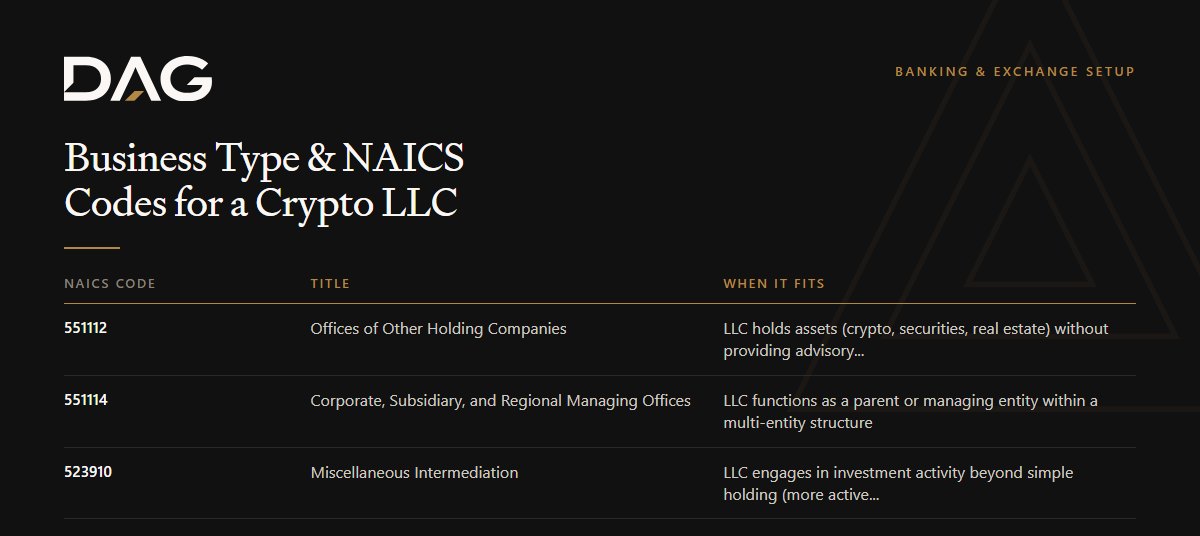
NAICS (North American Industry Classification System) codes appear on bank and exchange applications, tax registrations, and business formation documents. For an LLC primarily holding and managing digital assets:
| NAICS Code | Title | When It Fits |
|---|---|---|
| 551112 | Offices of Other Holding Companies | LLC holds assets (crypto, securities, real estate) without providing advisory services |
| 551114 | Corporate, Subsidiary, and Regional Managing Offices | LLC functions as a parent or managing entity within a multi-entity structure |
| 523910 | Miscellaneous Intermediation | LLC engages in investment activity beyond simple holding (more active portfolio management); verify this matches your actual activity |
| 525990 | Other Financial Vehicles | LLC structured as a pooled investment vehicle; rarely the right fit for a single-member LLC |
For most single-member or family crypto LLCs, 551112 is the common selection because it describes passive holding and asset management. The more active codes (523910, 525990) generally apply only if your LLC's actual operations match them; do not select an active-management or pooled-vehicle code for an entity that simply holds assets, and do not select a passive code if you in fact trade or manage outside capital. The classification should describe what the entity really does.
Note: The Census Bureau does not publish a NAICS code specific to digital-asset or cryptocurrency activity, so crypto LLCs map to the closest general financial code (verify current NAICS guidance, which is revised periodically). The codes above are illustrative of common practice for asset-holding entities, not a definitive selection for any particular entity. Your accountant or attorney can confirm the best fit for your specific operating agreement. This is not tax or legal advice.
How to complete a crypto exchange's business account application for an LLC
- Gather your entity documents, operating agreement, EIN confirmation letter (IRS Form SS-4), state formation documents (Articles of Organization or Certificate of Organization), and any registered agent information.
- Select the industry field, a financial or investment classification is generally the parent category for holding companies and investment entities.
- Select the business type, choose a holding-company or proprietary-investment category that matches your operating agreement. If your agreement describes the LLC as holding assets, a holding-company category is the natural fit. Use the labels the exchange actually presents at the time you apply.
- Enter your NAICS code, use 551112 for a passive holding LLC. Have your code ready before starting the application; the exchange's KYB form may ask for it directly.
- Upload required documents, the exchange typically requests the operating agreement, EIN letter, and government-issued ID for beneficial owners (anyone owning 25%+). Requirements may change; verify in the current application portal.
- Ensure consistency across all documents, if your operating agreement, NAICS registration, and exchange application all say "holding company," compliance review is straightforward. Contradictions between documents are the most common cause of manual review delays.
Keep classification consistent across all financial relationships
Banks and exchanges that onboard business accounts cross-check KYB information. If one exchange sees "holding company," a crypto-friendly bank sees "investment company," and your operating agreement describes "trading activity," the inconsistency requires explanation. Consistent documentation across all platforms, same business type, same NAICS code, same description of business purpose, reduces friction at every onboarding.
This also applies to your crypto custody for LLCs setup. The custody arrangement and account behavior should match the stated business purpose. An LLC registered as a passive holding company that executes dozens of short-term trades will diverge from its stated classification over time.
For LLCs holding digital assets within a trust structure, the same classification logic applies, the LLC's stated purpose should match how the trust documents describe the entity's function.
Related Questions
Can I change my business type on a crypto exchange after the account is opened?
Major crypto exchanges allow business information updates, but changing core KYB classifications typically requires submitting updated documentation and may trigger a compliance review. Verify directly with the exchange's support team for the current process, as procedures change.
Does my NAICS code affect how a crypto exchange monitors my account?
Exchanges use industry classification as one input into transaction monitoring thresholds and risk ratings. A holding company classification is generally treated as lower-risk than an active trading or money services classification. Accurate classification is required; misclassification to obtain more favorable treatment creates KYB compliance exposure.
Do other exchanges use the same business type categories?
Each exchange has its own KYB form structure. A major crypto exchange and an institutional crypto custodian, for example, may use different dropdown options. The underlying logic is consistent, accurately describe your entity type and activity level, but you will need to map your LLC's classification to whatever categories each platform provides. See crypto account opening checklist for trusts and LLCs for a broader onboarding framework.
What records should my LLC keep related to business classification?
Your LLC's recordkeeping obligations include the operating agreement, any NAICS code used on government or financial filings, and copies of the KYB documentation submitted to each exchange or bank. Consistent records support both compliance reviews and tax reporting.
Sources
- U.S. Census Bureau, North American Industry Classification System: https://www.census.gov/naics/, authoritative NAICS code definitions and lookup
- FinCEN, Customer Due Diligence Rule (31 CFR § 1010.230), beneficial ownership requirements applicable to KYB onboarding
Compliance Note
This page is for educational purposes only and does not constitute legal, tax, financial, or regulatory advice. NAICS code selection and business classification decisions for your specific entity should be reviewed with a qualified attorney or accountant familiar with your operating agreement and jurisdiction. A crypto exchange's application requirements and available business type categories may change without notice, verify current options in the platform before submitting. KYB regulations require accurate disclosure; do not misclassify your business to obtain a more favorable compliance outcome. DAG Wealth does not provide exchange onboarding services and is not affiliated with any exchange.