
For NY LLC crypto exchange accounts, New York's BitLicense requirement narrows your licensed options, a state-specific wrinkle within the broader crypto banking and exchange setup process. As of 2026, two major exchanges holding BitLicenses support New York LLC business accounts. Confirm current eligibility against the NYDFS list, and treat any setup fees as illustrative until verified.
What is the NY BitLicense and why does it limit exchange options?
New York's BitLicense, issued by the New York State Department of Financial Services (NYDFS), is required for any company engaging in virtual currency business activity with New York residents. The application is costly, time-consuming, and ongoing in its compliance obligations. Most exchanges have chosen not to pursue it, which leaves New York LLC owners with fewer licensed counterparties than operators in other states.
The BitLicense status of any exchange can change. Verify directly with the exchange and check the NYDFS virtual currency company list before opening an account.
Which exchanges currently hold a BitLicense?
The two most commonly used retail-and-business licensed exchanges for New York accounts are the major BitLicense holders. A small number of other firms hold conditional BitLicenses or operate under limited authorizations. The NYDFS website maintains the authoritative list, check it before assuming an exchange is eligible to serve you.
What documents does a New York LLC need to open an exchange account?
The BitLicense-holding exchanges require business account documentation that goes beyond what a personal account needs. Expect to provide:
- Articles of Organization (filed with the relevant state)
- Operating Agreement, typically Schedule 1 identifying managers and ownership percentages
- IRS EIN confirmation letter (CP 575 or 147C)
- Government-issued photo ID for each controlling manager
- Description of business activities (source of funds, nature of transactions)
- Principal business address, must match your actual operating location
Do not include capital contribution schedules or wallet addresses in your submission. Exchanges verify ownership and control, not your asset history or custody details. Keep that information in your internal LLC records.
How long does NY business account onboarding take?
Compliance teams in New York review applications more carefully than in lower-regulation states. A process that takes days elsewhere can take several weeks in New York. Build that timeline into any plans that depend on exchange access being available by a specific date.
What are the setup fees and account minimums?
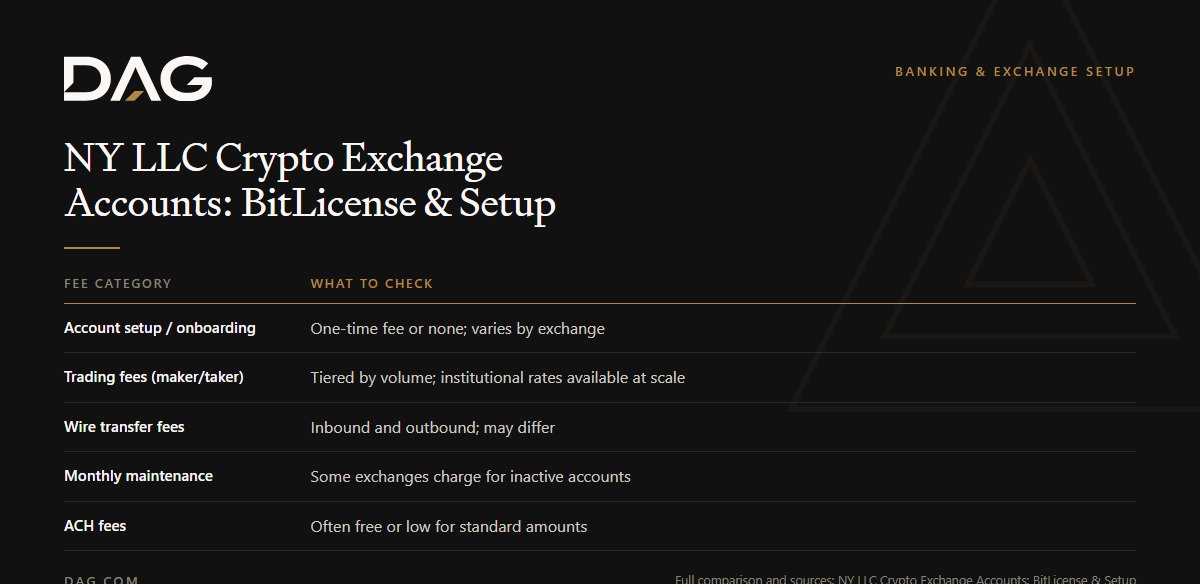
Fee structures vary by exchange and change with some regularity. Categories to review on each exchange's business account page include:
| Fee Category | What to Check |
|---|---|
| Account setup / onboarding | One-time fee or none; varies by exchange |
| Trading fees (maker/taker) | Tiered by volume; institutional rates available at scale |
| Wire transfer fees | Inbound and outbound; may differ |
| Monthly maintenance | Some exchanges charge for inactive accounts |
| ACH fees | Often free or low for standard amounts |
Illustrative note (verify current terms): Each licensed exchange publishes its business account fee schedule on its institutional or prime pages; information is subject to change. Verify current rates directly with the exchange before applying.
In addition to exchange fees, operating a crypto business in New York carries higher compliance overhead than other states: more document preparation, longer review timelines, and the need for ongoing regulatory awareness. Factor that into total cost-of-operations, not just the fee schedule.
Can I use a Wyoming LLC to avoid the New York BitLicense requirement?
No. Where your LLC is registered is a different question from where you physically operate and reside. Exchanges verify your principal operating address during KYC. If you are a New York resident managing the LLC from New York, the exchange treats you as a New York customer and applies BitLicense eligibility rules accordingly, regardless of which state your LLC was formed in.
Attempting to list a non-New York address when you actually operate from New York creates misrepresentation risk in KYC filings. Exchanges and banks do identify discrepancies during enhanced due diligence. The correct approach is to work with the licensed exchanges that actually serve New York.
If your LLC structure is not yet finalized, see Should I Put My Crypto in a Wyoming LLC? and What Is a Wyoming Digital Asset LLC? for guidance on structure choices.
How does NY banking work alongside the exchange accounts?
Business bank accounts face similar dynamics. Banks that operate nationally, including crypto-friendly banks and fintechs, will ask about your principal operating location during account opening. New York-based businesses typically face additional verification steps. This is not unique to crypto businesses; it reflects New York's financial regulatory environment broadly.
Get your LLC documents clean and consistent before beginning any application. Discrepancies between your Articles of Organization, Operating Agreement, and EIN records give compliance reviewers grounds to delay or deny. See Crypto Account Opening Checklist for Trusts and LLCs for a full document preparation checklist.
Where should long-term crypto holdings be held?
Exchanges are on-ramps and off-ramps, not long-term custody solutions. Once assets are converted or settled, they should move to a more controlled environment. See Crypto Custody for LLCs for an overview of custody structures appropriate for LLC-held digital assets, and Qualified Custodian vs Crypto Exchange for a comparison of the two approaches.
For tax reporting responsibilities that arise from LLC exchange activity, see Crypto Tax Reporting for LLCs.
Related Questions
Does the NY BitLicense cover all digital assets, or just Bitcoin?
The BitLicense applies to "virtual currency business activity" broadly, which NYDFS has interpreted to cover a wide range of digital assets, not only Bitcoin. Specific asset coverage has evolved as NYDFS has updated guidance. Check the current NYDFS coin-listing framework for any specific asset your LLC plans to trade.
What happens if I open an exchange account and then relocate to New York?
Exchanges require you to keep your account information current, including your principal operating address. If you relocate to New York after opening an account, update your address with the exchange promptly. If the exchange is not licensed in New York, they may restrict or close your account at that point. Better to identify a licensed alternative before relocating.
Is there a minimum portfolio size for NY LLC exchange accounts?
The major BitLicense-holding exchanges have no published minimum portfolio size for standard business accounts. Institutional and prime tiers do carry minimums, those figures change and should be verified directly with each exchange. If your LLC is managing assets at a scale where institutional custody and trading infrastructure matter, see Crypto Custody for LLCs for the institutional onboarding picture.
Sources
- New York State Department of Financial Services. Virtual Currency Businesses (BitLicense list): https://www.dfs.ny.gov/apps_and_licensing/virtual_currency_businesses
- NYDFS BitLicense Regulatory Framework (23 NYCRR Part 200): https://www.dfs.ny.gov/virtual_currency_businesses
- IRS. Employer Identification Number (EIN): https://www.irs.gov/businesses/small-businesses-self-employed/employer-id-numbers
Compliance Note
This page is for educational purposes only and does not constitute legal, tax, investment, or regulatory compliance advice. Exchange eligibility, fee schedules, BitLicense status, and documentation requirements change. Verify current terms directly with each exchange and with the NYDFS before submitting any application. Entity formation and operating-agreement matters are legal services; DAG coordinates these and does not provide legal advice. Consult a qualified attorney and tax professional familiar with New York financial regulations before structuring or operating a crypto LLC in New York. Advisory services are provided by DAG Wealth, an SEC-registered investment adviser. Registration does not imply a certain level of skill or training. DAG Wealth and Digital Ascension Group do not guarantee access to any exchange or banking relationship.