
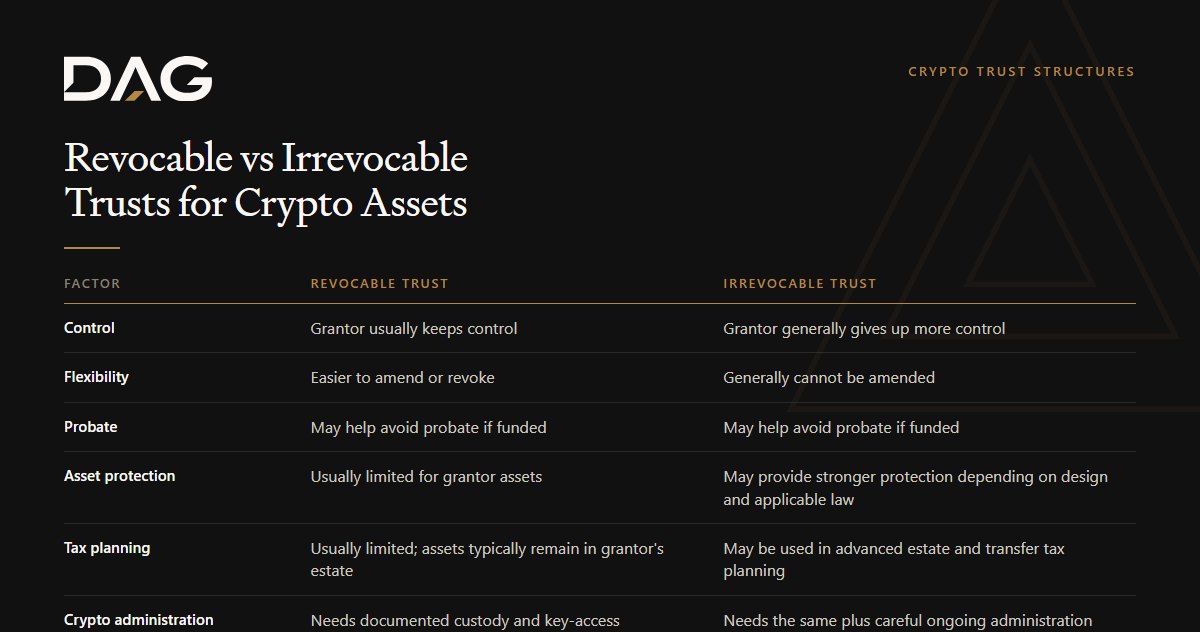
A revocable trust generally keeps control with the grantor and helps with privacy, probate avoidance, and continuity, while an irrevocable trust is generally used for more advanced goals such as asset protection, estate tax, or multi-generational planning. For crypto, choosing between a revocable vs irrevocable trust matters less than whether the trust can securely administer digital assets and private key access.
What These Two Trust Types Mean
A revocable trust (often a revocable living trust) can be amended or revoked by the grantor during life, who usually keeps full control of the assets. An irrevocable trust generally cannot be changed once established, and the grantor typically gives up direct control in exchange for benefits the revocable form does not provide. Both are funding-dependent: assets only receive trust treatment once they are actually titled into the trust, which for crypto means coordinating with custody accounts, wallets, and any trust-owned LLC.
Why This Matters
Crypto assets are easy to lose operationally and difficult to recover if access fails. A trust can name fiduciaries and beneficiaries, but the documents must be coordinated with custody accounts, wallets, LLCs, and private key procedures. This is part of the broader work covered in our Crypto Trust Structures Hub.
For crypto holders, the revocable-versus-irrevocable question should not be answered in isolation. Tie it to control, tax, creditor exposure, beneficiary needs, custody model, and family governance.
How They Compare
| Factor | Revocable Trust | Irrevocable Trust |
|---|---|---|
| Control | Grantor usually keeps control | Grantor generally gives up more control |
| Flexibility | Easier to amend or revoke | Generally cannot be amended |
| Probate | May help avoid probate if funded | May help avoid probate if funded |
| Asset protection | Usually limited for grantor assets | May provide stronger protection depending on design and applicable law |
| Tax planning | Usually limited; assets typically remain in grantor's estate | May be used in advanced estate and transfer tax planning |
| Crypto administration | Needs documented custody and key-access instructions | Needs the same plus careful ongoing administration |
For either structure, the digital-asset specifics, qualified custody, cold storage, multi-sig signing authority, and succession of private keys, usually matter more than the label. See private key succession planning and what trust provisions should cover digital assets.
Evidence Standard
This draft does not use examples or client stories. Any scenario added later should be labeled hypothetical unless verified and approved.
When It May Help
A revocable trust may fit when the holder wants to keep control and avoid probate. An irrevocable trust may be considered when the family has larger transfer, tax, creditor, or dynasty planning objectives. Both require careful funding and administration, and both depend on the facts.
When It May Not Be Enough
Neither trust type automatically solves private key access, and neither removes market, custody, or tax risk. Neither should be treated as a generic tax strategy. Trust treatment can vary by state, structure, tax classification, and facts, so confirm the design with qualified counsel. Whether the trust is revocable or irrevocable, an irrevocable trust owning Bitcoin faces the same custody and administration questions as any other digital-asset trust.
Related Questions
Can a revocable trust hold crypto?
It generally may, but implementation matters. The trust, custodian, wallet setup, and access instructions must work together, and the assets must be titled into the trust before they receive any trust treatment.
Does an irrevocable trust protect crypto from creditors?
Possibly in some structures, but never automatically. Asset protection generally depends on the trust design, timing, jurisdiction, facts, and applicable law. Consult qualified counsel before relying on any protection.
Which trust is better for crypto?
There is no universal answer, and "better" depends on your goals. Revocable trusts are often simpler for probate and continuity; irrevocable trusts are more advanced and require careful legal and tax advice. The custody and key-succession plan often matters more than the trust type.
Bottom Line
Revocable and irrevocable trusts solve different problems, and neither eliminates the underlying market, custody, or tax risk of holding digital assets. For crypto wealth, make the trust choice alongside custody, LLC titling, tax planning, and private key succession, with qualified counsel reviewing the structure.
Sources
Compliance Note
This article is for general educational purposes and is not legal, tax, or investment advice. Trust decisions should be reviewed by qualified counsel and tax professionals.