
A private trust company (PTC) for crypto is a closely held entity a wealthy family forms to act as the trustee of its own family trusts, rather than naming an individual or a commercial bank trust department. For crypto families, a PTC can centralize control of digital-asset decisions, keep specialized knowledge in-house, and provide trustee continuity, but it carries real chartering, governance, and cost burdens that generally make sense only at substantial asset levels.
What a Private Trust Company Is
A private trust company is an entity, usually an LLC or corporation, created to serve as trustee for the trusts of a single family (or a defined group of related families). Instead of a person being the trustee, the family-owned company holds that role. The family staffs and governs the company, often with a board, investment committee, and distribution committee, so trustee decisions are made by a structured organization rather than one individual who can die, resign, or lack crypto expertise.
A PTC differs from naming an individual trustee or hiring a commercial trust company. An individual trustee is a single point of failure and may not understand private keys. A commercial trustee brings institutional process but may decline to hold self-custodied crypto or charge for assets it will not actively manage. A PTC keeps the trustee function inside the family while still allowing it to engage qualified custodians, advisers, and counsel. For the related question of whether the family even needs a separate company versus a directed structure, see directed trusts for digital assets.
A PTC is distinct from the combined Wyoming structure that layers a qualified trustee, a PTC, and a holding LLC together; this page explains the PTC itself. For how those pieces fit into one Wyoming arrangement, see Wyoming private trust company LLC structure.
When a Crypto Family Needs a PTC
A PTC is an advanced tool, not a default. Indicators that a crypto family may have outgrown an individual or commercial trustee generally include:
- Multiple trusts and generations. Several trusts (dynasty, descendants', insurance) that all need consistent, coordinated trustee decisions.
- Concentrated, volatile, or self-custodied digital assets. Trustee decisions that require crypto-specific knowledge a commercial trust department may not provide.
- A desire for retained family control. The family wants to direct investment and distribution policy through committees rather than delegate it entirely.
- Continuity needs. A trustee that survives the death or incapacity of any one family member, with documented signer and key succession.
- Privacy and governance. A single governed entity to administer family wealth rather than disclosing affairs to an outside institution.
If the family's main goal is simply separating key custody from the trust, a trust-owned LLC for crypto assets may be enough without forming a full PTC. A PTC adds a trustee layer on top of, not instead of, sound custody.
Cost and Asset Thresholds
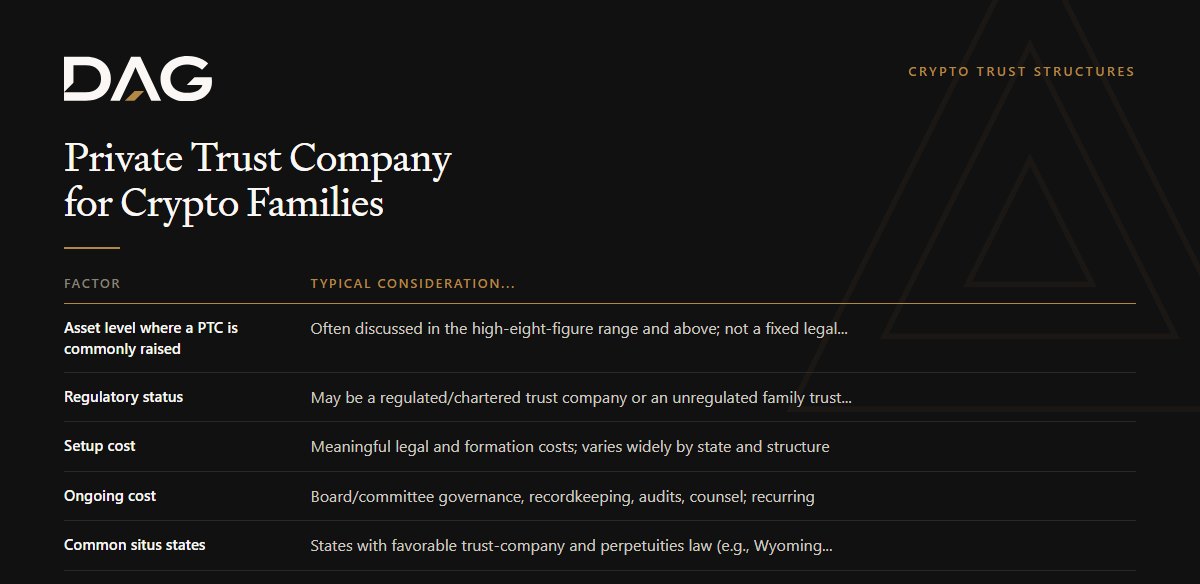
A PTC introduces ongoing legal, administrative, and (often) regulatory cost: formation, possible state chartering or registration, a board and committees, recordkeeping, audits, and counsel. Whether a PTC is regulated or can operate as an unregulated family trust company depends on the state and on how many families it serves, a fact-specific legal question. Because of this overhead, PTCs are generally discussed only at high asset levels.
| Factor | Typical consideration (illustrative, verify current) |
|---|---|
| Asset level where a PTC is commonly raised | Often discussed in the high-eight-figure range and above; not a fixed legal threshold |
| Regulatory status | May be a regulated/chartered trust company or an unregulated family trust company, depending on state law and whether it serves one family |
| Setup cost | Meaningful legal and formation costs; varies widely by state and structure |
| Ongoing cost | Board/committee governance, recordkeeping, audits, counsel; recurring |
| Common situs states | States with favorable trust-company and perpetuities law (e.g., Wyoming, South Dakota, Nevada) |
These figures are illustrative and dated; there is no single asset level that triggers a PTC, and the right answer depends on the family's goals, the number of trusts, and applicable state law. Confirm current chartering rules, capital requirements, and costs with qualified counsel in the chosen state.
Related Questions
Is a private trust company the same as a Wyoming LLC holding crypto?
No. A holding LLC owns assets; a PTC acts as trustee of the trusts. A family may use both, a PTC serving as trustee of a trust that owns an LLC holding the keys. The combined arrangement is covered in Wyoming private trust company LLC structure.
Does a PTC have to be regulated?
It depends on the state and how many families it serves. Some states allow unregulated family trust companies serving a single family; others require chartering and supervision. Whether a given PTC is regulated is a fact-specific legal question for counsel in the chosen jurisdiction.
Can a PTC manage the family's crypto keys directly?
A PTC can hold trustee authority and engage qualified custodians, multi-sig arrangements, or a trust-owned LLC to handle the actual keys. Concentrating both trustee authority and key custody in one place generally raises the same single-point-of-failure and security questions any crypto trustee faces; see private key succession planning. For how a PTC fits alongside other vehicles, see the crypto trust structures hub.
Sources
- Internal Revenue Service guidance on family trust companies / private trust companies (e.g., IRS Notice 2008-63)
- State trust-company chartering statutes (e.g., Wyoming, South Dakota, Nevada)
Compliance Note
This article is for general educational purposes and is not legal, tax, fiduciary, or estate advice. Forming and operating a private trust company, choosing situs, and obtaining any required charter are professional services that Digital Ascension Group coordinates with qualified attorneys and tax professionals; the firm does not provide legal advice. Advisory services are provided through DAG Wealth. Asset levels and costs cited are illustrative and dated and must be verified with qualified counsel in the relevant state. No structure removes market, custody, or tax risk, and no outcome is guaranteed. Registration does not imply a certain level of skill or training.