
A trustee can hold a hardware wallet for trust-owned crypto only when the trust document, applicable law, fiduciary duties, a written custody policy, and operational controls all support it. Self-custody puts private keys in the trustee's hands, which raises access, security, and recordkeeping risks. For many trusts a qualified custodian is the more defensible choice.
What a Hardware Wallet Means for a Trustee
A hardware wallet is a physical device that stores the private keys controlling crypto offline, in cold storage. Whoever holds the device and its recovery seed phrase can move the assets. When a trustee self-custodies this way, the trustee personally bears responsibility for securing keys, documenting holdings, and ensuring an orderly transfer if the trustee changes. That is a different posture than using a qualified custodian, which is generally a regulated third party that holds assets under the SEC custody framework and provides controls such as SOC 1 or SOC 2 reporting.
Self-custody is not prohibited, but it concentrates operational risk on one person. The decision depends on the facts of the trust, and a trustee unsure of their authority should consult qualified counsel before taking custody of any keys.
Questions for Trustees Before Self-Custodying
Work through these before holding a device:
- Does the trust document authorize digital asset ownership and self-custody?
- Does the trustee have explicit authority to hold private keys directly?
- Who else knows the recovery procedure, and is it written down securely?
- Are private keys and seed phrases protected against loss, theft, and single points of failure (for example, through multi-sig or geographically split backups)?
- Are wallet addresses documented so holdings can be verified independently?
- Are all transactions recorded for tax reporting, given the IRS generally treats digital assets as property?
- What happens to the assets if the trustee resigns, dies, or becomes incapacitated?
If any answer is unclear, the trustee may be taking on liability beyond what the trust intended. See can a trustee be liable for crypto losses for how fiduciary standards apply.
Self-Custody vs Qualified Custody at a Glance
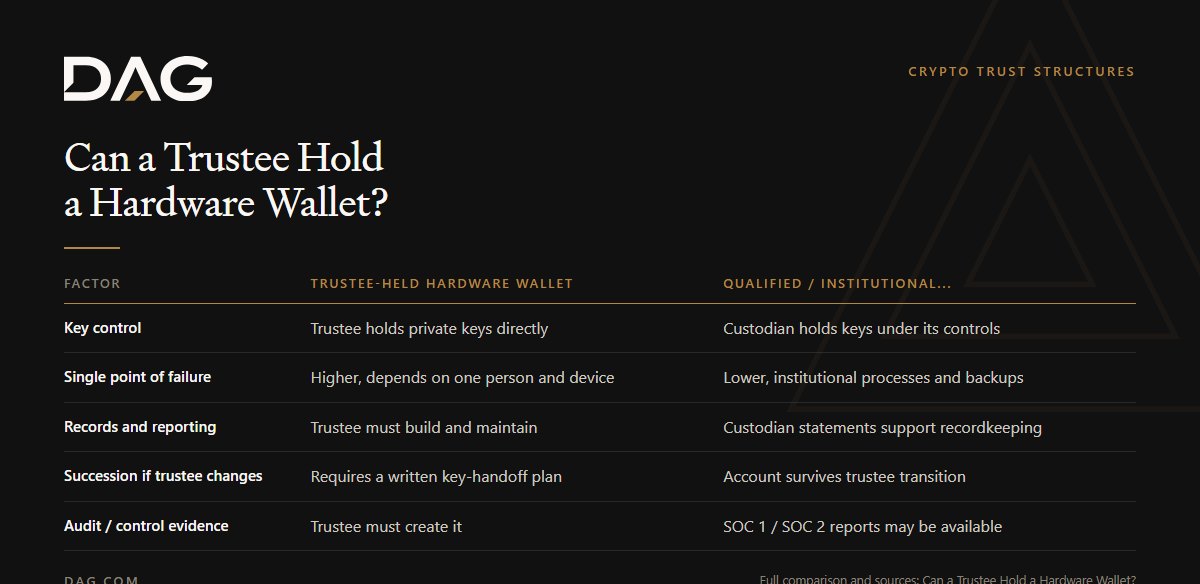
| Factor | Trustee-held hardware wallet | Qualified / institutional custodian |
|---|---|---|
| Key control | Trustee holds private keys directly | Custodian holds keys under its controls |
| Single point of failure | Higher, depends on one person and device | Lower, institutional processes and backups |
| Records and reporting | Trustee must build and maintain | Custodian statements support recordkeeping |
| Succession if trustee changes | Requires a written key-handoff plan | Account survives trustee transition |
| Audit / control evidence | Trustee must create it | SOC 1 / SOC 2 reports may be available |
Neither model removes market, custody, or tax risk. The right choice depends on the trust's terms, the size of the holdings, and the trustee's capacity to administer keys safely.
Alternative Custody Models
Beyond a self-custodied hardware wallet, a trustee may consider qualified custody, institutional custody, multi-signature controls, MPC-based custody, or holding crypto through a trust-owned LLC account, depending on the facts. Building a documented key-handoff process is part of private key succession planning and protects beneficiaries if the trustee is unavailable.
Why Documentation Matters
A trustee should be able to show what assets the trust holds, who controls them, how they are secured, and how beneficiaries and tax professionals receive required information. Clear records support the trustee's fiduciary duties and make a custody review or audit far easier to satisfy.
Related Questions
Does a trustee need to use a qualified custodian for crypto?
Not necessarily. Whether a qualified custodian is required depends on the trust document, applicable law, and the trustee's regulatory status. Many trusts use one to reduce single-point-of-failure risk, but self-custody is generally permitted where authorized. Consult qualified counsel for your situation.
What happens to a trust's crypto if the trustee loses the hardware wallet?
If keys and the recovery seed are lost with no backup, the assets can become permanently inaccessible. This is why a documented, secured recovery procedure and a succession plan generally matter more for self-custodied crypto than for assets held by a third-party custodian.
Can a trustee be personally liable for mishandling a hardware wallet?
Possibly. A trustee owes fiduciary duties of care and prudence, and failing to secure keys or document decisions could expose the trustee to liability depending on the facts. A trustee in doubt should seek qualified legal advice before self-custodying.
Sources
Compliance Note
This article is educational and does not provide legal, tax, fiduciary, investment, security, or custody advice. Trustees should consult qualified counsel before self-custodying crypto.