
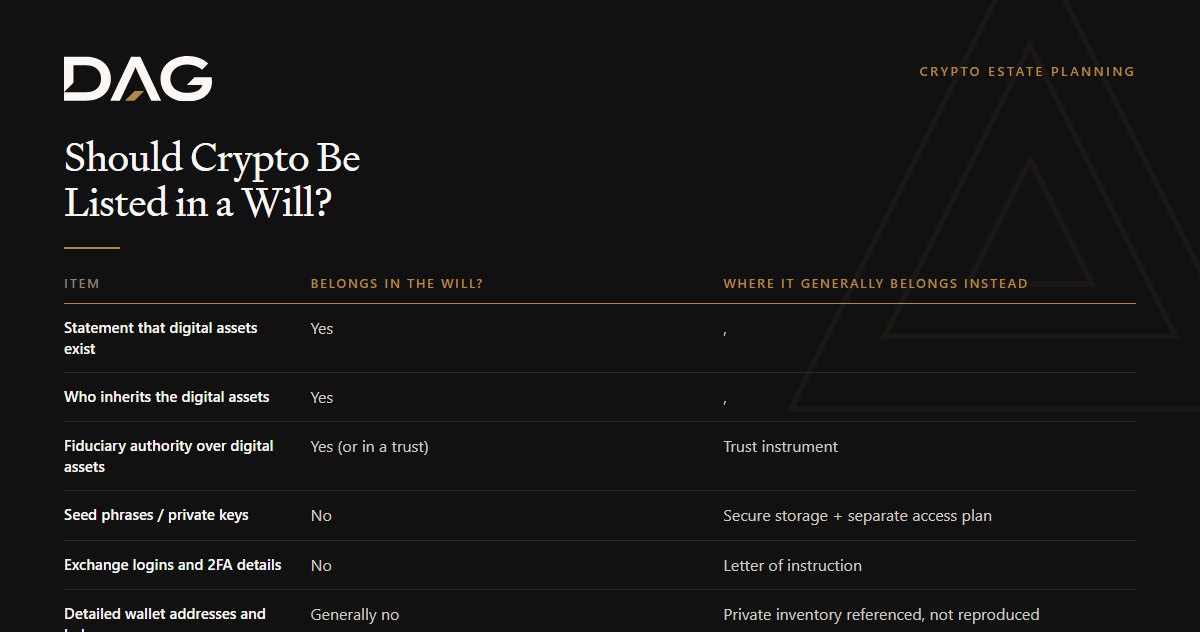
Crypto should be listed in a will only at the level of identifying that digital assets exist and naming who inherits them. A will should not contain seed phrases, private keys, or wallet credentials, because a will can become a public probate record. Keep access instructions in a separate, secure, private process instead.
What "Listing Crypto in a Will" Actually Means
A will is a legal document that names beneficiaries and directs how property passes at death. "Listing crypto" can mean two very different things: naming the existence of digital assets and who receives them, or recording the access secrets needed to control those assets. The first belongs in a will. The second generally does not, because a self-custodied wallet is controlled by whoever holds the private key or seed phrase, and a will can lose its confidentiality once it enters probate.
Why This Matters
A will admitted to probate can involve court filings, attorneys, executors, and records that may become public or semi-public depending on the jurisdiction. Writing key material into that document can expose it at the moment a family is least equipped to react. For an overview of how these pieces fit together, see the Crypto Wealth Management Hub, and for the recurring errors families make, see common crypto estate planning mistakes.
What to Put Where
| Item | Belongs in the will? | Where it generally belongs instead |
|---|---|---|
| Statement that digital assets exist | Yes | , |
| Who inherits the digital assets | Yes | , |
| Fiduciary authority over digital assets | Yes (or in a trust) | Trust instrument |
| Seed phrases / private keys | No | Secure storage + separate access plan |
| Exchange logins and 2FA details | No | Letter of instruction |
| Detailed wallet addresses and balances | Generally no | Private inventory referenced, not reproduced |
This separation lets the will do its legal job, directing inheritance, while sensitive access material stays out of a document that can be read by others. A crypto will versus a crypto trust differ here too: a trust can keep the directive private and avoid probate exposure in many cases.
How the Pieces Fit Together
A coordinated plan generally includes:
- Will or trust language that covers digital assets and names who inherits them.
- A private letter of instruction describing what exists and how to find help, without exposing secrets.
- Secure storage of access materials, with seed phrase storage planned for estate purposes.
- Custody-account beneficiary designations or fiduciary procedures, where the custodian supports them.
- Trust or LLC ownership where appropriate to the facts.
- Tax and valuation records, since the IRS generally treats digital assets as property.
Evidence Standard
This article explains planning risks and does not provide legal drafting language.
When It May Help
- Your current will does not mention digital assets at all.
- Crypto is held in self-custody, where no third party can grant heirs access.
- You want heirs to inherit without exposing key material in a public document.
- You need a private instruction layer that sits beside, not inside, the will.
When It May Not Be Enough
Adding crypto to a will does not, by itself, create access. The executor still needs secure instructions and legal authority to act. A will can transfer ownership rights, but it cannot move coins that no one can technically reach, which is why access planning matters as much as the inheritance directive.
Related Questions
Should the will name each wallet?
Generally, broad language naming digital assets plus a private inventory may be safer than reproducing wallet addresses or balances in the will itself. Estate counsel familiar with the facts should make that call.
Should a trust be used instead?
Often worth considering, especially for privacy, probate avoidance, and continuity. See crypto will vs crypto trust to compare. The right choice depends on your jurisdiction and circumstances; consult a qualified estate attorney.
Can an executor access an exchange account?
That depends on the exchange or custodian's estate process and the documents it requires, which vary by provider. Self-custodied assets are different again, see how heirs access crypto after death.
What happens to the crypto if access is lost?
If no one can recover the private key or seed phrase, the assets may be permanently unreachable regardless of what the will says. This is a custody and security risk that estate documents alone do not remove.
Bottom Line
Crypto should not be ignored in a will, but a will should not become a map to your private keys. Name the assets and the heirs in the legal document; keep the access secrets in a separate, secure process.
Sources
Compliance Note
This article is for general educational purposes and is not legal, tax, custody, or security advice.