
What happens if I die with crypto on a major exchange is that the assets do not disappear, but heirs or an executor must work through the platform's estate process to reach them. The exchange holds the crypto custodially, so access depends on submitting a death certificate, proof of legal authority, and identification before any transfer can occur.
What "Custodial" Means Here
A major crypto exchange is a custodial platform: it holds the private keys, and the account holder controls the assets through login credentials rather than a self-custodied seed phrase. Because a regulated custodian sits between the owner and the keys, recovery after death runs through the provider's estate procedures and applicable law, not through finding a hardware wallet. This is the opposite of self-custody, where heirs may need the seed phrase or hardware wallet itself.
What Heirs and Executors Typically Need
The exact requirements depend on the facts of the estate and the exchange's current procedures, but estate documentation generally includes:
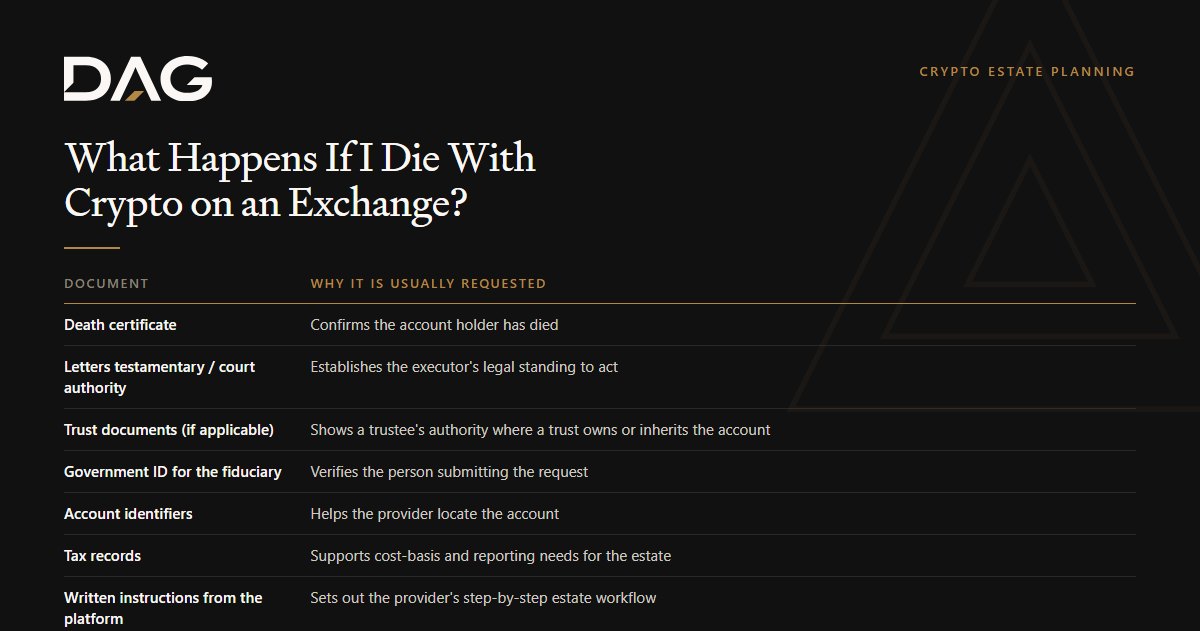
| Document | Why it is usually requested |
|---|---|
| Death certificate | Confirms the account holder has died |
| Letters testamentary / court authority | Establishes the executor's legal standing to act |
| Trust documents (if applicable) | Shows a trustee's authority where a trust owns or inherits the account |
| Government ID for the fiduciary | Verifies the person submitting the request |
| Account identifiers | Helps the provider locate the account |
| Tax records | Supports cost-basis and reporting needs for the estate |
| Written instructions from the platform | Sets out the provider's step-by-step estate workflow |
Because exchanges update these workflows, an executor should confirm the live checklist directly with the provider rather than relying on a saved list. The same principle applies across exchanges generally, which is why a broader crypto estate data room checklist helps keep records current.
Planning Before Death
Organizing records in advance generally shortens the process for fiduciaries. Useful steps:
- Document that the exchange account exists, without writing the password where it can be misused.
- Identify legal ownership of the assets so the estate plan and the account match.
- Keep tax records, since the IRS generally treats digital assets as property and the estate may face reporting on Form 1099-DA and capital-gains calculations.
- Make sure the executor or trustee knows how to contact the provider and where to find account identifiers.
Owners weighing whether to name the holdings in a will or route them through a trust can compare the two in crypto will vs crypto trust. These choices sit inside the broader discipline of crypto estate planning, and the Crypto Wealth Management Hub collects the related guidance.
Do Not Share Passwords Casually
Estate access should run through legal authority and the provider's procedures, not informal password sharing. Handing out login credentials can create security exposure while the owner is alive and may conflict with the platform's terms or the estate plan after death. A documented instruction routed to a fiduciary is generally safer than a shared password.
Related Questions
Does crypto on an exchange pass through probate?
It generally can. Assets held in an individual exchange account typically become part of the probate estate unless a trust or other structure holds them, so the executor's court authority is usually what unlocks access.
Can an exchange freeze or close an account when the holder dies?
Providers generally restrict an account once notified of a death and then reopen access only to a verified fiduciary who completes the estate process. Confirm the current procedure with the provider, since terms change.
Is custodial crypto safer for heirs than self-custody?
Neither is universally safer; they fail in different ways. Custodial accounts avoid lost-seed-phrase risk but depend on the provider staying solvent and accessible, while self-custody removes the intermediary but shifts full key-recovery responsibility to the family. No arrangement removes market, custody, or tax risk, and a qualified professional can help weigh the trade-offs.
Sources
Compliance Note
This article is educational and does not provide legal, tax, fiduciary, investment, or custody advice. Heirs should consult estate counsel and current provider procedures.