
This crypto trust and estate planning FAQ answers the questions families ask most about passing digital assets to heirs: whether a trust can own crypto, how to handle seed phrases without exposing them, what trustees and executors may do, and what happens when recovery information goes missing. Each answer is general and points back to qualified professional review.
Crypto trust and estate planning is the set of legal documents, custody arrangements, and records that decide who controls digital assets and how those assets transfer at death or incapacity. Because self-custodied crypto can be lost permanently without the private key, planning combines ordinary estate tools (wills, trusts, fiduciary authority) with custody and key-succession controls that ordinary estate plans never had to address. For broader framing, see crypto estate planning for high-net-worth families and the Crypto Trust Structures Hub.
Quick reference
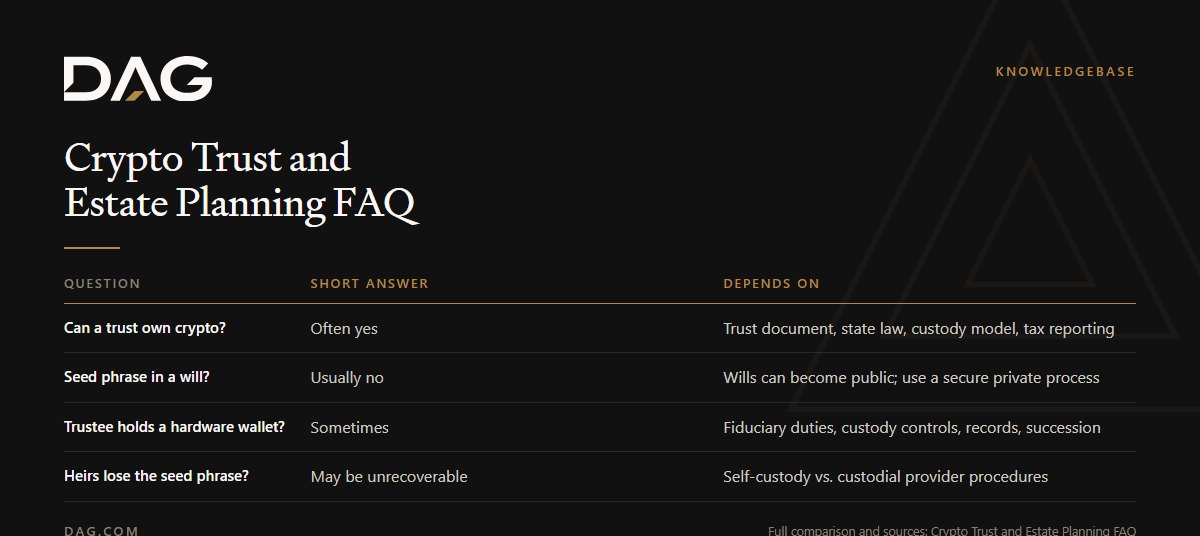
| Question | Short answer | Depends on |
|---|---|---|
| Can a trust own crypto? | Often yes | Trust document, state law, custody model, tax reporting |
| Seed phrase in a will? | Usually no | Wills can become public; use a secure private process |
| Trustee holds a hardware wallet? | Sometimes | Fiduciary duties, custody controls, records, succession |
| Heirs lose the seed phrase? | May be unrecoverable | Self-custody vs. custodial provider procedures |
Can a trust own crypto?
A trust may be able to own crypto when the trust document, applicable state law, custody model, fiduciary duties, and tax reporting process all support it. The practical questions are how the trust holds keys (a qualified custodian, multi-sig, or trustee-controlled cold storage) and who is authorized to transact. Confirm the structure with counsel; see trust structures for crypto wealthy individuals.
Should seed phrases be in a will?
Usually no. A will can become a public record once it enters probate, so placing recovery phrases in it can expose the assets it was meant to protect. Sensitive recovery information generally belongs in a secure private process kept separate from the public document. Private key succession planning covers how families do this without single points of failure.
What should heirs know?
Heirs should generally know four things: that the crypto exists, who holds legal authority, where instructions are located, and which professionals to contact. They do not need the keys in advance, they need a reliable path to them. See how do heirs access crypto after death for how that path is built.
Can a trustee hold a hardware wallet?
Possibly, but a trustee should first review their authority under the trust, their fiduciary duties, the custody controls in place, the records they must keep, and the succession procedure if they can no longer serve. A trustee holding keys directly takes on custody risk that a qualified custodian would otherwise carry. Crypto trustee duties walks through these obligations.
What happens if heirs cannot find the seed phrase?
Self-custodied crypto may be permanently unrecoverable without a valid recovery path, there is no provider to call and no password reset. Crypto held with a custodian may instead follow that provider's estate procedures. This contrast is the core trade-off in qualified custody vs self-custody for crypto wealth.
Related Questions
Does putting crypto in a trust remove tax obligations?
No. A trust changes who controls and who may inherit assets; it does not erase tax. The IRS generally treats digital assets as property, so transfers and sales can carry tax consequences regardless of the wrapper. Confirm treatment with a qualified tax professional.
Is a trust or a will better for crypto?
It depends on the facts. Wills pass through probate and can become public, while trusts can keep details private and provide continuous control during incapacity. Many plans use both. A qualified estate attorney should match the structure to your situation.
Does naming a trustee guarantee the crypto is secure?
No. Naming a fiduciary assigns authority, but security still depends on the custody model, key controls, records, and a tested succession procedure. Authority and operational security are separate problems, and both need attention.
Sources
Compliance Note
This FAQ is educational and does not provide legal, tax, fiduciary, estate, investment, or custody advice. Estate planning should be reviewed with qualified professionals.