
A crypto family office playbook is the written operating manual a family office uses to oversee digital assets across policy, custody, reporting, tax records, risk, estate planning, and committee governance. It turns scattered wallets and ad hoc decisions into documented workflows with named owners, a review cadence, and approval controls, so the family treats crypto as an ongoing program, not a one-off line item.
What a Crypto Family Office Playbook Covers
A family office is the private team that manages a wealthy family's investments, administration, and succession. When that family holds digital assets, the playbook defines how each function operates: who can move coins, where keys live, how gains are tracked for tax, and how heirs eventually gain access. The document sits alongside the family's broader crypto wealth management approach and gives the office a single reference for repeatable decisions. For the structural picture of how these pieces fit, see what a crypto family office is.
Crypto belongs in the office's operating system, not only on the balance sheet. Custody, transfer controls, and record-keeping need standing processes because digital assets settle irreversibly and self-custodied keys have no help desk.
Core Workflows
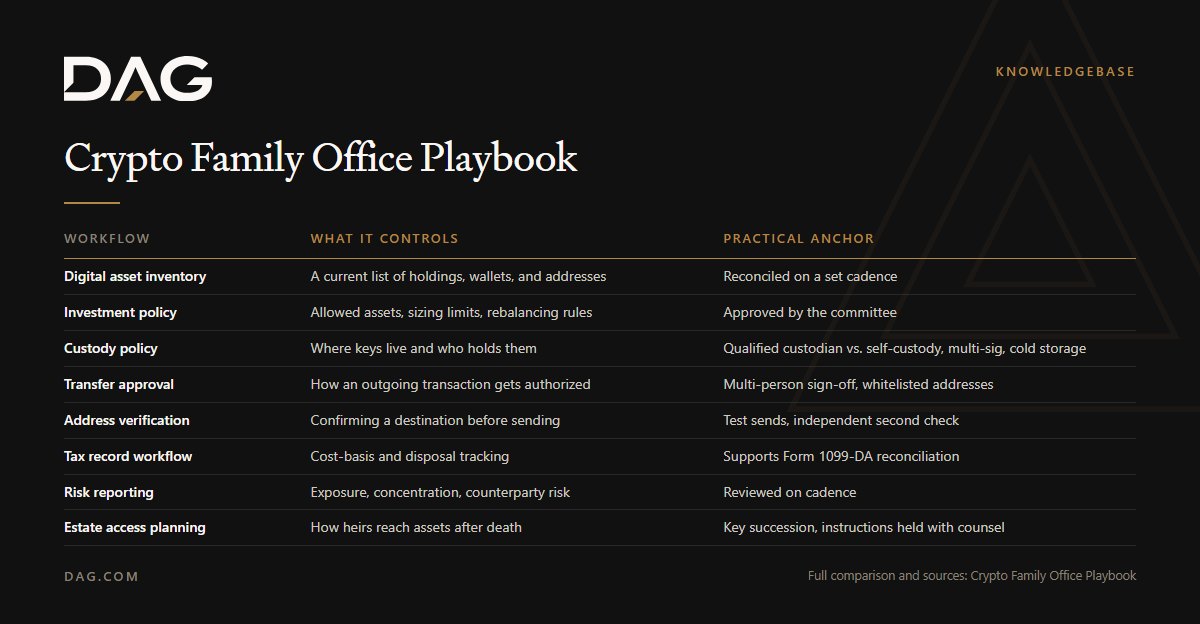
Each workflow below should have a written procedure, a named owner, and a defined trigger or schedule.
| Workflow | What it controls | Practical anchor |
|---|---|---|
| Digital asset inventory | A current list of holdings, wallets, and addresses | Reconciled on a set cadence |
| Investment policy | Allowed assets, sizing limits, rebalancing rules | Approved by the committee |
| Custody policy | Where keys live and who holds them | Qualified custodian vs. self-custody, multi-sig, cold storage |
| Transfer approval | How an outgoing transaction gets authorized | Multi-person sign-off, whitelisted addresses |
| Address verification | Confirming a destination before sending | Test sends, independent second check |
| Tax record workflow | Cost-basis and disposal tracking | Supports Form 1099-DA reconciliation |
| Risk reporting | Exposure, concentration, counterparty risk | Reviewed on cadence |
| Estate access planning | How heirs reach assets after death | Key succession, instructions held with counsel |
| Custodian annual review | Re-checking the custodian's controls | SOC 1 / SOC 2 reports, Form ADV where applicable |
| Incident response | Steps if keys or accounts are compromised | Defined roles, contact tree |
Custody choices sit at the center of most of these workflows. The custody policy should record whether assets are held with a qualified custodian under the SEC's custody framework or in some form of self-custody, and a custody due diligence checklist helps the office vet each provider's controls consistently. No custody model removes risk entirely, qualified custody concentrates trust in a third party, while self-custody concentrates operational and key-loss risk on the family.
Governance Cadence
Set a fixed schedule for reviewing exposure, custody status, tax-record completeness, liquidity, policy exceptions, and open issues. A regular cadence keeps small problems visible before they compound, and it creates a documented trail that supports the family's tax and estate work. Tie the tax portion to ongoing crypto tax planning for high-net-worth investors so reporting obligations are addressed during the year rather than at filing.
Team Roles
Name a specific owner for each function: investment decisions, custody oversight, reporting, tax coordination, estate coordination, and family communications. Roles can overlap in a small office, but accountability should not be ambiguous, the playbook should say who signs off on a transfer and who reviews the custodian. Estate and succession owners should also coordinate private key succession planning so access does not depend on a single person's memory.
Related Questions
What is the difference between a crypto family office playbook and an investment policy statement?
An investment policy statement generally covers asset allocation, sizing, and rebalancing rules. A crypto family office playbook is broader: it adds custody, transfer controls, tax record-keeping, estate access, and incident response. The investment policy is usually one section inside the wider playbook. The right scope depends on the family's facts; confirm with qualified advisers.
Does a family office need a qualified custodian for crypto?
It depends on how the assets are held and which rules apply to the family's structure and advisers. Registered investment advisers are generally subject to custody requirements that can involve a qualified custodian, while a family managing its own assets may face different considerations. This is a legal and regulatory question to review with qualified counsel rather than a fixed rule.
How should a family office track crypto for taxes?
The IRS generally treats digital assets as property, so each disposal can create a taxable gain or loss that depends on cost basis. A standing tax record workflow that captures acquisition dates, amounts, and basis supports accurate reporting and reconciliation against forms such as Form 1099-DA. Specific treatment depends on the facts; consult a qualified tax professional.
Sources
Compliance Note
This playbook is educational and does not provide legal, tax, investment, fiduciary, family office, or custody advice. Family office processes should be reviewed with qualified professionals. Registration does not imply a certain level of skill or training.