
This crypto wealth management FAQ answers the questions high-net-worth investors, family offices, and founders ask most often about coordinating digital assets: what a crypto wealth manager does, when you need one, how custody and Bitcoin ETFs differ, and which records to organize first. Answers are general and educational, not advice for your specific situation.
Crypto wealth management is the coordination of digital asset strategy, custody, taxes, estate planning, liquidity, reporting, and governance into a single plan rather than a set of disconnected accounts. For a fuller treatment, see what crypto wealth management is and the broader Crypto Wealth Management Hub. No approach removes market, custody, or tax risk; digital assets can be volatile and may lose value.
What is crypto wealth management?
Crypto wealth management coordinates digital asset strategy, custody, taxes, estate planning, liquidity, reporting, and governance. The aim is a connected plan: the way assets are held, taxed, transferred at death, and reported all reference one another instead of being decided in isolation.
When do I need a crypto wealth manager?
Generally, when crypto is material to your net worth, spread across multiple wallets or exchanges, connected to a liquidity event, or hard to report cleanly for taxes and estate planning. The trigger is usually complexity rather than a fixed dollar threshold. If you are weighing this decision, how to choose a crypto wealth manager walks through what to look for.
Is a crypto wealth manager the same as a crypto broker?
No. A broker typically helps execute transactions. A crypto wealth manager coordinates the broader planning architecture around the assets, custody, tax, estate, and governance, and may engage other professionals. Note that registration as an investment adviser describes a regulatory status; it does not by itself guarantee skill or results.
Should I use a Bitcoin ETF or direct Bitcoin?
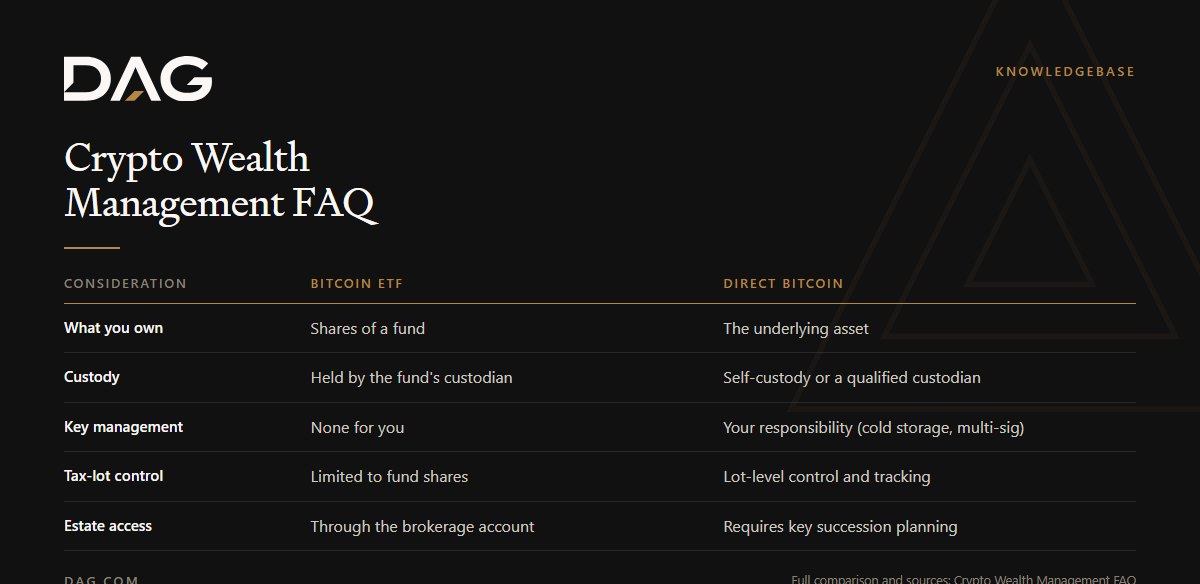
It depends on the facts. A Bitcoin ETF offers price exposure inside a familiar brokerage wrapper but no direct ownership of the underlying coins. Direct Bitcoin gives ownership and custody control along with the responsibility for key management, tax-lot tracking, and estate access. The comparison below is general; consult a qualified professional before deciding.
| Consideration | Bitcoin ETF | Direct Bitcoin |
|---|---|---|
| What you own | Shares of a fund | The underlying asset |
| Custody | Held by the fund's custodian | Self-custody or a qualified custodian |
| Key management | None for you | Your responsibility (cold storage, multi-sig) |
| Tax-lot control | Limited to fund shares | Lot-level control and tracking |
| Estate access | Through the brokerage account | Requires key succession planning |
Neither option is FDIC- or SIPC-insured against market loss, and neither offers guaranteed yield or a stable value.
What records should I organize first?
Start with a wallet and account inventory, account statements, full transaction history, cost basis support, and legal ownership records. Clean records make tax reporting and estate transfer far easier. For tax-year reporting, see what Form 1099-DA is; the IRS generally treats digital assets as property, so each disposal can be a taxable event with its own cost basis.
Related Questions
Is my crypto safe with a wealth manager?
No arrangement removes custody or market risk. A wealth manager generally coordinates custody rather than personally holding your keys, and assets may sit with a qualified custodian under written agreements. Safety depends on the specific structure, the custodian's controls (such as SOC 1/SOC 2 reporting), and your own key practices.
Does a crypto wealth manager handle my taxes?
Usually they coordinate tax planning and reporting alongside a qualified tax professional rather than replacing one. Because digital assets are generally taxed as property, accurate cost basis and transaction records matter; outcomes depend on your facts and current law.
What happens to my crypto when I die?
Without a succession plan, heirs may be unable to access keys, and the assets can be effectively lost. Estate planning for digital assets generally pairs legal documents with a secure method for transferring access. Consult a qualified estate attorney about your situation.
Sources
Compliance Note
This FAQ is educational and does not provide legal, tax, investment, fiduciary, or custody advice. Investors should consult qualified professionals.