
This crypto family office FAQ answers the questions families most often raise when they coordinate digital asset wealth: how a crypto family office differs from a custodian, what a custody policy should cover, how stablecoins are handled, and which reports matter. Answers are general and educational, not advice for any specific situation.
A crypto family office is the operating model that coordinates a family's digital asset wealth across investment policy, custody, tax records, reporting, estate planning, and governance. It does not replace specialist providers; it ties them together under one set of controls. The function sits within broader crypto wealth management and depends heavily on sound digital asset custody arrangements.
What is a crypto family office?
A crypto family office coordinates digital asset wealth across investment policy, custody, tax records, reporting, estate planning, and family governance. Think of it as the control layer above individual vendors. The exact scope depends on the family's holdings, jurisdictions, and goals, so the right structure varies and is worth reviewing with qualified advisers.
How is it different from a crypto custodian?
A custodian holds or safeguards the assets themselves; a qualified crypto custodian typically holds client assets under arrangements meant to satisfy the SEC custody rule and may provide SOC 1 or SOC 2 reports. A crypto family office coordinates the broader operating model around those assets, policy, approvals, reporting, and succession, and usually relies on one or more outside custodians rather than holding keys itself.
Should a family office have a crypto custody policy?
Yes. A written policy is the backbone of family office crypto custody. A useful policy generally defines:
- Approved custodians and wallet types (for example, qualified custody versus self-custody, cold versus hot wallets)
- Authorized signers and any multi-signature or quorum requirements
- Transfer approval thresholds and dual-control steps
- Address verification and whitelisting before any transfer
- Reporting cadence and who reviews exceptions
No policy removes custody, market, or operational risk; it is meant to reduce avoidable error. Families weighing custody models can compare qualified custody versus self-custody before committing.
Can a family office hold stablecoins?
Possibly, but a family office should review issuer risk, reserve disclosures, custody, transfer controls, legal ownership, and tax records before holding stablecoins. A stablecoin's name does not guarantee its peg, and these instruments are not FDIC- or SIPC-insured. Treat the analysis as facts-and-circumstances and confirm the tax treatment with a qualified professional, since the IRS generally treats digital assets as property.
What reports should a family office maintain?
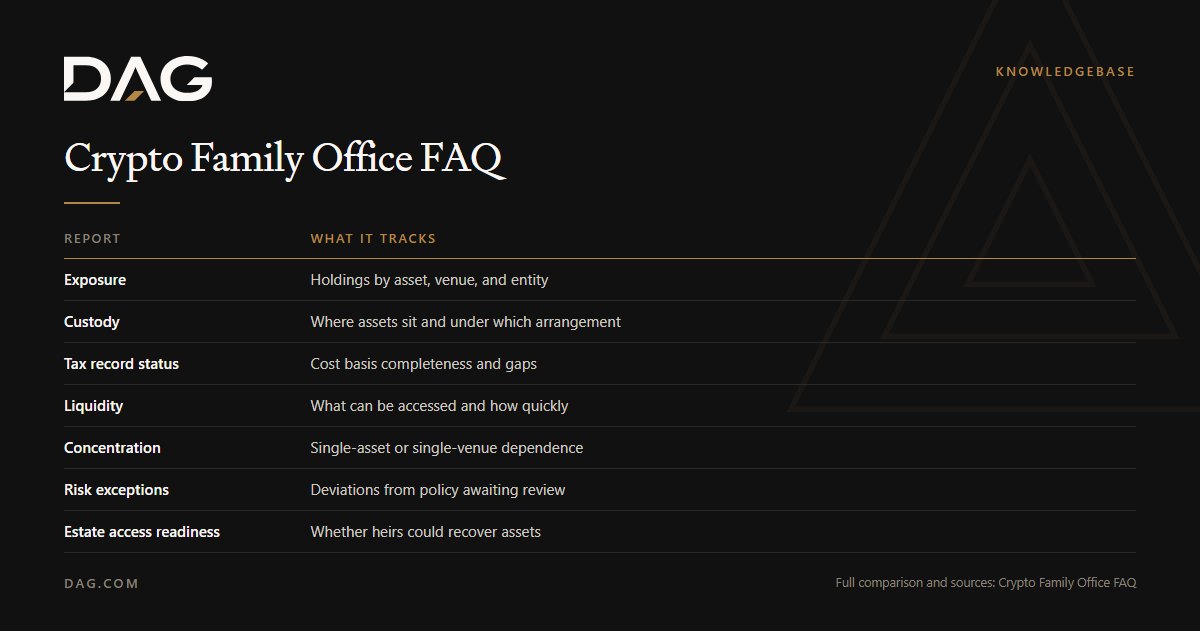
Reporting is where governance becomes visible. Common reports include:
| Report | What it tracks |
|---|---|
| Exposure | Holdings by asset, venue, and entity |
| Custody | Where assets sit and under which arrangement |
| Tax record status | Cost basis completeness and gaps |
| Liquidity | What can be accessed and how quickly |
| Concentration | Single-asset or single-venue dependence |
| Risk exceptions | Deviations from policy awaiting review |
| Estate access readiness | Whether heirs could recover assets |
Tax record gaps are common with older holdings; see how to reconstruct crypto cost basis for the general approach, and remember that estate readiness ties directly to private key succession planning.
Related Questions
Does a family office need a separate legal entity for crypto?
Often families use an entity such as an LLC or trust to hold digital assets for liability and succession reasons, but whether that fits depends on the facts. The trade-offs are general and should be reviewed with qualified legal and tax advisers.
Is a registered adviser required to run a crypto family office?
Not necessarily, and the answer turns on the services provided and applicable regulation. Note that registration alone does not guarantee skill or good outcomes; it is one factor among many when evaluating who coordinates the family's assets.
How does a crypto family office reduce key-person and custody risk?
Generally through written policy, multiple authorized signers, multi-signature controls, documented succession, and independent reporting. These controls aim to reduce avoidable risk; none of them eliminate market, custody, or operational risk entirely.
Sources
Compliance Note
This FAQ is educational and does not provide legal, tax, investment, fiduciary, family office, or custody advice. Family offices should consult qualified professionals.