
There is no single safest method, but a family office can make crypto storage lower-risk by layering it: qualified institutional custody for core holdings, legal entity ownership, documented governance controls, and a limited self-custody sleeve for operations. Each layer offsets a different failure, reducing, though never eliminating, the chance that one event causes catastrophic loss. For a full overview of the institutional crypto custody landscape and for implementation detail specific to family offices, see crypto custody for family offices.
What Does "Crypto Custody" Mean for a Family Office?
Custody refers to who holds the private keys that control a digital asset and under what legal, operational, and technical framework. For family offices, this question carries extra weight: generational wealth must survive personnel changes, legal disputes, succession events, and operational failures, often simultaneously. No single custody method addresses all of these exposures, which is why a layered structure is generally preferable to any single-method approach.
Why Single-Solution Custody Creates Unacceptable Concentration Risk
Most custody failures at the family-wealth level trace back to a single point of failure:
- Hardware wallets reduce remote-hack exposure but create succession gaps and carry no insurance.
- Exchange storage offers convenience but introduces counterparty risk, commingling of assets, and account-freeze risk.
- Institutional custody alone provides professional management and insurance but can create operational delays and third-party dependency.
Layering these methods so that each layer compensates for a different class of risk is how family offices generally reduce overall exposure.
How to Build a Layered Crypto Custody Structure
Step 1. Establish Legal Entity Ownership
Hold cryptocurrency through an LLC or trust rather than directly in the family office's name. This creates:
- Liability separation: assets in a properly structured entity are generally more difficult for creditors to reach than assets held directly.
- Governance scaffolding: formal authorization procedures, multi-party approval thresholds, and documented succession rules can be built into an operating agreement or trust document.
- Estate planning integration: ownership transfers according to predetermined instructions rather than informal arrangements.
Consult a qualified estate or trust attorney before forming the entity; state law (particularly Wyoming) affects available protections. See should crypto be held personally, in an LLC, or in a trust for a comparison of structure options.
Step 2. Place Core Holdings With a Qualified Custodian
The bulk of a family office's digital assets typically belongs with a regulated, qualified custodian, not an exchange. Qualified custodians generally offer:
- Crime insurance that may cover certain assets against specific perils (coverage limits, exclusions, and scope vary by custodian and change over time; verify current terms directly with the custodian, and note this does not function like FDIC or SIPC protection)
- Bankruptcy-remote segregated accounts: your assets are legally separated from the custodian's balance sheet in the event of custodian insolvency
- HSM-grade key management: institutional hardware security modules rather than individual key holders
- Audit-ready reporting: transaction documentation that supports accounting, tax reporting, and regulatory compliance
Institutional custody is not risk-free. Custodian failure, operational errors, or regulatory action remain possible exposures. See what happens if a crypto custodian fails and crypto custody for family offices for a fuller risk picture.
Step 3. Implement Documented Governance Controls
Custody infrastructure alone does not prevent unauthorized or erroneous transactions. Governance controls address internal operational risk:
| Control | Purpose | Example threshold |
|---|---|---|
| Separation of duties | No single person initiates and executes a transfer | Proposer, approver, and executor are different individuals |
| Transaction approval tiers | Escalating oversight as transaction size increases | Tiered signature requirements that rise with transfer size (illustrative only; thresholds should be set by the family office's own governance policy) |
| Access rights reviews | Confirm that current personnel have appropriate permissions | Quarterly |
| Incident response procedures | Defined steps for a suspected breach or key compromise | Written and tested annually |
Multi-signature (multisig) wallets and MPC (multi-party computation) custody both support separation of duties; they address the risk differently. See MPC vs multi-sig custody for the technical trade-offs.
Step 4. Maintain a Limited Self-Custody Sleeve for Operations
Not all holdings belong in institutional custody. Family offices that trade actively, participate in DeFi protocols, or require immediate access without approval delays generally maintain a small self-custody component.
The self-custody allocation should be:
- Small relative to total holdings: sized to operational needs rather than used as a primary storage method; the appropriate percentage depends on the family office's operational requirements and risk tolerance, and should be set deliberately rather than by any rule of thumb
- Documented in the custody policy: quantity, purpose, key-holder(s), and review cycle stated in writing
- Succession-tested: recovery phrases stored securely, locations known to designated successors, and recovery procedures tested before they are needed
See hardware wallet estate planning and seed phrase storage for estate planning for self-custody succession specifics.
Step 5. Integrate Succession Planning
A custody structure that works during normal operations but fails at death or incapacity has not solved the family office's core problem.
- Institutional custody accounts should carry proper beneficiary designations and authorization documentation for successor decision-makers.
- Self-custody recovery information (seed phrases, hardware wallet locations) must be documented, stored securely (not in the same physical location as the device), and accessible to designated successors.
- The operating agreement or trust document should specify who has signing authority when primary decision-makers are unavailable.
See crypto inheritance planning for high-net-worth families and private key succession planning for a fuller treatment.
Custody Approach Comparison
| Approach | Key strengths | Key limitations |
|---|---|---|
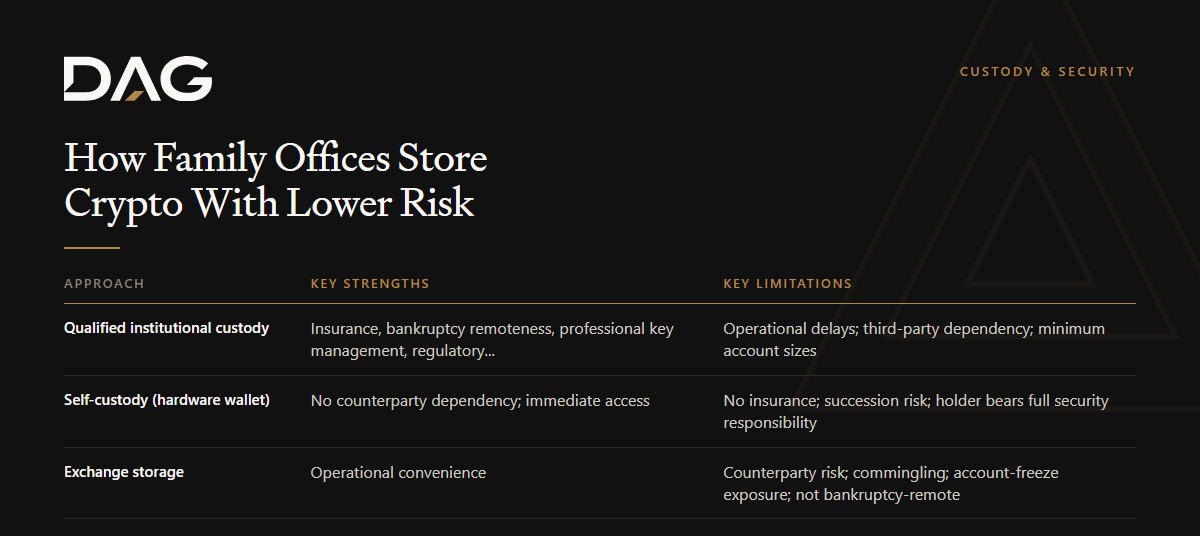
| Qualified institutional custody | Insurance, bankruptcy remoteness, professional key management, regulatory compliance support | Operational delays; third-party dependency; minimum account sizes |
| Self-custody (hardware wallet) | No counterparty dependency; immediate access | No insurance; succession risk; holder bears full security responsibility |
| Exchange storage | Operational convenience | Counterparty risk; commingling; account-freeze exposure; not bankruptcy-remote |
| Multisig / MPC governance overlay | Reduces single-point-of-failure for key control | Adds operational complexity; requires documented recovery procedures |
Related Questions
Does geographic distribution of custody add meaningful protection?
Distributing custody across multiple qualified custodians in different jurisdictions can reduce the impact of a single custodian failure, regulatory action in one jurisdiction, or a localized operational disruption. The trade-off is added operational complexity, increased reporting overhead, and additional KYC/AML onboarding requirements. See should a family office use more than one crypto custodian for a structured analysis.
Does crypto custody insurance fully cover losses?
Crypto crime insurance policies issued by institutional custodians typically cover theft caused by hacking, fraud, and employee misconduct up to the policy limit. They do not function like FDIC or SIPC protection. Coverage limits, exclusions, deductibles, and claim procedures vary materially by custodian and policy year. A family office should review the custodian's current policy terms and consider whether supplemental coverage is warranted. See crypto insurance and custody.
What compliance documentation does a family office need to support institutional custody?
Family offices typically need entity formation documents (operating agreement or trust instrument), beneficial ownership information, AML/KYC documentation, and an investment policy statement or custody policy before opening an institutional custody account. Ongoing obligations include transaction records, audit reports, and tax reporting support. See crypto custody due diligence checklist and family office crypto custody policy.
Sources
- SEC, Custody of Digital Asset Securities by Special Purpose Broker-Dealers, Release No. 34-90788 (Dec. 23, 2020): https://www.sec.gov/rules/policy/2020/34-90788.pdf
- SEC, Commission Interpretation Regarding the Custody Rule for Digital Asset Securities, Release No. IA-5528 (Sept. 23, 2019): https://www.sec.gov/rules/interp/2019/ia-5528.pdf
- OCC, Interpretive Letter 1170, Authority of a National Bank to Provide Cryptocurrency Custody Services (July 22, 2020): https://www.occ.gov/topics/charters-and-licensing/interpretations-and-actions/2020/int1170.pdf
- Wyoming Statutes §§ 17-31-101 et seq. (Wyoming Digital Asset Statutes): https://law.justia.com/codes/wyoming/title-17/chapter-31/
Compliance Note
This page is educational only and does not constitute legal, tax, investment, or financial advice. Custody approaches involve material risks, including but not limited to custodian insolvency, hacking, operational error, regulatory change, and loss of private keys. No custody structure eliminates these risks. Insurance coverage provided by institutional custodians is limited, does not function like FDIC or SIPC protection, and is subject to policy terms that change over time, verify current coverage directly with any custodian. All references to transaction thresholds, allocation percentages, and custodian features are illustrative only; actual parameters should be set by qualified legal, compliance, and financial professionals based on your specific circumstances. Digital Ascension Group does not guarantee any outcome. Advisory services are provided by DAG Wealth, an SEC-registered investment adviser. Registration does not imply a certain level of skill or training. Entity formation, trust and estate drafting, and operating-agreement drafting are legal services; the firm coordinates these and does not provide legal advice. Consult a qualified attorney, CPA, and registered investment adviser before making custody, entity structure, or estate planning decisions.