
To fund a crypto IRA with XRP, open a self-directed IRA with a qualified custodian that supports XRP, move cash in via a direct transfer, rollover, or new cash contribution, then direct the custodian to buy XRP for the account, a process that starts with understanding institutional crypto custody options. You cannot contribute XRP you already own; IRA contributions must be made in cash.
What Is a Self-Directed IRA for Cryptocurrency?
A self-directed IRA (SDIRA) is an IRA that permits alternative assets, including cryptocurrency, beyond the stocks and bonds available at conventional custodians. The key structural rule: the custodian holds the assets and executes purchases on the account's behalf. You direct what to buy; you do not hold the private keys personally. The IRA is on the wallet, not you.
That structure is what preserves tax-deferred or tax-free treatment. Taking personal custody of IRA assets triggers an immediate distribution, which is taxable and subject to penalty if you are under 59½.
Any purchase or transaction involving a qualified crypto custodian must go through the custodian's systems, not through a personal wallet or exchange account.
How to Fund a Crypto IRA With XRP: Step by Step
Step 1. Choose a custodian that specifically supports XRP
Not every SDIRA custodian supports digital assets, and not every one that does supports XRP. XRP settles on the XRP Ledger, requires destination tags for certain transfers, and has faced periods of U.S. regulatory uncertainty that led some custodians to limit or suspend XRP trading. Confirm XRP availability before initiating any transfer.
Evaluate each candidate on:
- IRS compliance for self-directed IRAs
- Custody infrastructure (cold storage, insurance, SOC 2)
- XRP-specific trading and settlement capability
- Tax reporting: Form 5498 (contributions), Form 1099-R (distributions), year-end fair market value reporting
- Fee structure (annual, trading, transfer-out)
See how to choose a crypto custodian for a full due diligence framework, and crypto custody due diligence checklist for the specific items to verify.
Step 2. Open the self-directed IRA
Complete the custodian's account application, including entity documentation and beneficiary designation. Decide at this step whether to open a Traditional or Roth SDIRA, the tax treatment differs significantly (see Tax Treatment section below).
Step 3. Fund the account with cash
There are three valid methods:
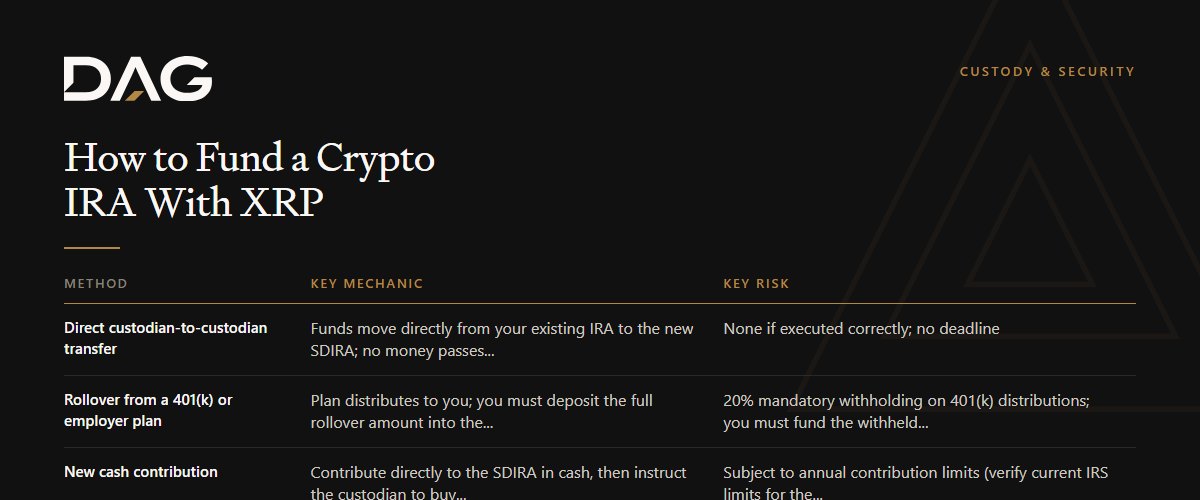
| Method | Key mechanic | Key risk |
|---|---|---|
| Direct custodian-to-custodian transfer | Funds move directly from your existing IRA to the new SDIRA; no money passes through your hands | None if executed correctly; no deadline |
| Rollover from a 401(k) or employer plan | Plan distributes to you; you must deposit the full rollover amount into the IRA within 60 days | 20% mandatory withholding on 401(k) distributions; you must fund the withheld amount out of pocket and reclaim it at filing; missing the 60-day window converts the shortfall to a taxable distribution plus 10% penalty if under 59½ |
| New cash contribution | Contribute directly to the SDIRA in cash, then instruct the custodian to buy XRP | Subject to annual contribution limits (verify current IRS limits for the applicable tax year) and earned-income eligibility |
What does not work: contributing XRP you already own. IRA contributions must be made in cash (IRC §408(a)(1)), so an in-kind transfer of crypto you hold personally is not a valid contribution. Dealing directly between your IRA and yourself can also raise prohibited-transaction concerns under IRC §4975 (self-dealing). The consequences can be severe: an excess or invalid contribution carries an excise tax, and a prohibited transaction can disqualify the entire IRA, making the full account balance immediately taxable plus penalties. Confirm the correct mechanics with a qualified tax professional.
Step 4. Instruct the custodian to purchase XRP
Once cash is in the SDIRA, submit a purchase direction to the custodian. The custodian executes the trade through its exchange relationships and holds the resulting XRP in custody under the IRA account structure.
The purchase price becomes the IRA's cost basis for the position. Because Traditional IRA distributions are taxed as ordinary income, not capital gains, the basis matters less than it would in a taxable account. What matters more is fair market value at year-end for IRS reporting and at the time of any distribution.
Tax Treatment: Traditional vs. Roth SDIRA
Traditional IRA: XRP grows tax-deferred. Contributions may be deductible (depending on income and whether you have a workplace plan). You pay ordinary income tax on distributions in retirement. Gains inside the account are not subject to capital gains tax, the appreciation is taxed as income when distributed.
Roth IRA: XRP grows tax-free on qualified distributions. Contributions are made with after-tax dollars; the appreciation escapes tax entirely if you meet the holding-period and age requirements (generally age 59½ and five years since first Roth contribution). Roth IRAs also have no Required Minimum Distributions during the account owner's lifetime.
Which structure makes sense depends on your current income, expected retirement income, and your view of future tax rates. DAG coordinates with qualified tax professionals on IRA structure selection; this page is educational and not tax or legal advice.
Required Minimum Distributions and XRP Concentration
Traditional SDIRAs are subject to Required Minimum Distributions (RMDs) starting at age 73 (verify current IRS rules. SECURE 2.0 changed the RMD age and rules may be updated). Each year, a calculated percentage of the account balance must be distributed and is taxable as ordinary income.
If most of a Traditional IRA is in XRP and XRP has appreciated, the RMD calculation may require liquidating a portion of the position at the current price, regardless of whether that is a price you would otherwise choose to sell at. Planning ahead, either by converting to Roth before RMDs begin, or by keeping enough liquid assets in the IRA to cover RMDs without forced XRP sales, is worth addressing well before age 73.
Cryptocurrency is volatile. The account balance used to calculate an RMD may differ significantly from the balance at year-end when the distribution is actually taken. See crypto concentration risk management for broader context.
Related Questions
Can I roll over a 401(k) directly into a crypto IRA holding XRP?
Yes, with important mechanics to plan for. A direct rollover (custodian-to-custodian) avoids the 20% withholding requirement and is the cleaner path. An indirect rollover, where the 401(k) plan distributes the funds to you, triggers mandatory 20% withholding, and you must deposit the full pre-withholding amount into the IRA within 60 days to avoid a taxable distribution. The withheld amount is reclaimed when you file taxes, but you must fund it out of pocket in the interim.
What happens if I try to contribute XRP I already own to an IRA?
It is not a valid contribution. IRA contributions must be made in cash (IRC §408(a)(1)), and the IRS does not permit in-kind contributions of cryptocurrency into an IRA. An invalid or excess contribution carries an excise tax, and dealing directly between your IRA and yourself can also raise prohibited-transaction concerns under IRC §4975, which, if triggered, can disqualify the entire IRA, making the full account balance immediately taxable in the year of the transaction, plus the 10% early withdrawal penalty if you are under 59½. All IRA contributions must be cash.
Are there contribution limits on a crypto IRA?
Contribution limits for SDIRAs are the same as for conventional IRAs, they are not separately capped for alternative assets. The IRS sets annual contribution limits that adjust periodically for inflation; verify the current limits at IRS.gov before contributing. Limits also depend on earned income, you cannot contribute more than your earned income for the year, and Roth IRA eligibility phases out above certain income thresholds. Rollovers and transfers from other qualified plans are not subject to the annual contribution limits.
Do all crypto IRA custodians support XRP?
No. Some custodians have limited or suspended XRP trading during periods of regulatory uncertainty. Before opening an account or initiating a transfer, confirm that XRP is currently supported for both purchase and custody at the specific custodian you are evaluating. Custodian capabilities change; verify current status directly.
Internal Links
- Crypto IRA vs Crypto Family Office Structure, compare the IRA structure against a family office approach for larger positions
- How to Choose a Crypto Custodian, due diligence framework for evaluating custodians
- Crypto Custody Due Diligence Checklist, item-by-item custodian evaluation list
- Qualified Custodian vs Crypto Exchange, why a qualified custodian is required for IRA assets, not a retail exchange
- Crypto Concentration Risk Management, managing a concentrated XRP position inside a retirement account
- Crypto Tax Planning for HNW Investors, broader tax strategy context for crypto retirement accounts
Sources
- IRS, "Self-Directed IRAs and the Risk of Fraud", https://www.irs.gov/retirement-plans/self-directed-iras
- IRS, Publication 590-A, "Contributions to Individual Retirement Arrangements (IRAs)", https://www.irs.gov/publications/p590a
- IRS, Publication 590-B, "Distributions from Individual Retirement Arrangements (IRAs)", https://www.irs.gov/publications/p590b
- IRC §4975 (Prohibited Transactions), https://uscode.house.gov/view.xhtml?req=granuleid:USC-prelim-title26-section4975
- SECURE 2.0 Act of 2022 (RMD age changes), verify current RMD age at IRS.gov
Compliance Note
This page is for educational purposes only and does not constitute legal, tax, or investment advice. Self-directed IRAs involve complexity and risk, including the risk of prohibited transactions that can disqualify the account and result in immediate taxation of the full balance. Contribution limits, RMD rules, and custodian eligibility requirements are subject to change; verify current figures with the IRS or a qualified tax professional before acting. Cryptocurrency is volatile and may lose value; past performance does not indicate future results. Consult a qualified tax attorney, CPA, and financial advisor before establishing or funding a self-directed IRA. DAG coordinates custodian onboarding and does not provide legal or tax advice. Advisory services are provided by DAG Wealth, an SEC-registered investment adviser. Registration does not imply a certain level of skill or training.