
Setting up successor trustees for a crypto trust takes more than naming someone in a legal document. A qualified successor trustee needs both the fiduciary authority granted by the trust instrument and a documented, tested path to private keys, custody accounts, and hardware wallets, part of the crypto trust structures challenge unique to digital assets. Without that path, legal authority over the assets is meaningless.
What is a successor trustee for a crypto trust?
A successor trustee is the individual or institution named in a trust document to assume management when the original trustee dies, becomes incapacitated, or resigns. For a trust holding digital assets, the role combines standard fiduciary duties, managing assets in beneficiaries' interests, handling tax compliance, and making distributions per the trust instrument, with operational responsibility for accessing and transacting cryptocurrency.
Unlike a bank account or brokerage, there is no institution to call. Control of on-chain assets lives in the private keys. If the successor trustee cannot locate the hardware wallet, has no access to the seed phrase, and cannot authenticate into custody accounts, the trust assets may be permanently inaccessible regardless of what the legal documents say.
How does a crypto trust succession differ from a traditional trust?
Traditional successor trustees contact financial institutions, present authority documentation (death certificate, letters of trusteeship), and the institution transfers the account. Custody platforms can follow a similar process, but only if the platform was notified of the trust structure in advance and the trustee meets the platform's documentation requirements.
Self-custodied assets have no equivalent mechanism. Control is cryptographic, not institutional. This creates two distinct succession problems that must both be solved:
- Legal succession: the trust document must grant the successor explicit authority to manage, transact, and liquidate digital assets, including the power to engage crypto custodians and advisors.
- Technical succession: the trustee must have a documented, tested path to the private keys or institutional access credentials before they are needed.
Most traditional estate plans address only the first problem.
How to select a successor trustee for a crypto trust
What qualities should a crypto successor trustee have?
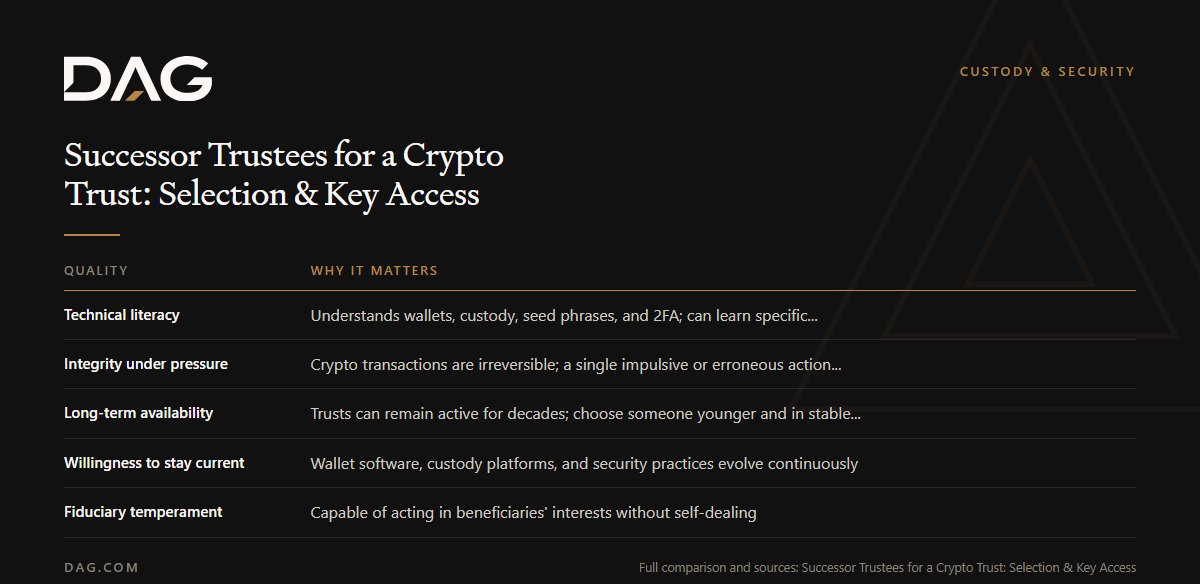
| Quality | Why it matters |
|---|---|
| Technical literacy | Understands wallets, custody, seed phrases, and 2FA; can learn specific procedures |
| Integrity under pressure | Crypto transactions are irreversible; a single impulsive or erroneous action can destroy assets |
| Long-term availability | Trusts can remain active for decades; choose someone younger and in stable circumstances |
| Willingness to stay current | Wallet software, custody platforms, and security practices evolve continuously |
| Fiduciary temperament | Capable of acting in beneficiaries' interests without self-dealing |
The trustee does not need to be a crypto expert, but they need enough comfort with technology to follow documented procedures carefully and ask questions when uncertain. A trustworthy but technically incapable trustee is the wrong choice for digital asset responsibilities. Consider naming separate trustees for traditional and digital assets, or naming a co-trustee with technical skills for the digital asset portion.
Should a corporate trustee manage crypto trust assets?
Institutional trustees, trust companies, banks with trust departments, can provide continuity that individual trustees cannot, though as of 2026 many do not yet support self-custodied digital assets, and this is changing as the market evolves. Qualified institutional custody through platforms such as those offering regulated crypto custody for trusts may be a workable alternative. See crypto custody for trusts for current platform options.
A directed trust structure, where the trustee administers the trust while a separate investment director handles digital asset decisions, may allow an institutional trustee to serve while a technically capable advisor manages the crypto side. See directed trusts for digital assets for how this structure operates.
How to set up key-access succession for a crypto trust
Step-by-step: building a successor trustee access plan
Inventory every asset and access path. Document each wallet (hardware and software), custody account, exchange account, and staking position. For each, record: device type and physical location, login credentials location, 2FA method and backup codes location, and the recovery phrase storage method.
Choose a key-access succession model. Three approaches, in order of security-to-complexity:
- Institutional custody: move assets to a regulated custodian that supports trust account structures and has documented trustee-transition procedures. Highest continuity, least technical burden on the successor trustee. See crypto custody for trusts.
- Multisig or MPC arrangement: configure wallets to require 2-of-3 or similar signature thresholds. You hold one key, the successor trustee holds one, a neutral third party (estate attorney or institutional custodian) holds one. No single party can act alone; no single death locks the assets. See MPC vs multi-sig custody.
- Sealed-instruction protocol: recovery phrases and access instructions are stored in sealed, tamper-evident envelopes with an estate attorney or in a notarized letter of instruction. The successor trustee receives the location, not the secrets themselves, until succession is triggered.
Never share private keys or seed phrases in plaintext over email, messaging apps, or unencrypted documents.
Draft a digital asset letter of instruction. This document, separate from the trust itself, provides step-by-step access procedures. Include device locations, where sealed instructions are held, custody platform contact procedures, and the name of the technical advisor to call first. See what is a digital asset letter of instruction for what this document should contain.
Train the successor trustee on your actual setup. Walking through legal documents is not preparation. Show the trustee where hardware devices are stored. Explain custody account login and 2FA. Practice a small transaction on a test wallet (not your main holdings) so the trustee understands the process before it matters.
Document the succession trigger procedures. The trust instrument and any accompanying protocols should specify what documentation the successor trustee needs to present to custody platforms (death certificate, letters of trusteeship, trust certification) and who coordinates the transition.
Review annually. Custody platforms change. Software wallets update. Security practices evolve. Set a calendar review each year: verify each wallet is accessible, confirm the trustee still knows where everything is, update any outdated procedures, and document changes.
What should the trust document say about digital assets?
The trust instrument should explicitly authorize the trustee to:
- Hold, manage, and transact cryptocurrency and other digital assets
- Engage qualified crypto custodians and advisors
- Execute wallet management decisions, including key rotation and platform migration
- Manage volatile assets without being held to a traditional prudent investor standard as applied to price fluctuations alone
Without explicit digital asset authority, a successor trustee may face uncertainty about the scope of their powers, particularly for less familiar assets or DeFi positions. See what trust provisions should cover digital assets for specific language guidance.
Common mistakes that result in inaccessible assets
- Naming a trustee without technical capability. A trustee who cannot locate a hardware wallet or recognize a seed phrase cannot fulfill the role, regardless of trust or family relationship.
- Overcomplicating access procedures. Security arrangements so elaborate that only the grantor understands them, split seed phrases across five locations with complex retrieval logic, often fail exactly when succession is triggered. Security that the successor trustee cannot execute is not security.
- Leaving documentation outdated. Changing custody providers, adding wallets, or modifying 2FA without updating the trustee's instructions makes prior documentation useless.
- Treating crypto like traditional assets. The estate attorney who handled the trust drafting and the financial advisor managing traditional accounts may both lack crypto-specific knowledge. Crypto succession requires specialized coordination. See common crypto estate planning mistakes.
- Assuming incapacity is handled. Death is not the only trigger. Incapacity, whether temporary or permanent, requires the same access infrastructure. The successor trustee needs the same path to keys whether the grantor is deceased or in a hospital.
Professional coordination for crypto trust succession
DAG coordinates the technical side of successor trustee preparation: access protocol documentation, custody platform setup, trustee training on actual procedures, and annual review scheduling. This coordination supplements, and does not replace, legal and tax counsel.
An estate attorney is needed to draft trust provisions granting adequate digital asset authority and to hold sealed access instructions as part of the trustee transition protocol. Not all estate attorneys have crypto-specific experience; see crypto planning for estate attorneys for what to look for.
Tax advisors need to address step-up in basis at death, cost basis reporting for trust-held assets, and the tax implications of distributions to beneficiaries. These differ from traditional securities. See crypto tax reporting for trusts for current reporting requirements.
Custody platforms, particularly institutional custodians, may require advance documentation: trust certification, trustee identification, and authorization letters before they will recognize a successor trustee's authority. These requirements should be confirmed and satisfied before succession is triggered.
Related Questions
Can a successor trustee be held liable for crypto losses in a trust?
Yes. Successor trustees have fiduciary duties and may be liable for losses resulting from imprudent decisions, failure to diversify, unauthorized transactions, or negligence in managing digital assets. Liability exposure is one reason the trust document should grant clear authority and the trustee should document their decision-making. See can a trustee be liable for crypto losses for how courts have approached this.
What happens if the successor trustee cannot access a hardware wallet?
If private keys and seed phrases are not accessible to the successor trustee, the assets may be permanently lost, regardless of legal authority. There is no recovery path for on-chain assets without the private key or seed phrase. This outcome is preventable with advance documentation and an access protocol; it is not recoverable after the fact. See what happens if I die with crypto in a hardware wallet.
Should the successor trustee know the seed phrase before succession is triggered?
Generally, no, and sharing a seed phrase directly creates its own security and legal risks. The preferred approach is a sealed-instruction or institutional custody structure where the trustee knows where to find the access information when succession is triggered, but does not hold it in plaintext in advance. See private key succession planning and seed phrase storage for estate planning for current best practices.
Does a successor trustee need technical crypto training?
Yes. Naming a trustee in a legal document does not prepare them to manage digital assets. They need to walk through your specific setup, understand each wallet and custody account, practice transaction procedures on a test wallet, and know where access documentation is held. Annual review keeps them current as technology changes.
Sources
- Uniform Trust Code (UTC), Article VII (Trustee's Powers and Duties), https://www.uniformlaws.org/committees/community-home?CommunityKey=193ff839-7955-4846-8f3c-ce74ac23938d
- Uniform Fiduciary Income and Principal Act (UFIPA) 2018, https://www.uniformlaws.org/committees/community-home?CommunityKey=2b9dbd7f-2f8a-4b36-9fe3-44e924bb3eea
- Wyoming Digital Asset Statute, Wyo. Stat. § 34-29-101 et seq. (state adoption of digital-asset property and fiduciary rules varies; confirm current law in the governing jurisdiction), https://law.justia.com/codes/wyoming/title-34/chapter-29/article-1/section-34-29-101/
- IRS Notice 2014-21 (virtual currency as property), https://www.irs.gov/pub/irs-drop/n-14-21.pdf
- Revised Uniform Fiduciary Access to Digital Assets Act (RUFADAA), a model act adopted, with variations, by most U.S. states; confirm the version enacted in the governing jurisdiction, https://www.uniformlaws.org/committees/community-home?CommunityKey=f7237fc4-74c2-4728-81c6-b39a91ecdf22
Compliance Note
This page is educational only and does not constitute legal, tax, investment, or financial advice. Trust drafting, fiduciary appointments, and digital asset succession planning require coordination with licensed estate attorneys, qualified tax advisors, and, where applicable, registered investment advisers. DAG coordinates technical and advisory services but does not draft legal documents or provide legal advice. Consult a qualified professional before making decisions about trust structure, trustee selection, or asset custody. Registration does not imply a certain level of skill or training.