
The custodian onboarding documents needed to open a crypto custody account fall into four categories: identity verification (KYC), source-of-funds proof, entity formation records (KYB), and governance policies, all required before any assets transfer. Custodians follow KYC/AML checklists shaped by SEC, FinCEN, and state regulators, and incomplete or inconsistent submissions are the leading cause of delays.
What Is Custodian Onboarding?
Institutional crypto custody is a regulated financial service. A qualified crypto custodian holds your digital assets under institutional-grade security protocols and answers to regulators. Before your first deposit, every beneficial owner, authorized signer, and (for entities) the entity itself must pass KYC/KYB review.
The compliance burden runs both ways: custodians must demonstrate they know who you are and where your capital originated; you must demonstrate a legitimate entity with documented governance.
What Documents Do You Need to Open a Crypto Custody Account?
Individual and Beneficial Owner Documents (KYC)
Every beneficial owner and authorized signer must submit:
| Document | Notes |
|---|---|
| Government-issued photo ID | Passport or driver's license; must be current |
| Proof of address | Utility bill or bank statement dated within 90 days |
| Beneficial ownership disclosure | Required for anyone owning 25% or more |
| PEP declaration | States whether the individual is a politically exposed person |
| Custodian compliance questionnaires | Vary by institution; complete fully |
Custodians cross-check submitted information against KYC databases and sanctions watchlists. Mismatches, a different address on your ID versus your bank statement, trigger follow-up and delay approval.
Source of Funds Documentation
This category causes the most delays. "I made it trading crypto" is not documentation. Acceptable proof of source of funds includes:
- Bank statements covering the full transaction history (typically 3–6 months)
- Audited financial statements (for corporate entities)
- Tax returns demonstrating income sources
- Investment account statements from prior holdings
- Transaction confirmations from business sales, real estate closings, or other asset dispositions
- Purchase agreement if wealth originated from a liquidity event
- Transfer confirmations if moving assets from another custodian
The clearer the paper trail, the faster approval proceeds. Gaps or unexplained large inflows will generate additional questions.
Corporate Formation Documents (KYB for LLCs, Trusts, Corporations)
For entities, custodians need legal proof of existence and authority:
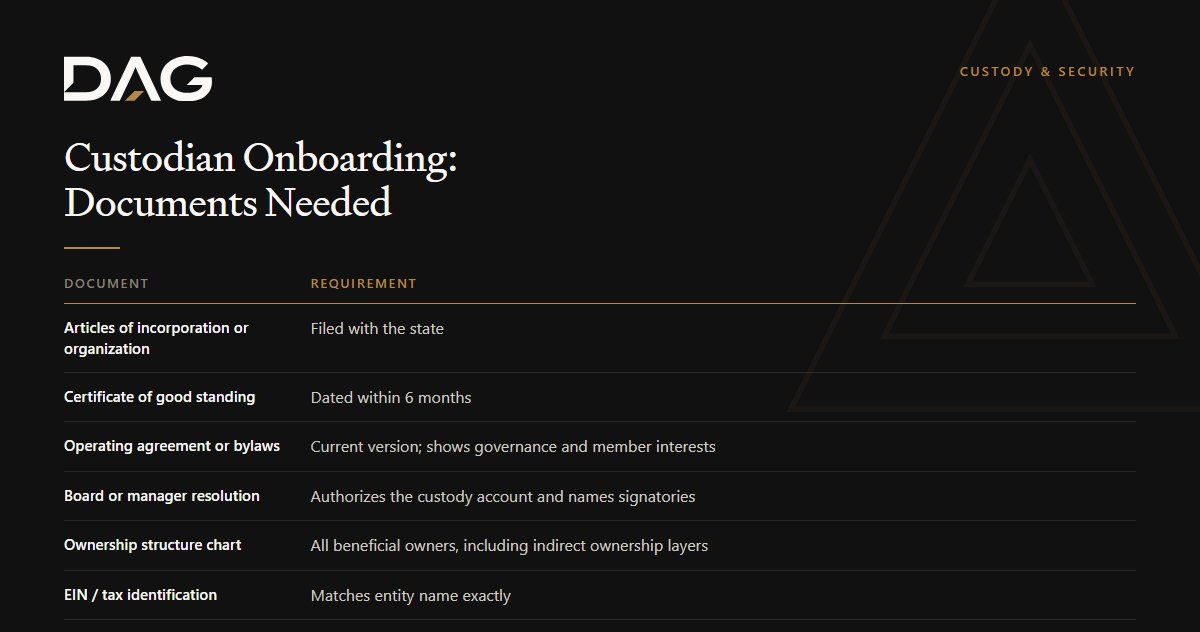
| Document | Requirement |
|---|---|
| Articles of incorporation or organization | Filed with the state |
| Certificate of good standing | Dated within 6 months |
| Operating agreement or bylaws | Current version; shows governance and member interests |
| Board or manager resolution | Authorizes the custody account and names signatories |
| Ownership structure chart | All beneficial owners, including indirect ownership layers |
| EIN / tax identification | Matches entity name exactly |
Multi-jurisdictional structures, a Delaware LLC owned by a Cayman trust with US beneficial owners, for example, require additional regulatory verification and typically extend review timelines.
Important: Entity documents should reflect your governance and control framework. Never submit seed phrases, private keys, or wallet credentials to a custodian or include them in any formation or governance document. Custody agreements govern access to the custodial account, not to private keys held elsewhere.
Governance and Operational Controls
Custodians review how you will manage digital asset risk internally. Standard requirements include:
- List of authorized signatories with specimen signatures
- Internal custody policy (wallet access procedures, approval workflows, key management framework, not private keys themselves)
- Risk management framework (position limits, concentration rules)
- Compliance procedures (transaction monitoring, suspicious activity protocols)
If you do not have formal governance documentation, you will need to create it. Custodian-provided templates are a starting point, but documents should reflect your actual operational structure. See how to build a crypto custody policy for a structured approach.
Why Onboarding Fails
Incomplete submissions. A missing signature page or expired ID triggers resubmission. Compliance teams follow checklists, they do not make judgment calls on borderline documents.
Contradictory information. Inconsistencies between your bank statement address, ID, and corporate filings will stop the review until resolved.
Jurisdictional complexity. Cross-border structures require additional regulatory verification. Plan for longer timelines if your entity involves multiple jurisdictions.
Poor file organization. Forty-seven unlabeled PDFs in a single email forces the compliance team to sort and identify each document, adding days or weeks. Label files clearly (e.g., Smith_John_Passport_2025.pdf) and provide a document index.
How to Prepare for Custodian Onboarding
- Compile everything before you start. Partial submissions extend timelines without advancing the application. Have all categories above ready before initiating onboarding.
- Check document dates. An expired certificate of good standing is an automatic delay. Verify dates on all formation documents before submitting.
- Confirm information consistency. Your name, address, and entity details should match exactly across all documents.
- Label files clearly. Descriptive filenames and a one-page document index eliminate sorting work on the custodian's side.
- Assign a point person. Someone must own the onboarding process and respond to custodian questions promptly, delays in response extend timelines further.
- Prepare governance documentation in advance. If your entity lacks a formal custody policy or risk framework, draft it before submitting. See the crypto custody policy template for family offices as a reference structure.
For entities considering which custodian to approach first, crypto custody options compared covers qualified custodians, state trust companies, and exchange alternatives. The crypto account opening checklist for trusts and LLCs provides a printable preparation checklist.
What Happens If Onboarding Goes Wrong
Delays carry real cost. A month-long delay caused by a missing document creates unintended market exposure for assets waiting to transfer.
Rejected applications can carry longer-term risk. A denial may surface in later due diligence and complicate applications elsewhere, so it is worth getting the package right the first time.
Compliance failures create legal exposure. If source-of-funds documentation later proves insufficient and regulators raise questions, acceptance by the custodian does not provide a legal defense.
Why Custodians Set These Requirements
Regulatory scrutiny of digital asset custody increased after the FTX collapse. Custodians now operate under examination by the SEC, state banking regulators, and FinCEN. They cannot make documentation exceptions without risking enforcement action, loss of insurance coverage, and reputational damage.
Proper documentation also protects the client. A clear record of legitimate asset ownership matters if you need to demonstrate source of funds to a bank, a regulator, or a court.
For background on the regulatory framework, see what is institutional crypto custody and qualified custody for RIAs managing digital assets.
DAG coordinates with custodians to assemble documentation packages and manage compliance communication throughout the approval process. We coordinate, and do not provide, legal services such as entity formation, trust drafting, and operating-agreement preparation; those remain the work of your own attorney, and we work alongside your legal and tax advisors. Advisory services are provided by DAG Wealth, an SEC-registered investment adviser. Registration does not imply a certain level of skill or training.
Related Questions
Does a trust need different documents than an LLC for custodian onboarding?
The core KYC requirements for beneficial owners are the same. The entity-level documents differ: trusts submit the trust agreement (or a certificate of trust), trustee identification, and trust powers documentation; LLCs submit articles of organization, operating agreement, and a manager or member resolution. Some custodians also require a trustee acceptance letter. See crypto custody for trusts for trust-specific requirements.
How long does custodian onboarding typically take?
Timeline varies by custodian and entity complexity. As an illustrative range only, a straightforward US individual or single-member LLC with complete documentation might complete review in roughly two to four weeks, while multi-jurisdictional entities, trusts with complex ownership chains, or submissions with documentation gaps can take meaningfully longer. These figures are illustrative; verify current timelines and review backlogs directly with your custodian.
Do I need to resubmit documents if I change custodians?
Yes. Each custodian conducts its own KYC/KYB review. Documents from a prior custodian onboarding may accelerate preparation, but they cannot be transferred. If entity documents have changed or lapsed since your last onboarding, obtain updated versions before starting. The crypto custody due diligence checklist covers what to review when evaluating a new custodian relationship.
Sources
- FinCEN Customer Due Diligence Requirements (31 CFR Part 1010, 1020, 1023, 1024, 1026): https://www.fincen.gov/resources/statutes-and-regulations/cdd-final-rule
- SEC staff statements on digital asset custody (verify the current applicable statement before relying on it): https://www.sec.gov/rules-regulations/staff-guidance
- FinCEN Beneficial Ownership Rule (effective 2024): https://www.fincen.gov/beneficial-ownership-information-reporting
Compliance Note
This page is for educational purposes only and does not constitute legal, tax, investment, or compliance advice. Document requirements vary by custodian, account type, entity structure, and jurisdiction. Requirements change as regulations evolve, verify current requirements directly with your custodian and your legal counsel before initiating onboarding. Nothing on this page should be construed as a guarantee of approval, timeline, or outcome. Consult qualified legal and compliance professionals for guidance specific to your situation.