
No storage method eliminates all risk, so there is no single safest place to store crypto. The lower-risk crypto storage options, qualified crypto custody, hardware (cold) wallets, and exchange hot wallets, each carry trade-offs across security, access, and counterparty exposure. The right fit depends on asset size, ownership structure, and operational control. Crypto is not FDIC- or SIPC-insured.
What does "storing crypto" actually mean?
Crypto is stored by controlling private keys, cryptographic credentials that authorize transactions. Whoever controls the private key controls the asset. Storage decisions are really decisions about who holds the key and what safeguards govern its use.
The three main storage categories differ on exactly that question:
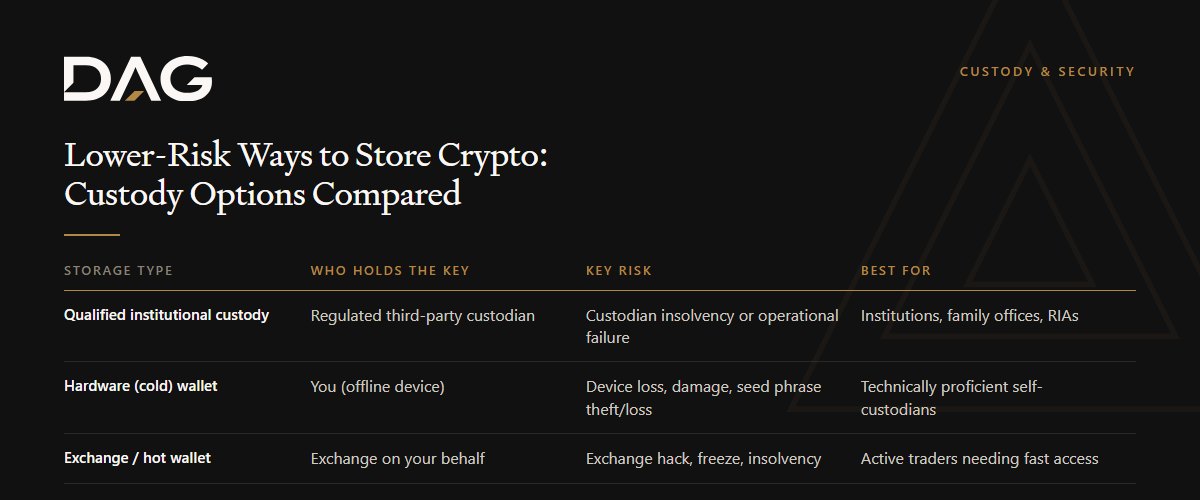
| Storage Type | Who Holds the Key | Key Risk | Best For |
|---|---|---|---|
| Qualified institutional custody | Regulated third-party custodian | Custodian insolvency or operational failure | Institutions, family offices, RIAs |
| Hardware (cold) wallet | You (offline device) | Device loss, damage, seed phrase theft/loss | Technically proficient self-custodians |
| Exchange / hot wallet | Exchange on your behalf | Exchange hack, freeze, insolvency | Active traders needing fast access |
How does qualified custody differ from self-custody?
A qualified crypto custodian is a regulated entity, typically a chartered bank, trust company, or state-licensed custodian, that holds private keys on behalf of clients under a formal custody agreement. Key features:
- Segregated client assets (assets are not commingled with custodian funds in most structures)
- May carry commercial crime or specie insurance on digital assets held (coverage limits, scope, and exclusions vary by provider, verify current terms in writing before relying on it)
- Subject to regulatory oversight (e.g., OCC, state banking regulators, or SEC rules for RIAs under certain interpretations)
- Institutional-grade key management: multi-party computation (MPC) or multi-signature schemes, hardware security modules (HSMs)
Trade-off: you depend on the custodian's solvency, operational controls, and counterparty relationships. If the custodian fails, recovery may be complex, see what happens if a crypto custodian fails.
For RIAs managing client crypto, qualified custody is often the expected standard under SEC custody requirements. SEC guidance on digital-asset custody remains in flux as of 2026, confirm the current rule before relying on any specific treatment. See qualified custody for RIAs managing digital assets for the regulatory framing.
How does a hardware wallet reduce risk compared to hot storage?
A hardware wallet is an offline device that stores private keys without connecting them to the internet during normal use. Because the key never leaves the device in plaintext, it is not exposed to the remote attacks that compromise exchange accounts.
Lower-risk factors:
- Private key generated and stored entirely on the device
- Transactions signed on-device; only the signed transaction is broadcast
- No custodian counterparty risk
Remaining risks:
- Seed phrase risk: the 12–24 word recovery phrase is the master key. If it is lost, stolen, or destroyed, assets may be permanently inaccessible. See seed phrase storage for estate planning for durable storage approaches.
- Device failure or loss: hardware can break or go missing; recovery depends entirely on the seed phrase backup.
- User error: sending to the wrong address is irreversible. See what happens if I transfer crypto to the wrong address.
- Supply-chain or firmware attacks: buy hardware wallets directly from manufacturers, not third parties.
Cold storage is often appropriate for long-term holdings that do not need frequent access. For estate-planning considerations specific to hardware wallets, see hardware wallet estate planning.
What are the risks of leaving crypto on an exchange?
Exchange or hot wallet storage is the most accessible but generally the highest-risk option for holding significant assets:
- Exchange insolvency: exchanges are not FDIC- or SIPC-insured. If an exchange fails, customer recovery depends on bankruptcy proceedings.
- Account freeze: exchanges can freeze accounts for compliance, legal, or technical reasons. See what should I do if my crypto exchange freezes my account.
- Hacks: exchange hot wallets are high-value targets. Not all losses are covered by exchange insurance funds.
- Not self-custodied: you hold a claim against the exchange, not the keys.
Exchange storage may be acceptable for funds held for near-term trading. Holding concentrated or long-term wealth on an exchange is a practice most custody professionals would flag as high-risk.
How to evaluate which option fits your situation
Custody option selection checklist
- Asset size: larger positions generally warrant institutional custody or dedicated cold storage; do not size your risk controls to your cost tolerance alone
- Ownership structure: assets held in a trust, LLC, or family office have governance requirements; self-custody may be operationally unsuitable, see crypto custody for trusts and crypto custody for family offices
- Regulatory obligations: RIAs and other regulated entities may have qualified custody requirements
- Succession: self-custody creates key-person risk; cold storage without an estate plan can result in permanent loss, see private key succession planning
- Operational security: hardware wallet security is only as strong as your seed phrase backup and physical security practices
- Insurance verification: ask any custodian for current policy limits, coverage scope, and exclusions in writing
Related Questions
Is a hardware wallet safer than an exchange?
A hardware wallet removes custodian counterparty risk, but shifts all responsibility for seed phrase security to the holder. An exchange carries counterparty and hack risk but handles key management on your behalf. Neither is unconditionally lower-risk, the trade-off is counterparty risk vs. self-custody operational risk. For a structured comparison, see cold storage vs qualified custody.
Can you lose crypto stored in a hardware wallet?
Yes. If the device is destroyed and the seed phrase backup is lost or inaccessible, the assets are permanently inaccessible. Theft of the seed phrase also results in loss. Hardware wallet security depends entirely on how well the recovery phrase is protected and stored.
Does crypto custody insurance protect against all losses?
No. Commercial crime and specie insurance on digital assets typically covers specific events (e.g., theft from hot wallets up to defined limits) and excludes others (e.g., private key mismanagement, certain insider events, or losses exceeding policy caps). Verify the current policy with the custodian, coverage structures vary significantly. See crypto insurance and custody for what to ask.
What custody structure suits a family office or trust?
Institutional or qualified custody is generally more operationally appropriate for entities that require audit trails, multi-party approval workflows, and formal governance. Self-custody introduces key-person risk that can conflict with trustee duties. See family office crypto custody policy for the governance layer.
Sources
- SEC Staff Bulletin: Custody of Digital Asset Securities (2023), https://www.sec.gov/staff-bulletins/sb-custody-digital-asset-securities
- OCC Interpretive Letter 1170: National Banks as Cryptocurrency Custodians (2020), https://www.occ.gov/topics/charters-and-licensing/interpretations-and-actions/2020/int1170.pdf
- FDIC: Digital Assets and Deposit Insurance FAQ, https://www.fdic.gov/resources/resolutions/bank-failures/failed-bank-list/crypto.html
- FINRA Investor Alert: Cryptocurrency, https://www.finra.org/investors/insights/cryptocurrency
Compliance Note
This page is educational only and does not constitute investment, legal, or tax advice. No custody method eliminates the risk of loss. Crypto assets are not FDIC- or SIPC-insured. Insurance coverage offered by custodians varies by provider, policy, and coverage period, verify current terms in writing before relying on any representation. DAG Wealth coordinates custody arrangements with third-party custodians and does not itself act as a qualified custodian or provide legal advice; it does not guarantee any outcome from any custody arrangement. Advisory services are provided by DAG Wealth, an SEC-registered investment adviser. Registration does not imply a certain level of skill or training. Consult a qualified financial, legal, and tax professional before making custody decisions.