
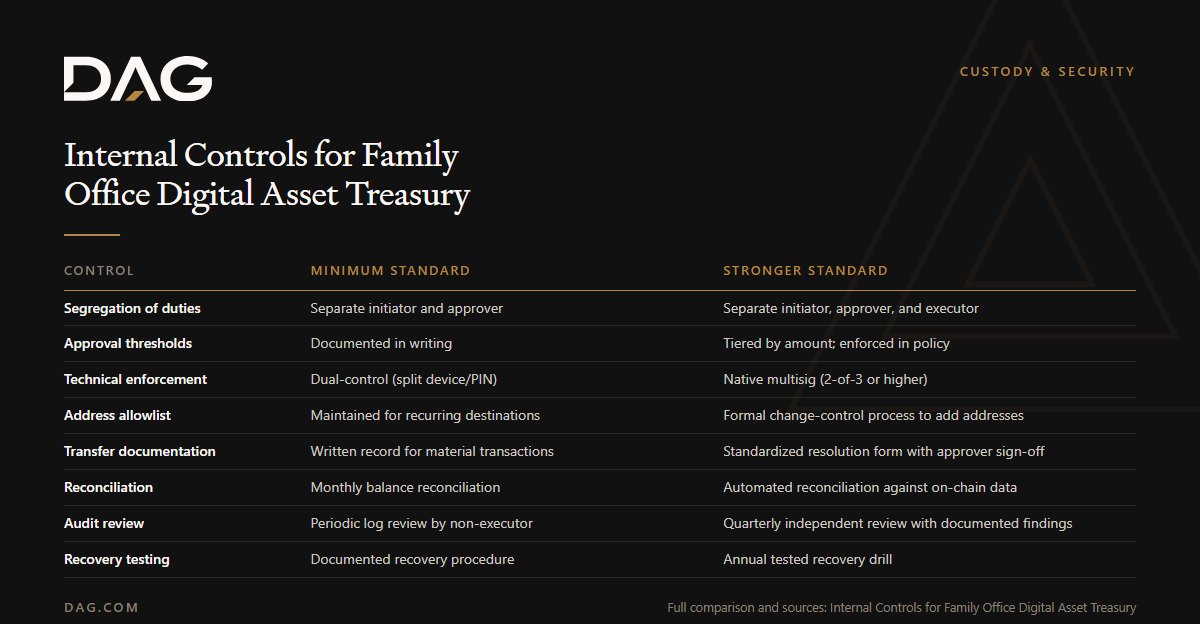
Internal controls for family office digital asset treasury management are the documented policies, approval structures, and technical safeguards, including segregation of duties, multi-approver workflows, address allowlists, transaction reconciliation, and periodic audit, that govern how digital assets move, who can authorize transfers, and how those decisions are recorded; they work in tandem with institutional crypto custody to limit operational risk.
What Are Internal Controls for Digital Asset Treasury Management?
A family office applying institutional-grade treasury discipline to digital assets separates four core functions: initiating, approving, executing, and auditing transactions. No single person controls the full flow. The same governance that prevents unauthorized wire transfers from a brokerage account applies to cryptocurrency, with the added complexity that on-chain transactions are irreversible and have no compliance callback by default.
Traditional custodians enforce friction automatically. Crypto removes that friction entirely. A wallet-holder with unchecked access can move seven-figure sums in seconds with no institutional check. The internal control framework exists to rebuild that friction deliberately.
See crypto governance for family offices for the broader governance layer this fits into.
Why Crypto Requires Explicit Controls That Traditional Assets Don't
Banks enforce approval thresholds whether or not a family office has written policies. Crypto does not. The absence of built-in friction means every safeguard must be constructed on purpose:
- No callback from a compliance officer when a large transfer initiates
- No wire recall once an on-chain transaction confirms
- No automatic dual-control requirement unless the wallet architecture enforces it
- No audit trail of business purpose, only a ledger of addresses and amounts
A family holding significant digital asset positions needs written controls, not just intentions. See common crypto custody mistakes for family offices for what happens when these are absent.
How to Build an Internal Control Framework: Step-by-Step
Map wallet authority. List every wallet address or custodial account, assign an owner of record, and document which role can initiate, approve, and execute transactions from each.
Separate initiation from approval from execution. The person proposing a transfer should not also approve it. The person approving should not also hold the signing key. This three-way separation is the foundation of segregation of duties.
Set threshold tiers in writing. Establish dollar-denominated tiers (for example: single-approver below a lower threshold, dual-approver above it, committee approval plus written resolution above a higher threshold). The specific thresholds matter less than documenting them and following them consistently. Any figures used should be reviewed and updated as asset values change.
Implement technical enforcement with multisig or dual control. A 2-of-3 multisig wallet requires any two of three authorized signers before funds move, this turns written policy into a protocol-enforced rule. Where native multisig is unavailable, split physical control: one person holds the hardware device, another holds the PIN or passphrase. Neither can transact alone.
Maintain an address allowlist. Pre-approve destination addresses for recurring counterparties (exchanges, custodians, tax wallets). Require a separate approval workflow to add new addresses. This reduces the surface area for social-engineering attacks that redirect transfers to attacker-controlled addresses.
Require written transfer documentation for material transactions. Before any transfer above the lower threshold, generate a contemporaneous record: what is moving, where it is going, the business purpose, and who approved it. Email, a shared document, or a dedicated log all work, the format is less important than the habit.
Reconcile regularly. Compare wallet balances against your internal records at least monthly for active portfolios. Flag discrepancies immediately. Reconciliation is the control that catches errors after the fact; the preceding steps aim to prevent them.
Assign audit to someone outside the execution role. A person who does not execute transactions reviews logs periodically, checking for threshold violations, undocumented transfers, and pattern anomalies. This closes the loop on accountability.
Review controls annually (or after any structural change). Confirm that documented procedures are actually being followed. Update thresholds if valuations have shifted materially. Revisit key-person dependencies, who holds signing authority, what happens if that person is unavailable, and whether recovery procedures have been tested.
See crypto custody policy template for family offices for a template that formalizes many of these steps.
Internal Controls Checklist for Family Office Digital Asset Treasury
| Control | Minimum Standard | Stronger Standard |
|---|---|---|
| Segregation of duties | Separate initiator and approver | Separate initiator, approver, and executor |
| Approval thresholds | Documented in writing | Tiered by amount; enforced in policy |
| Technical enforcement | Dual-control (split device/PIN) | Native multisig (2-of-3 or higher) |
| Address allowlist | Maintained for recurring destinations | Formal change-control process to add addresses |
| Transfer documentation | Written record for material transactions | Standardized resolution form with approver sign-off |
| Reconciliation | Monthly balance reconciliation | Automated reconciliation against on-chain data |
| Audit review | Periodic log review by non-executor | Quarterly independent review with documented findings |
| Recovery testing | Documented recovery procedure | Annual tested recovery drill |
Related Questions
Does segregation of duties apply when one person manages everything?
Yes, and it is most important in that situation. A sole manager creates key-person risk and removes the secondary check that would catch errors or unauthorized activity. At minimum, bring in a second authorized party for approvals above a set threshold, even if that person is an outside advisor or co-trustee. See crypto key person risk policy for how to structure this.
What is an address allowlist and why does it matter for crypto treasury?
An allowlist is a pre-approved set of destination addresses, exchange accounts, custodians, tax wallets, or counterparties the family regularly transacts with. Any transfer to an unlisted address triggers a separate approval step. This control specifically targets social engineering and phishing attacks where an attacker impersonates a known counterparty and substitutes their own address. See crypto address verification policy for implementation guidance.
How often should a family office reconcile digital asset holdings?
Monthly is a reasonable minimum for portfolios that see regular activity; quarterly may be acceptable for passive holdings. The reconciliation compares on-chain balances (pulled from block explorer or custodian reporting) against the internal ledger. It also confirms that no transfers occurred outside the documented approval workflow. See family office digital asset quarterly review process for a structured cadence.
What documentation is required for a crypto transfer under these controls?
At minimum: the amount and asset, the destination address, the business purpose, and the name of the approver with the date. For transactions above higher thresholds, a written resolution signed by the required number of approvers provides the strongest audit trail. These records become essential during tax reporting, external audits, and any dispute about whether a transfer was authorized. See crypto transfer approval policy for a policy template.
Sources
- COSO Internal Control. Integrated Framework (Committee of Sponsoring Organizations of the Treadway Commission, 2013), available at coso.org
- SEC Staff Bulletin: Custody of Digital Asset Securities (SEC, 2023), sec.gov
- OCC Interpretive Letter 1170: Authority of National Banks and Federal Savings Associations to Participate in Independent Node Verification Networks and Use Stablecoins (OCC, Jan. 2021), occ.gov
- AICPA & CIMA, "Accounting for and Auditing of Digital Assets" practice aid (2022 edition), aicpa-cima.com
- IRS Notice 2014-21 and Revenue Ruling 2023-14 (treatment of cryptocurrency as property for federal tax purposes), irs.gov
Compliance Note
This page is for educational purposes only and does not constitute legal, tax, investment, or accounting advice. Internal control frameworks for digital asset treasury management vary by entity structure, jurisdiction, custodial arrangement, and applicable regulatory requirements. Consult qualified legal, compliance, and financial professionals before implementing any governance policy. Threshold figures used in examples are illustrative only and should be calibrated to each family's specific situation and verified against current guidance. This page does not advise on any specific custody product or key-management configuration; consult a qualified security professional before implementing wallet or signing arrangements.
DAG coordinates crypto family office services including digital asset governance frameworks; it does not provide legal advice, and any entity formation, trust, or operating-agreement work is coordinated with qualified outside counsel. Advisory services are provided by DAG Wealth, an SEC-registered investment adviser. Registration does not imply a certain level of skill or training.