
To hire a digital asset manager for XRP, verify the advisor's fiduciary status and SEC registration on adviserinfo.sec.gov, confirm they understand XRP Ledger technology, ask exactly where your XRP will be custodied and by which qualified custodian, a decision anchored in institutional crypto custody, and get the full fee structure in writing, flat, AUM percentage, or transaction-based, before signing anything.
What Makes XRP Different From Other Digital Assets
XRP runs on the XRP Ledger (XRPL), which settles transactions in 3–5 seconds with fees under a fraction of a cent. The network uses a consensus protocol built for payment rails, not proof-of-work mining or staking. That design makes XRP relevant for cross-border settlement between financial institutions, liquidity provisioning in currency corridors, and real-time gross settlement systems.
An advisor unfamiliar with these mechanics cannot position your holdings correctly. They will miss opportunities specific to XRPL's institutional adoption cycle and may misread regulatory signals that do not apply to Bitcoin or Ethereum.
Who Does What: Investment Advice vs. Coordination
Advisory decisions (what to buy, sell, or hold based on your goals and risk tolerance) fall within the regulated scope of a registered investment adviser. The legal entity currently registered with the SEC as an investment adviser is DAG Wealth.
Coordination services, entity structuring, custody setup, platform access, vendor relationships, and document management, are operational, not advisory. Entity structuring and related formation work are legal services; the firm coordinates these with qualified attorneys and does not itself provide legal advice.
This distinction is not bureaucratic. It determines who is legally accountable for each recommendation, and it determines whether you have the protections of fiduciary law behind the advice you receive.
How to Vet a Digital Asset Manager for XRP
Step 1: Verify Registration and Fiduciary Status
Before any meeting, search the advisor on adviserinfo.sec.gov. Look for:
- Active registration as an investment adviser (RIA)
- Any disciplinary history or disclosure events
- Current Form ADV Part 2A, which describes investment strategies, fees, and conflicts of interest
Fiduciary standard means the advisor is legally required to act in your best interest. Not all financial professionals operate under this standard. Confirm it explicitly.
Step 2: Test XRP-Specific Knowledge
Generic crypto experience does not substitute for XRPL expertise. Ask directly:
- How does the XRP Ledger consensus mechanism differ from proof-of-work or proof-of-stake?
- What is Ripple's On-Demand Liquidity (ODL) program and how does institutional adoption affect XRP's use case?
- Which custody solutions support XRPL native features such as the reserve requirement?
- How do you monitor network health and validator performance?
If the advisor cannot answer these without searching, they lack the specific knowledge your position requires.
Step 3: Confirm the Custody Arrangement
Ask where exactly your XRP will be held and get specifics:
- Name of the qualified custodian (not a hardware wallet in a drawer)
- Multi-signature or MPC setup so no single person can move funds unilaterally, see MPC vs Multi-Sig Custody
- Cold storage protocols and documented procedures for asset movement
- Insurance coverage details, where available
Review how to choose a crypto custodian for a full due-diligence framework. Also ask what happens if the custodian fails, see What Happens If a Crypto Custodian Fails?
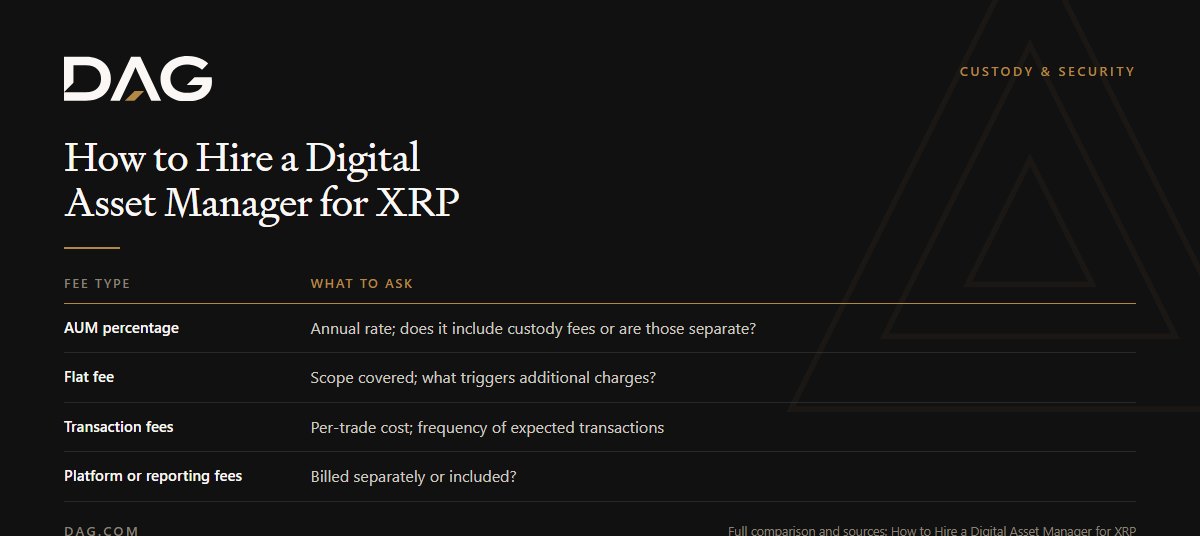
Step 4: Understand the Fee Structure
Clarify before signing:
| Fee Type | What to Ask |
|---|---|
| AUM percentage | Annual rate; does it include custody fees or are those separate? |
| Flat fee | Scope covered; what triggers additional charges? |
| Transaction fees | Per-trade cost; frequency of expected transactions |
| Platform or reporting fees | Billed separately or included? |
Any specific fee figure cited here would be illustrative only, verify current terms directly with the firm.
Step 5: Confirm Tax Coordination Capability
XRP tax treatment carries regulatory uncertainty that general crypto guidance may not address. Confirm the manager:
- Tracks cost basis across wallets and exchanges
- Understands how to report transactions in your jurisdiction
- Stays current on IRS guidance and relevant court decisions
- Coordinates with qualified tax professionals rather than opining on tax strategy independently
Tax law is outside investment management scope. A good manager coordinates with CPAs; they do not replace them.
Step 6: Review the Reporting Format
Request a sample report. It should show current holdings and valuations, transaction history with cost basis, and fee breakdowns. If the manager cannot produce a clean sample, they are not tracking what matters.
Questions to Ask Before You Hire
- What is your specific experience with XRP?, "I manage crypto portfolios" is not an answer.
- Where exactly will my XRP be held?. Custodian name, security model, insurance.
- Are you a fiduciary?. Get it in writing.
- How do you handle regulatory changes affecting XRP?. XRP has faced significant regulatory scrutiny. What is their monitoring process?
- What do you charge and how is it structured?. No surprises after onboarding.
- How often do we communicate?. Monthly calls? Quarterly reviews? On-demand access?
- Can I see a sample report?. Verifies they actually track what matters.
Red Flags
- Guaranteed returns. No one can guarantee crypto returns. Any such claim violates SEC Marketing Rule 206(4)-1.
- Vague custody answers. If they cannot name the custodian and explain the security model, do not transfer assets.
- No specific XRP knowledge. General crypto experience does not translate.
- Hard to reach before signing. Availability during sales rarely improves after.
- Dismissive of compliance questions. Regulatory fluency is non-negotiable for XRP given its litigation history with the SEC.
Risks That Remain With Professional Management
Professional management can reduce but not eliminate:
- Price volatility. XRP prices have historically moved sharply in both directions.
- Regulatory uncertainty. Rules, court interpretations, and agency positions change.
- Custody and technology risk. Even institutional custodians face operational risks.
- Counterparty exposure. You are trusting a third party with your assets.
Proper disclosure requires stating these material risks alongside any description of services.
Related Questions
What credentials should a digital asset manager for XRP have?
At minimum: SEC registration as an investment adviser (verifiable on adviserinfo.sec.gov), demonstrated XRP Ledger knowledge, and a documented custody arrangement with a qualified custodian. Additional credentials such as CFP or CFA are relevant but do not substitute for regulatory registration or XRPL-specific expertise.
Is a fiduciary required for XRP investment management?
No law requires that an XRP manager be a fiduciary, but choosing a registered investment adviser (RIA) means fiduciary duty applies by law under the Investment Advisers Act of 1940. Non-fiduciaries operate under a suitability standard, which is a lower bar. The distinction is consequential when advice is disputed.
What is the XRP Ledger reserve requirement and why does it matter for custody?
The XRPL requires each account to hold a base reserve in XRP that cannot be spent, plus an additional reserve per owned object (such as trust lines or offers). The reserve amount is set by validator vote and has changed over time, so confirm the current base and owner reserve at xrpl.org rather than relying on a fixed figure. Custodians and advisors unfamiliar with XRPL may miscalculate your available balance or fail to account for this in reporting. It is a straightforward but often overlooked technical detail.
Sources
- SEC Investment Adviser Public Disclosure (IAPD): adviserinfo.sec.gov, verify registrations and disciplinary history
- Investment Advisers Act of 1940, § 206 (fiduciary duty): law.cornell.edu/uscode/text/15/80b-6
- SEC Marketing Rule 206(4)-1 (restrictions on performance claims and testimonials), effective May 4, 2021
- SEC v. Ripple Labs, Inc., No. 20-cv-10832 (S.D.N.Y.), consult the current docket for the latest case status
Compliance Note
This page is educational only and does not constitute investment, legal, or tax advice. Digital asset management involves substantial risk, including risk of total loss. Advisory services are provided by DAG Wealth, an SEC-registered investment adviser. Registration does not imply a certain level of skill or training. Entity formation and related document drafting are legal services that the firm coordinates with qualified attorneys; it does not provide legal advice. Past performance does not indicate future results. All fee structures, reserve figures, and regulatory positions cited are illustrative or current as of the date noted, verify directly with the relevant firm or authority before acting.