
An IRA rollover to crypto follows the same IRS rules as any other IRA rollover. A direct trustee-to-trustee transfer has no deadline and no frequency cap. An indirect rollover, where funds pass through your hands, triggers a 60-day redeposit window and a once-per-12-months limit across all your IRAs, selecting the right qualified custodian is central to this process; see the crypto custody hub for the full landscape. Miss either deadline and the amount becomes taxable.
What is a crypto IRA?
A crypto IRA is a self-directed IRA holding digital assets instead of, or alongside, stocks and bonds. The tax treatment is identical to a conventional IRA: the same contribution limits apply, the same distribution rules govern withdrawals, and the same prohibited-transaction rules restrict how you interact with the account.
The IRS requires a qualified custodian for every IRA. For digital assets, that custodian must also handle secure storage of private keys, a function most traditional IRA custodians are not equipped to perform. The IRS has not published a definitive list of approved crypto IRA custodians, so current market practice relies on the existing custodian requirements that apply to all IRAs. Some custodians use institutional crypto custody services; others operate proprietary cold-storage infrastructure. The custodian's key-management practices matter: crypto holdings are generally not covered by FDIC insurance, and lost private keys mean lost assets.
What is the difference between a direct transfer and an indirect rollover?
Direct trustee-to-trustee transfer
The sending custodian wires funds directly to the receiving custodian. You never touch the money. Because the assets remain in qualified retirement accounts throughout, there is no taxable distribution, no 60-day clock, and no restriction on how often you can do it. This is the lower-risk path and the one to use whenever both custodians can accommodate it.
Indirect rollover
The sending custodian issues a check to you, or wires funds to your personal account. The money is now outside a retirement account. You have 60 calendar days from the distribution date to deposit it into an eligible IRA. Days are counted continuously: weekends, holidays, and custodian processing delays all count against the window.
Two hard limits apply:
- 60-day deadline. Miss it by one day and the full amount is treated as a taxable distribution. The IRS can grant a waiver in narrow circumstances (financial institution error, certain hardships), but waivers are not automatic.
- Once-per-12-months rule. You may complete only one indirect IRA-to-IRA rollover in any rolling 12-month period across all of your IRAs combined, not per account, not per calendar year. A second indirect rollover within that window is treated as a taxable distribution even if deposited within 60 days. This aggregate interpretation was confirmed in Bobrow v. Commissioner (2014) and reflected in IRS guidance, taking effect January 1, 2015.
Note: This once-per-year limit applies only to indirect (60-day) rollovers. It does not restrict direct trustee-to-trustee transfers, which can be done any number of times.
How does the 60-day rule apply to crypto IRA rollovers?
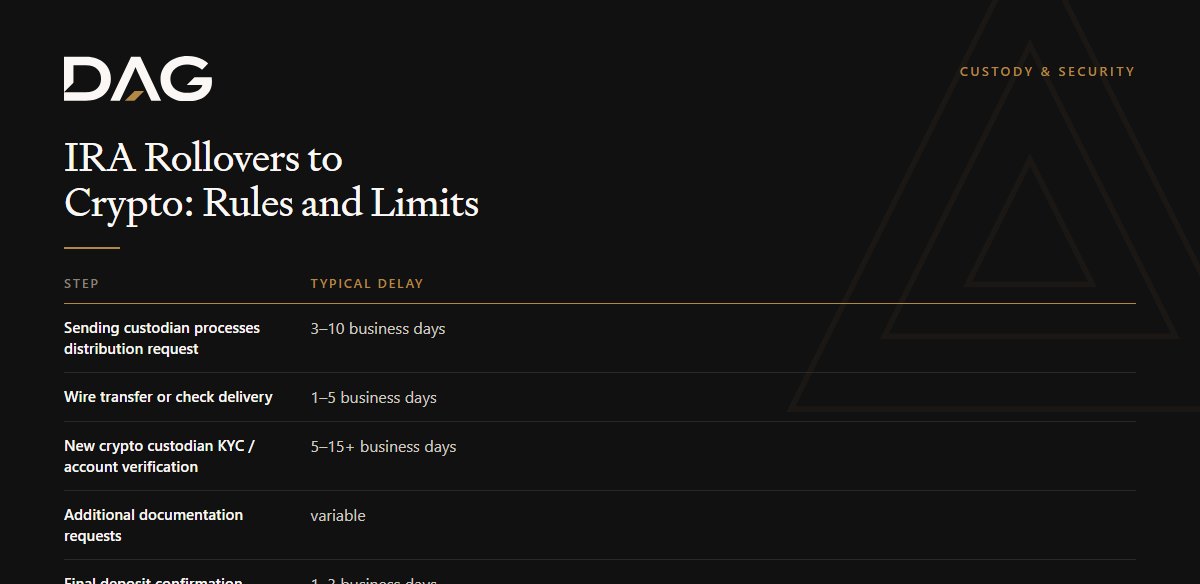
Crypto introduces coordination friction that accelerates the clock:
| Step | Typical delay |
|---|---|
| Sending custodian processes distribution request | 3–10 business days |
| Wire transfer or check delivery | 1–5 business days |
| New crypto custodian KYC / account verification | 5–15+ business days |
| Additional documentation requests | variable |
| Final deposit confirmation | 1–3 business days |
Total processing time can exceed 30 days before funds are even deposited. A documentation request or re-verification at any step can push you past day 60.
Practical rules when doing an indirect rollover:
- Confirm both custodians can work together before initiating the distribution.
- Start the receiving account setup and KYC well before requesting the distribution.
- Treat day 45 as your personal deadline, not day 60.
- Track the calendar in business days and calendar days simultaneously.
- Keep all documentation: distribution notice, wire receipt, deposit confirmation, and any custodian correspondence. The IRS may ask you to prove the timeline.
What qualifies as a prohibited transaction in a crypto IRA?
Self-directed IRAs, including crypto IRAs, are subject to the IRC §4975 prohibited-transaction rules. These are general principles, not an exhaustive list. Common violations include:
- Using IRA-owned crypto to pay personal expenses
- Transacting with a disqualified person (yourself, spouse, lineal descendants, certain fiduciaries)
- Receiving compensation from an IRA investment
- Pledging IRA assets as collateral for a personal loan
A prohibited transaction causes the IRA to lose its qualified status entirely, triggering immediate taxation of the full account balance, not just the transaction amount. This is distinct from simply missing a rollover deadline.
For a closer look at custody requirements that intersect with prohibited-transaction rules, see qualified custody for RIAs managing digital assets.
How to complete an IRA rollover to crypto without triggering taxes
- Choose a qualified custodian. The IRS requires a qualified custodian for every IRA. Confirm your chosen crypto IRA custodian is a bank, federally insured credit union, savings and loan, or an entity approved by the IRS to hold IRA assets. Review how they custody private keys. See how to choose a crypto custodian.
- Open the receiving account first. Complete KYC, provide required documentation, and fund any minimum balance before requesting the distribution. Account setup is often the longest step.
- Request a direct transfer if possible. Contact both custodians to confirm they can coordinate a direct trustee-to-trustee transfer. Get confirmation in writing.
- If doing an indirect rollover: start immediately. Request the distribution only after the receiving account is fully open and verified. Begin the deposit process the same day funds arrive.
- Track every date. Note the exact distribution date from the custodian statement. Count 60 calendar days forward. Mark day 45 as your action deadline.
- Retain all records. Distribution notices, wire receipts, deposit confirmations, and all custodian correspondence should be stored permanently in case of an IRS inquiry.
- Verify the deposit was coded correctly. Confirm with the receiving custodian that the deposit was coded as a rollover contribution, not a regular IRA contribution, to avoid it being subject to contribution limits.
Related Questions
Does the 60-day limit apply to Roth conversions?
No. A traditional-to-Roth IRA conversion is not a rollover in the same sense, it is a taxable event by design. The once-per-12-months indirect rollover limit does not apply. However, Roth conversions carry their own tax implications (ordinary income in the year of conversion), and the amount cannot be undone after 2017 under current law. Consult a tax advisor before converting a traditional crypto IRA to Roth.
Can you roll a 401(k) directly into a crypto IRA?
Yes. A 401(k)-to-IRA rollover is not subject to the once-per-12-months IRA-to-IRA indirect rollover limit. Employer plan-to-IRA rollovers are separately governed. A direct rollover from a 401(k) is still preferable: the plan administrator sends funds directly to the IRA custodian, no withholding applies, and there is no 60-day risk.
What are contribution limits for a crypto IRA?
For the 2024 tax year, the IRA contribution limit was $7,000 ($8,000 if you are 50 or older), illustrative figures that change annually; verify the current limit at IRS.gov before relying on it. These limits apply to new contributions, not to rollover amounts. A rollover from another IRA or qualifying retirement plan does not count against the annual contribution limit, provided the rollover rules are followed correctly. Verify current limits at IRS.gov before relying on any specific figure.
What happens to crypto IRA assets when I die?
IRA assets pass to named beneficiaries outside of probate. However, beneficiaries must be able to access the custodian account and understand how to manage or liquidate the digital assets. If the custodian loses private keys or the beneficiary cannot authenticate, the assets may be unrecoverable. This makes both custodian selection and estate planning documentation critical. See crypto inheritance planning for high-net-worth families and crypto estate planning for high-net-worth families.
Sources
- IRS Publication 590-B, Distributions from Individual Retirement Arrangements, https://www.irs.gov/publications/p590b
- IRS Publication 590-A, Contributions to Individual Retirement Arrangements, https://www.irs.gov/publications/p590a
- IRS Rollover Chart (one-rollover-per-year rule), https://www.irs.gov/retirement-plans/ira-one-rollover-per-year-rule
- Bobrow v. Commissioner, T.C. Memo. 2014-21
- IRC §408 (Individual Retirement Accounts)
- IRC §4975 (Prohibited Transactions)
- IRS Revenue Ruling 2014-9 (rollover rule application)
Compliance Note
This page is for educational purposes only. It does not constitute legal, tax, investment, or financial advice. IRA rollover rules, contribution limits, and tax treatment change over time; verify current figures directly with the IRS or a qualified tax professional. Crypto assets are volatile and speculative; holding them inside a tax-advantaged account does not eliminate market risk or guarantee any investment outcome. Consult a qualified tax advisor, ERISA attorney, or financial professional before making any rollover decision.
DAG provides educational resources and financial planning coordination. Advisory services are provided by DAG Wealth, an SEC-registered investment adviser. Registration does not imply a certain level of skill or training. Consult Form ADV for full disclosures.