
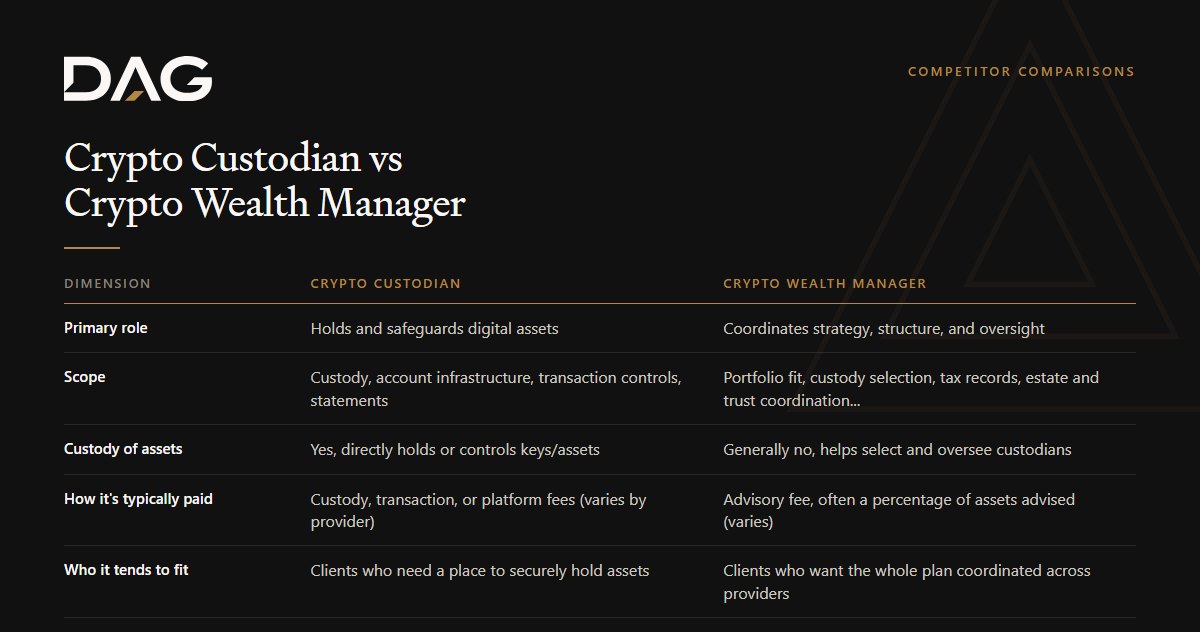
In the crypto custodian vs crypto wealth manager comparison, a custodian holds and safeguards digital assets under a defined custody model, while a wealth manager coordinates the broader plan: investment strategy, custody selection, tax records, estate planning, trusts, and governance. The roles solve different problems, and many high-net-worth investors and family offices end up using both.
These two functions are distinct, and they often work best together rather than as substitutes. Understanding where one ends and the other begins helps you decide what your situation actually calls for. This page sits within our Crypto Wealth Management Hub, which covers how custody, advice, and structure fit together.
What Is a Crypto Custodian?
A crypto custodian holds or safeguards digital assets on a client's behalf. The custodian may provide account infrastructure, asset safekeeping, transaction controls, statements, and the operational workflows used to move or secure assets. Depending on its registration and the facts of an account, a custodian may operate as a qualified custodian under the relevant rules. The custodian answers a narrow, important question: where and how are the assets held?
What Is a Crypto Wealth Manager?
A crypto wealth manager helps decide how crypto fits into a client's overall picture. That can include which custody model is appropriate, how a portfolio is constructed, how tax and estate issues are coordinated, and how a family or advisory team governs the assets over time. A wealth manager typically does not take custody of assets itself; instead, it helps select and oversee custodians and other providers as part of a coordinated plan. For a closer look at where advice ends and custody begins, see Crypto Wealth Manager vs Financial Advisor.
Crypto Custodian vs Crypto Wealth Manager: Comparison Table
| Dimension | Crypto Custodian | Crypto Wealth Manager |
|---|---|---|
| Primary role | Holds and safeguards digital assets | Coordinates strategy, structure, and oversight |
| Scope | Custody, account infrastructure, transaction controls, statements | Portfolio fit, custody selection, tax records, estate and trust coordination, governance |
| Custody of assets | Yes, directly holds or controls keys/assets | Generally no, helps select and oversee custodians |
| How it's typically paid | Custody, transaction, or platform fees (varies by provider) | Advisory fee, often a percentage of assets advised (varies) |
| Who it tends to fit | Clients who need a place to securely hold assets | Clients who want the whole plan coordinated across providers |
| Compliance posture | May serve as a qualified custodian, depending on registration and facts | May be a registered investment adviser; registration alone does not guarantee skill or results |
Specific services, fees, and registrations vary by provider and change over time. Verify each against the provider's current disclosures.
Key Difference
Custody answers a "where and how" question. Wealth management answers a "why and how does it fit" question: why are assets held in a given way, how do they fit the plan, and who coordinates the moving parts when tax, estate, and portfolio decisions interact.
This is also why the two are often complementary. A custodian can secure the assets without advising on whether the allocation, structure, or tax treatment makes sense for the household. A wealth manager can coordinate that plan without itself holding the assets. Many family offices pair the two deliberately, a point we explore in Crypto Custody Options Compared and in What Is a Crypto Family Office.
Related Questions
Do I need both a crypto custodian and a crypto wealth manager?
It depends on your situation. Some investors only need secure custody; others want strategy, tax, and estate coordination layered on top. Many high-net-worth households and family offices use both, with the wealth manager helping select and oversee the custodian. Consider your goals, complexity, and the professionals already on your team.
Can a crypto wealth manager hold my assets directly?
Generally, a wealth manager focuses on advice and coordination rather than taking custody itself, and often helps you choose a separate custodian. Whether any specific firm holds assets depends on its registration, structure, and the facts of the engagement. Confirm the custody arrangement in a provider's current disclosures before relying on it.
Is a crypto custodian regulated the same way as a wealth manager?
Not necessarily. Custodians and advisers can fall under different rules, and a custodian may or may not be a "qualified custodian" depending on its registration and the account. A wealth manager may be a registered investment adviser. Registration on its own does not guarantee performance, safety, or skill, so review the specifics for any provider you consider.
How do fees differ between custody and wealth management?
They tend to be structured differently. Custody is commonly priced through custody, transaction, or platform fees, while wealth management is often charged as an advisory fee. Exact pricing varies by provider and changes over time, so consult current disclosures and consider how the combined cost fits your plan.
Sources
Compliance Note
This article is educational and does not provide legal, tax, investment, fiduciary, compliance, or custody advice. Digital assets carry risk, including the potential loss of principal; nothing here implies guaranteed yield, a stable value, or protection by FDIC or SIPC insurance. Where a firm is described as registered, registration alone does not guarantee skill, performance, or results. Provider roles, fees, and services should be verified against current disclosures, and you should consult a qualified professional about your specific facts. Registration does not imply a certain level of skill or training.