
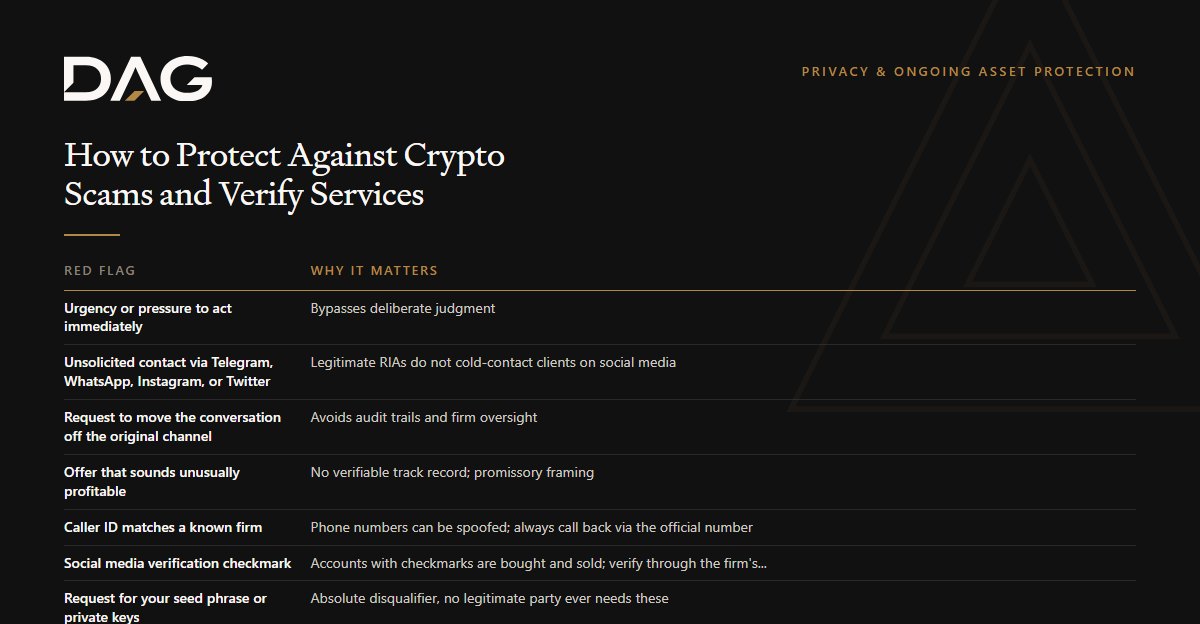
Crypto scam protection starts with one habit: slow down before you move money or share credentials. Scammers rely on urgency to bypass judgment. Verifying any contact through official channels, the SEC IAPD database, FINRA BrokerCheck, or the firm's registered website, takes a few minutes and can prevent irreversible losses. Scam awareness is a core pillar of crypto privacy and asset protection.
What Are the Most Common Crypto Scams Targeting Investors?
High-net-worth investors face five recurring scam types:
1. Impersonation scams. Someone poses as a wealth advisor, exchange employee, or government official via email, social media, or phone. The contact looks legitimate; the domain or phone number is not.
2. Pig-butchering. A scammer builds trust over weeks or months through social media or messaging apps, then introduces a "high-return" investment platform. Funds transferred to the platform disappear.
3. Fake support and account-security scams. A message warns that your account has been compromised. You're directed to a spoofed site or asked to share credentials to "verify" your identity.
4. Phishing and domain-spoofing. Links in emails or messages point to domains that look nearly identical to the real site (e.g., one transposed letter). Logging in hands your credentials to the attacker.
5. Fake recovery services. After a loss, a "crypto recovery specialist" offers to retrieve stolen funds for an upfront fee. No legitimate recovery service can reverse confirmed blockchain transactions.
How Do I Verify a Legitimate Financial Service?
Use official regulatory databases, not a firm's own marketing materials, as the primary verification source.
Step-by-step verification checklist
Look up the firm's SEC registration. Search the SEC Investment Adviser Public Disclosure (IAPD) database by firm name. A registered investment adviser will have a CRD number, a current Form ADV on file, and no material disciplinary history.
Check the individual advisor on FINRA BrokerCheck. At brokercheck.finra.org, enter the advisor's name. Review any disclosures, employment history, and exam qualifications.
Confirm the official domain independently. Search for the firm name via a search engine or use a bookmark you saved previously. Do not follow links sent in unsolicited messages. The domain in your browser bar must match the firm's registered website.
Verify the contact channel. Call the firm's main number, found on their registered site or Form ADV, and ask whether the message or contact you received was legitimate. Hang up on any unexpected inbound call; call back using the number you found independently.
Check email domain. The display name may read "DAG Wealth" while the actual sending address is a random Gmail. Look at the domain after the @ symbol. If it does not match the firm's official domain, the message is fraudulent.
Confirm no request for seed phrases or private keys. No legitimate advisor, custodian, or support team ever needs your seed phrase or private keys. These credentials are equivalent to your assets. Any request for them is a scam.
What Red Flags Indicate a Crypto Scam?
| Red Flag | Why It Matters |
|---|---|
| Urgency or pressure to act immediately | Bypasses deliberate judgment |
| Unsolicited contact via Telegram, WhatsApp, Instagram, or Twitter | Legitimate RIAs do not cold-contact clients on social media |
| Request to move the conversation off the original channel | Avoids audit trails and firm oversight |
| Offer that sounds unusually profitable | No verifiable track record; promissory framing |
| Caller ID matches a known firm | Phone numbers can be spoofed; always call back via the official number |
| Social media verification checkmark | Accounts with checkmarks are bought and sold; verify through the firm's registered website |
| Request for your seed phrase or private keys | Absolute disqualifier, no legitimate party ever needs these |
| Upfront fee to recover lost funds | Blockchain transactions cannot be reversed; recovery services cannot retrieve confirmed losses |
How Does a Fiduciary Advisor Differ From a Scammer?
A registered investment adviser operating under fiduciary duty, such as one registered with the SEC under the Investment Advisers Act of 1940, has a legal obligation to act in the client's interest. Key operational differences:
- No custody of your assets. A fiduciary advisor gives guidance; a qualified custodian holds assets. These are separate functions. Any arrangement that combines advice with unsanctioned custody of your funds is a red flag.
- No unsolicited outreach on personal social media. Legitimate advisory firms use regulated communication channels with compliance oversight.
- Communication verification protocols. A properly structured crypto family office or advisory firm establishes a known contact protocol in advance so clients can recognize legitimate outreach.
If you are researching what a fiduciary digital asset advisor looks like, see What Is a Digital Asset Fiduciary? and What Is a Crypto Fiduciary Advisor?.
What Should I Do If I Encounter a Crypto Scam?
- Do not send additional funds. Any instruction to deposit more to "unlock" or "verify" previous amounts is a secondary extraction attempt.
- Stop all communication with the suspected scammer. Do not attempt to negotiate or retrieve funds directly.
- Document everything. Preserve messages, wallet addresses, transaction IDs, domain names, and screenshots before accounts are closed or purged.
- Report to the FTC at reportfraud.ftc.gov.
- File a complaint with the FBI's Internet Crime Complaint Center (IC3) at ic3.gov.
- Notify your custodian. If your exchange or custodian account was accessed, report the incident immediately and initiate any available account-freeze or recovery options. See Crypto Incident Response Plan for a structured approach.
- Consult a qualified attorney if significant funds were transferred. Law enforcement referrals and potential civil remedies depend on accurate, prompt documentation.
As Assets Grow, Does Scam Risk Change?
Larger holdings attract more sophisticated, targeted attacks rather than opportunistic mass-phishing. High-net-worth investors researching crypto wealth management or family office services may be profiled from public information and approached through highly personalized contact. Pig-butchering campaigns, for example, commonly identify targets through LinkedIn and social media before initiating contact.
A coordinated approach to protecting crypto wealth, including verified communication protocols, custody separation, and security awareness across your legal and tax advisors, provides more durable protection than any single tool.
For custody-specific concerns, see Crypto Address Verification Policy and Crypto Transfer Approval Policy.
Related Questions
Can a legitimate advisor contact me through social media?
Registered investment advisers operating under SEC oversight use compliance-reviewed communication channels. Unsolicited outreach via Telegram, WhatsApp, Instagram, or Twitter does not meet that standard. A genuine advisory relationship is initiated through the firm's official channels, not through a social media DM.
What if my phone shows a familiar company name when I receive a scam call?
Caller ID spoofing allows any name or number to be displayed. A call appearing to come from a known financial institution may be entirely fraudulent. Hang up, then call the firm back using the phone number listed on their official website or SEC Form ADV.
Are there legitimate crypto recovery services that can retrieve stolen funds?
Blockchain transactions that have been confirmed are irreversible by design. No third party can reverse a completed on-chain transfer. Services claiming to recover stolen crypto for an upfront fee are themselves scams. Report any such solicitation to the FTC and IC3.
How do I know if a wealth management firm is actually SEC-registered?
Look up the firm in the SEC IAPD database. The search returns current registration status, Form ADV (including fee disclosures and business practices), and any disciplinary history. A firm that cannot be found in IAPD is not registered as an investment adviser with the SEC.
Sources
- SEC Investment Adviser Public Disclosure (IAPD): adviserinfo.sec.gov, current as of 2026
- FINRA BrokerCheck: brokercheck.finra.org, current as of 2026
- FTC Fraud Reporting: reportfraud.ftc.gov
- FBI Internet Crime Complaint Center (IC3): ic3.gov
- Investment Advisers Act of 1940, 15 U.S.C. § 80b-1 et seq.
- FTC Consumer Advice. Cryptocurrency Scams: consumer.ftc.gov/articles/what-know-about-cryptocurrency-and-scams
Compliance Note
This page is educational only and does not constitute legal, tax, or investment advice. Regulatory databases and reporting links are provided for informational purposes; consult a qualified legal or financial professional before taking action in response to suspected fraud. DAG Wealth refers to the marketing brand of Digital Ascension Group. Advisory services are provided by DAG Wealth, an SEC-registered investment adviser. Registration does not imply a certain level of skill or training. Verify all custodian and firm details independently before transferring any assets.