
On-chain privacy strategies are techniques that reduce how easily a public blockchain links your transactions to your identity. CoinJoin, privacy coins, stealth addresses, and layer-2 privacy. They are financial-privacy tools, not evasion tools. Tax, reporting, and AML/KYC obligations remain in full, and some specific services carry legal and OFAC-sanctions risk.
What "On-Chain Privacy" Means
Most public blockchains, including Bitcoin and Ethereum, are transparent by default. Every transaction is permanently visible, so anyone who links one address to your name can often trace your balances and history. On-chain privacy is the practice of breaking that link, making it harder for outside observers to map your holdings and payments back to you.
Privacy in this sense means limiting public exposure. It does not mean hiding from regulators, the IRS, or a court. The same transparency that lets a stranger trace you also lets chain-analysis firms and law enforcement do so, often with subpoena power over the exchanges where crypto enters and exits the system.
The Compliance Boundary You Cannot Cross
Before any technique, the boundary: privacy tools must never be used to evade taxes, defeat reporting requirements, or circumvent AML/KYC controls. That line is not advisory, it is enforced.
- Tax and reporting do not change. The IRS treats digital assets as property. Gains, income, and reportable transactions are taxable whether or not the chain is private. Using privacy tools to underreport is tax evasion.
- Sanctions risk is real. The U.S. Treasury's Office of Foreign Assets Control (OFAC) has sanctioned specific mixing services. Tornado Cash was sanctioned by OFAC in 2022; that designation was later removed in 2025 after litigation, which shows the legal status of individual tools can shift and must be checked at the time of use. Interacting with a currently sanctioned service can itself violate U.S. law, regardless of intent.
- AML/KYC still applies. Regulated exchanges run know-your-customer checks at entry and exit. Some platforms restrict or flag funds with a privacy-tool history. Privacy on-chain does not remove the obligations that attach when assets touch a regulated venue.
The legitimate use case is keeping financial details out of public view, the same reason your bank statement is not posted to a public ledger. The illegitimate use is concealment from authorities. This page covers the former only and provides no instructions for the latter.
How the Main Techniques Work
| Technique | What it generally does | Key limits and risks |
|---|---|---|
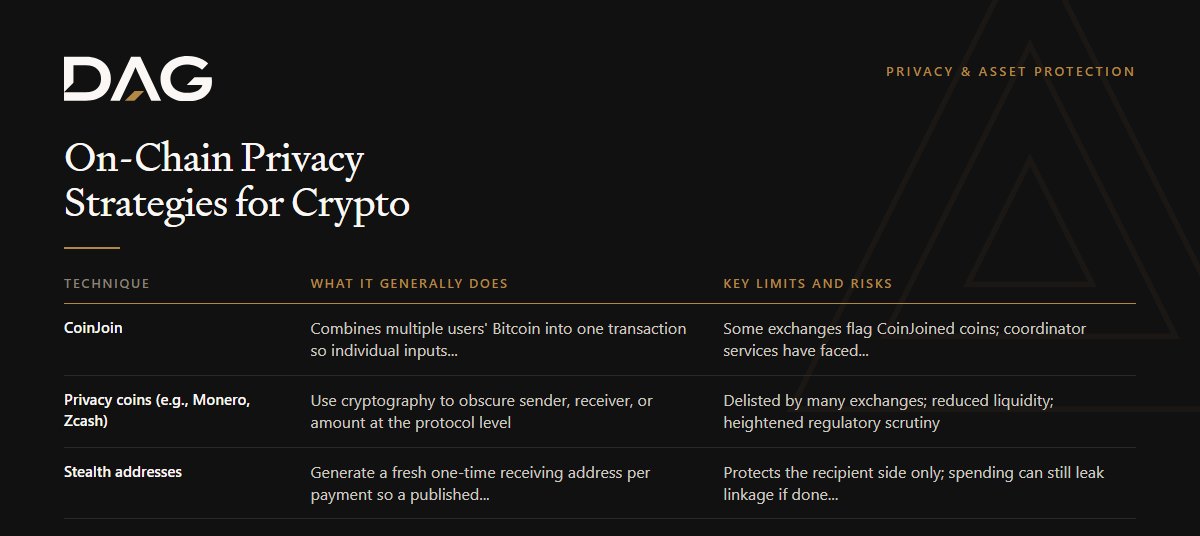
| CoinJoin | Combines multiple users' Bitcoin into one transaction so individual inputs and outputs are harder to link | Some exchanges flag CoinJoined coins; coordinator services have faced enforcement action; not unbreakable against advanced analysis |
| Privacy coins (e.g., Monero, Zcash) | Use cryptography to obscure sender, receiver, or amount at the protocol level | Delisted by many exchanges; reduced liquidity; heightened regulatory scrutiny |
| Stealth addresses | Generate a fresh one-time receiving address per payment so a published address is not reused | Protects the recipient side only; spending can still leak linkage if done carelessly |
| Layer-2 / shielded pools | Move activity off the main chain or into a shielded set to reduce public visibility | Withdrawal patterns and timing can de-anonymize; some pools are sanctioned services |
CoinJoin batches several people's coins into a single transaction so an outside observer cannot cleanly say which output belongs to which input. Privacy coins build concealment into the protocol itself rather than bolting it on. Stealth addresses solve address reuse, the most common privacy leak, by giving each payment its own address. Shielded pools and some layer-2 designs reduce what is publicly visible by moving value into a cryptographically protected set.
None of these is absolute. Chain-analysis techniques, timing correlation, and the KYC checkpoints at exchanges mean privacy is a matter of degree, not a guarantee. The most reliable privacy gain for most holders comes from basic hygiene, not reusing addresses and not publicly linking wallets to your identity, which is covered in keep crypto holdings private.
Related Questions
Are privacy coins and mixers illegal in the United States?
Owning or using privacy technology is not inherently illegal, but specifics matter. OFAC has sanctioned particular mixing services, and interacting with a currently sanctioned entity can violate the law. Several exchanges have delisted privacy coins to manage regulatory risk. Using any of these tools to evade tax or reporting is a crime independent of the tool. Check the current status of a specific service and consult a qualified attorney before use.
Does using on-chain privacy tools reduce my tax obligations?
No. Privacy techniques change what the public can see; they change nothing about what you owe or must report. The IRS treats digital assets as property, and gains and income remain reportable. Using privacy tools to hide a taxable event is evasion. See crypto privacy and asset protection for where lawful privacy ends and concealment begins.
What is the safest way to improve privacy without legal risk?
The lowest-risk gains are operational, not exotic: avoid address reuse, do not publicly tie wallets to your name, and use entity structure to keep your identity off public records. These reduce exposure without touching sanctioned services or flagged tools. For the structural side, see anonymous LLCs and the privacy benefits for holders, and for personal-safety OPSEC, physical security for crypto wealth.
Sources
- IRS. Digital Assets (digital assets treated as property; reporting obligations): https://www.irs.gov/filing/digital-assets
- U.S. Department of the Treasury / OFAC. Specially Designated Nationals and sanctions program. Treasury sanctioned Tornado Cash in 2022 and removed the designation in 2025. Verify current sanctions status and exact URL at treasury.gov / ofac.treasury.gov before relying on it.
- CFTC. Customer Advisory on crypto fraud and risk: https://www.cftc.gov/LearnAndProtect/AdvisoriesAndArticles/index.htm
- FinCEN, guidance on money services businesses and AML obligations, fincen.gov. Verify exact page and URL.
Compliance Note
This content is educational and does not provide legal, tax, or investment advice. It is financial-privacy education only and is not a guide to evading taxes, reporting, sanctions, or AML/KYC obligations, all of which remain fully in force. Some privacy services have been sanctioned by OFAC, and the legal status of specific tools can change; verify current status and consult qualified legal and tax professionals before using any technique described here. DAG coordinates with qualified professionals rather than providing legal or tax advice directly. Registration does not imply a certain level of skill or training.