
A Roth IRA crypto account can shelter digital-asset gains from federal income tax when a qualified distribution is taken after age 59½ and after the five-year holding period, with earnings then excluded from gross income under IRC § 408A. Contribution limits ($7,000, or $8,000 at age 50+, for 2025) and income phase-outs apply, and all standard crypto risks remain. Recordkeeping obligations inside an IRA connect to the broader crypto tax records framework investors need across all digital asset accounts.
What is a Roth IRA and how does it apply to crypto?
A Roth IRA is a retirement account funded with after-tax dollars. Contributions receive no upfront deduction. In exchange, assets held inside the account grow without generating tax on each transaction, and qualifying withdrawals of both contributions and earnings are excluded from gross income, provided the account has been open at least five years and the account holder is age 59½ or older (IRC § 408A(d)(2)).
For crypto investors, this structure addresses a specific tax friction: in a taxable account, every disposal of a digital asset, a sale, a trade, or an exchange, is a taxable event requiring cost-basis tracking and gain/loss reporting under IRS Notice 2014-21. Inside a Roth IRA, the custodian holds the assets on the account's behalf; individual trades do not trigger reportable gain or loss at the account holder level during accumulation.
How do Roth IRA tax rules work for crypto trading and rebalancing?
Inside a Roth IRA, the account, not the individual, is the legal owner of the assets. When the custodian sells Bitcoin and purchases Ethereum at the account holder's direction, that transaction occurs within the IRA and does not produce a Form 8949 entry or Schedule D gain for the individual. Cost-basis tracking at the individual level is not required for trades inside the account.
This matters most for investors who trade frequently, rebalance across tokens, or take profits and re-enter positions, each of which would generate a taxable event in a standard brokerage account.
Key tax rules that apply:
- Contributions are made with after-tax dollars, no deduction.
- Qualifying withdrawals of earnings are excluded from gross income (IRC § 408A(d)(2)).
- Early withdrawals of earnings (before age 59½ or before the five-year rule is met) are subject to income tax plus a 10% additional tax under IRC § 72(t).
- Contributions (not earnings) may be withdrawn at any time without tax or penalty.
- Roth IRAs have no required minimum distributions (RMDs) during the owner's lifetime, unlike traditional IRAs (IRC § 408A(c)(5)).
What are the 2025 and 2026 contribution limits and income phase-outs?
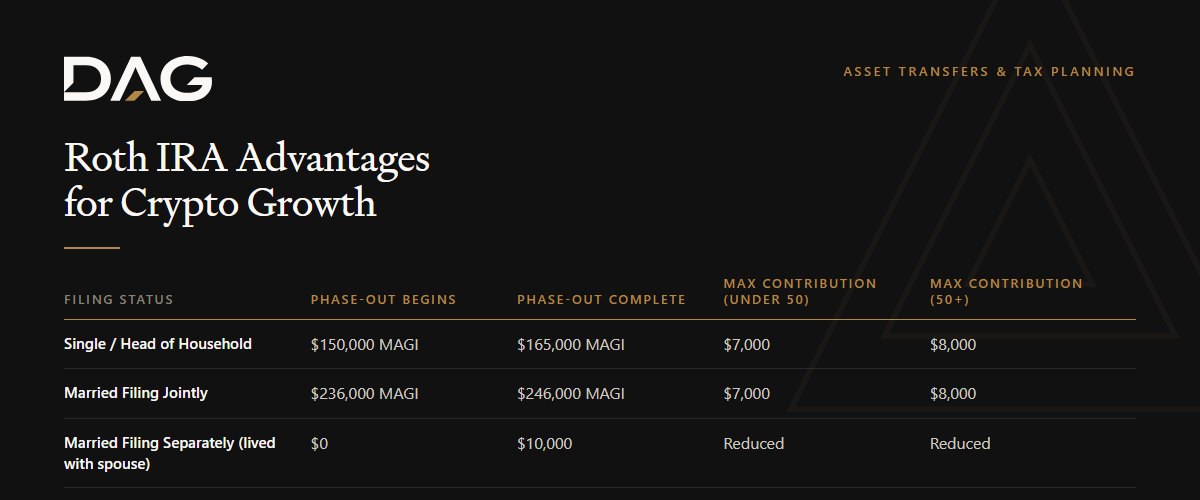
For tax year 2025, Roth IRA contributions are subject to the following limits (IRS Notice 2024-80):
| Filing Status | Phase-Out Begins | Phase-Out Complete | Max Contribution (under 50) | Max Contribution (50+) |
|---|---|---|---|---|
| Single / Head of Household | $150,000 MAGI | $165,000 MAGI | $7,000 | $8,000 |
| Married Filing Jointly | $236,000 MAGI | $246,000 MAGI | $7,000 | $8,000 |
| Married Filing Separately (lived with spouse) | $0 | $10,000 | Reduced | Reduced |
For tax year 2026, the IRS raised the base contribution limit to $7,500 ($8,600 at age 50+), with the single phase-out beginning at $153,000 (complete at $168,000) and the married-filing-jointly phase-out beginning at $242,000 (complete at $252,000) (IRS Notice 2025-67). Verify the figure for your filing year against the current IRS release before contributing.
Contributions also require earned income. The maximum contribution cannot exceed the account holder's earned income for the year. Investment income, including crypto gains in a taxable account, does not count as earned income for this purpose.
Backdoor Roth: Individuals whose modified adjusted gross income (MAGI) exceeds the phase-out ceiling may contribute to a nondeductible traditional IRA and then convert to a Roth IRA. This strategy has tax implications, particularly the pro-rata rule if the individual holds pre-tax IRA assets elsewhere, and should be executed with guidance from a tax professional. The IRS has not prohibited this approach, but Congress could restrict it.
How do you hold actual crypto in a Roth IRA?
Standard brokerages do not support custody of actual digital assets (Bitcoin, Ethereum, and other on-chain tokens) inside an IRA. They may offer exposure through spot ETFs or futures-based products, but not direct coin holdings.
To hold actual crypto inside a Roth IRA:
- Open a self-directed IRA (SDIRA) with a custodian that supports digital assets as an alternative investment. The custodian must be a bank, trust company, or IRS-approved non-bank trustee (IRC § 408(a)).
- Fund the account via direct contribution (subject to annual limits) or by rolling over an existing Roth IRA.
- Direct the custodian to purchase specific digital assets through their partner exchanges or OTC desks.
- The custodian, not the account holder, holds the private keys. IRS rules prohibit the account holder from personally controlling IRA assets (prohibited transaction rules under IRC § 4975).
The account holder directs investment decisions but cannot take personal custody of the crypto. Any arrangement in which the individual controls the private keys would constitute a prohibited transaction, potentially triggering immediate taxation of the entire IRA.
Custodian quality varies significantly across fees, supported assets, custody security, and regulatory standing. Selecting a reputable custodian is a due-diligence step that should not be skipped.
DAG Wealth works with clients to structure crypto retirement accounts, connecting them with qualified custodians, coordinating contribution strategy, and providing investment advisory guidance on allocation within the account.
What are the risks of holding crypto in a Roth IRA?
A Roth IRA wrapper does not reduce crypto's underlying risks:
- Volatility: Bitcoin has declined 50–80% from peak in prior market cycles. Altcoins can lose most or all of their value. The tax shelter applies to gains, if the position declines, the loss stays inside the IRA and cannot be used to offset other income (unlike losses in taxable accounts).
- Early withdrawal: Withdrawing earnings before age 59½ or before the five-year rule is met subjects those earnings to income tax plus the 10% additional tax. This is retirement capital.
- Custodian risk: Self-directed IRA custodians operate in a specialized segment. Some have failed, been acquired, or experienced security incidents. The custody arrangement for the underlying digital assets (who holds the keys, what insurance applies, how assets are segregated) requires independent verification.
- Regulatory risk: The IRS, SEC, and Congress retain authority to change how crypto inside IRAs is treated. Rules around self-directed IRAs, permitted assets, and Roth conversions have been subjects of proposed legislation. Future changes could affect the structure's viability or tax treatment.
- Staking and yield risk: Whether staking digital assets held inside an IRA, or earning on-chain yield, raises unrelated business taxable income (UBTI) or prohibited-transaction concerns is unsettled. The IRS has not issued IRA-specific guidance on staking rewards, and custodians differ on whether they permit it. Treat staking inside a Roth IRA as an open question to review with a tax professional before relying on it.
- Prohibited transaction risk: If the account holder engages in a prohibited transaction, including personally controlling the keys, using the IRA assets to benefit a disqualified person, or certain self-dealing arrangements, the IRA could be disqualified, triggering immediate taxation of the entire account value.
What estate planning advantages does a Roth IRA provide for crypto wealth?
Designated beneficiaries inherit a Roth IRA outside of probate, provided beneficiary designations are current. Qualifying withdrawals by beneficiaries are generally excluded from income, inherited Roth IRA assets pass without the income-tax burden that applies to inherited traditional IRA distributions.
Under the SECURE Act (2019) and SECURE 2.0 Act (2022), most non-spouse beneficiaries must fully distribute inherited IRA assets within 10 years of the account owner's death. The 10-year rule eliminates the "stretch IRA" strategy for most heirs, but qualifying withdrawals remain income-tax-free throughout the distribution period.
Roth IRAs are not exempt from estate tax. If the account holder's estate exceeds applicable federal or state estate-tax thresholds, the IRA's value is included in the gross estate.
For crypto estate planning for high-net-worth families, a Roth IRA is one element of a broader structure, coordination with trust planning, beneficiary designations, and crypto inheritance planning is typically required for larger estates.
Is a Roth IRA appropriate for your crypto strategy?
A Roth IRA may be appropriate when:
- The investor has a long time horizon (minimum 10–15 years before anticipated withdrawal).
- The investor expects to be in an equal or higher tax bracket in retirement than at the time of contribution.
- The investor has earned income at or below the MAGI phase-out ceiling (or can execute a backdoor Roth).
- The capital committed to the IRA is genuinely retirement capital, not funds likely needed within five to ten years.
A Roth IRA is generally less favorable when:
- The investor is in a significantly higher bracket now than expected in retirement (a traditional IRA or other structure may produce better outcomes).
- The investor may need the capital within the next five years.
- The investor requires immediate access for active trading funded by other capital.
The annual contribution limit ($7,000–$8,000 for 2025; $7,500–$8,600 for 2026) means this vehicle is one component of a broader crypto tax planning strategy for HNW investors, not a standalone solution for large crypto positions. Investors with significant holdings should review the full crypto wealth planning checklist and consider whether a crypto IRA vs crypto family office structure better fits their situation.
Related Questions
Can you trade crypto inside a Roth IRA without generating taxes?
Trades directed within a properly structured self-directed Roth IRA generally do not produce gain or loss at the account holder level during accumulation. The account, not the individual, holds the assets, so individual transactions do not trigger Form 8949 reporting. Taxes apply on early (non-qualifying) withdrawals of earnings.
What happens if you withdraw Roth IRA crypto gains before retirement?
Withdrawals of earnings before age 59½ or before the five-year holding period is met are subject to ordinary income tax plus a 10% additional tax under IRC § 72(t). Contributions (the amounts originally deposited, not gains) can be withdrawn at any time without tax or penalty.
Can high earners contribute to a Roth IRA for crypto?
Individuals whose MAGI exceeds the Roth IRA phase-out ceiling ($165,000 single / $246,000 married for 2025) cannot contribute directly. The backdoor Roth strategy, contributing to a nondeductible traditional IRA and converting, may be available, but the pro-rata rule and potential future legislative changes require careful planning with a tax professional.
Are Roth IRA crypto losses deductible?
No. Losses that occur inside a Roth IRA stay within the account. They cannot be used to offset capital gains or ordinary income in a taxable account. This is a meaningful asymmetry: the upside is tax-sheltered, but so is the downside, losses inside the IRA provide no tax offset outside it.
How does a Roth IRA for crypto interact with estate planning?
Roth IRA assets pass to named beneficiaries outside probate. Qualifying withdrawals by beneficiaries are income-tax-free, though most non-spouse beneficiaries must distribute the account within 10 years under current SECURE Act rules. The IRA's value is included in the taxable estate for estate-tax purposes.
Sources
- IRS Notice 2014-21, IRS Virtual Currency Guidance, https://www.irs.gov/irb/2014-16_IRB#NOT-2014-21
- IRC § 408A. Roth IRAs, https://uscode.house.gov/view.xhtml?req=granuleid:USC-prelim-title26-section408A
- IRC § 72(t), 10% additional tax on early distributions, https://uscode.house.gov/view.xhtml?req=granuleid:USC-prelim-title26-section72
- IRC § 4975. Prohibited transaction rules, https://uscode.house.gov/view.xhtml?req=granuleid:USC-prelim-title26-section4975
- IRS Publication 590-A, Contributions to Individual Retirement Arrangements, https://www.irs.gov/publications/p590a
- IRS Notice 2024-80, 2025 cost-of-living adjustments for retirement plans, https://www.irs.gov/pub/irs-drop/n-24-80.pdf
- IRS Notice 2025-67, 2026 cost-of-living adjustments for retirement plans, https://www.irs.gov/retirement-plans/cola-increases-for-dollar-limitations-on-benefits-and-contributions
- IRS Publication 590-B (2023), Distributions from Individual Retirement Arrangements, https://www.irs.gov/publications/p590b
- SECURE Act (Setting Every Community Up for Retirement Enhancement Act of 2019), Pub. L. 116-94
- SECURE 2.0 Act of 2022, Division T of Pub. L. 117-328
Compliance Note
This page is educational and does not constitute legal, tax, or investment advice. Roth IRA rules, contribution limits, income phase-outs, and prohibited transaction restrictions are complex and subject to change by Congress or the IRS. Individual outcomes depend on tax bracket, time horizon, asset performance, custodian selection, and compliance with IRS rules. Consult a qualified tax professional, estate attorney, and registered investment adviser before establishing or funding a self-directed IRA holding digital assets. Past performance of any asset class, including digital assets, is not indicative of future results. Registration does not imply a certain level of skill or training.