
On LLC timing for crypto assets, forming the entity before your portfolio appreciates generally reduces fraudulent-transfer exposure, IRS scrutiny on large transfers, and the rushed decisions that create taxable events. Early structuring is quiet, low-cost, and administratively simple. Acting after appreciation tends to raise both the risk and the cost of every step. The tax implications of contribution timing are part of a broader crypto tax planning picture that includes cost basis documentation and annual reporting obligations.
Why LLC Timing Matters for Crypto Investors
An LLC (limited liability company) separates your personal assets from business or investment liabilities. For digital asset holders, it provides structural insulation between a volatile portfolio and personal exposure to lawsuits, creditor claims, or exchange freezes.
The timing of when you form the LLC, and when you transfer assets into it, determines whether that structure works as intended or creates new legal and tax problems.
What Happens If I Set Up the LLC Before My Crypto Appreciates?
Transferring a $100,000 portfolio into an LLC as a capital contribution generates minimal scrutiny. The transaction is straightforward, documentation requirements are modest, and there is no urgent tax pressure. You have time to work with a qualified attorney and CPA to document the contribution correctly, choose the right tax classification, and build a custody arrangement that fits the structure.
The structure is in place before you need it. That is the entire point.
What Are the Risks of Waiting Until After Appreciation?
Several distinct risks increase as asset value rises.
Fraudulent transfer risk. If you are sued personally and then move appreciated assets into an LLC, a court may treat that transfer as a fraudulent conveyance, an attempt to put assets beyond a creditor's reach. Courts can unwind such transfers even if no fraud was intended. The timing makes the transaction suspect, regardless of your intent.
IRS visibility. Large transfers attract attention. Moving a $2 million portfolio into an LLC is a reported event your accountant must document carefully. Get the tax treatment wrong, treating a sale as a contribution, or triggering gift tax consequences by bringing in other members, and the error is proportionally expensive.
Pressure-driven mistakes. When a portfolio has just surged 10x, there is urgency to structure quickly. Urgency produces shortcuts: incomplete operating agreements, undocumented contribution values, poorly timed elections. These are correctable at lower values; at higher values, correction costs can run into six figures.
Exchange and bank freezes. Assets held entirely in one personal wallet or exchange account can be frozen in disputes. Distributing holdings across properly structured entities, done early, when stakes are lower, limits the blast radius of any single account problem.
What Is a Fraudulent Transfer and How Does It Apply to LLC Formation?
A fraudulent transfer (also called fraudulent conveyance) occurs when a debtor moves assets with the intent to hinder, delay, or defraud a creditor, or does so for less than reasonably equivalent value while insolvent. Most states follow the Uniform Fraudulent Transfer Act (UFTA) or the updated Uniform Voidable Transactions Act (UVTA).
Courts look at badges of fraud: transfer of substantially all assets, transfer to an insider, transfer shortly before or after a lawsuit, and transfer that leaves the debtor insolvent. Setting up a structure years before any litigation appears eliminates most of these indicators.
Does LLC Timing Affect the Tax Treatment of the Transfer?
Yes. The tax treatment of a contribution to an LLC depends on the type of asset, the LLC's tax classification, and whether the contribution meets the requirements for tax-free treatment under IRC §721.
Common mistakes when transferring appreciated assets under pressure:
- Mischaracterizing a sale as a capital contribution (creating an unintended taxable event)
- Failing to document fair market value at the time of contribution
- Triggering gift tax by transferring interest to family members without a proper valuation
- Mishandling the carryover basis rules that affect future gain recognition
Early structuring allows your CPA and attorney to coordinate these details before the numbers are large enough to make errors material.
When Is the Best Time to Set Up a Crypto LLC?
The lowest-risk window is before significant appreciation, while asset values are modest and the transfer is administratively simple. If you already hold appreciated crypto, the analysis changes but the principle does not: early is still better than waiting further, and coordination with qualified tax and legal counsel becomes more important, not less.
A general framework for timing:
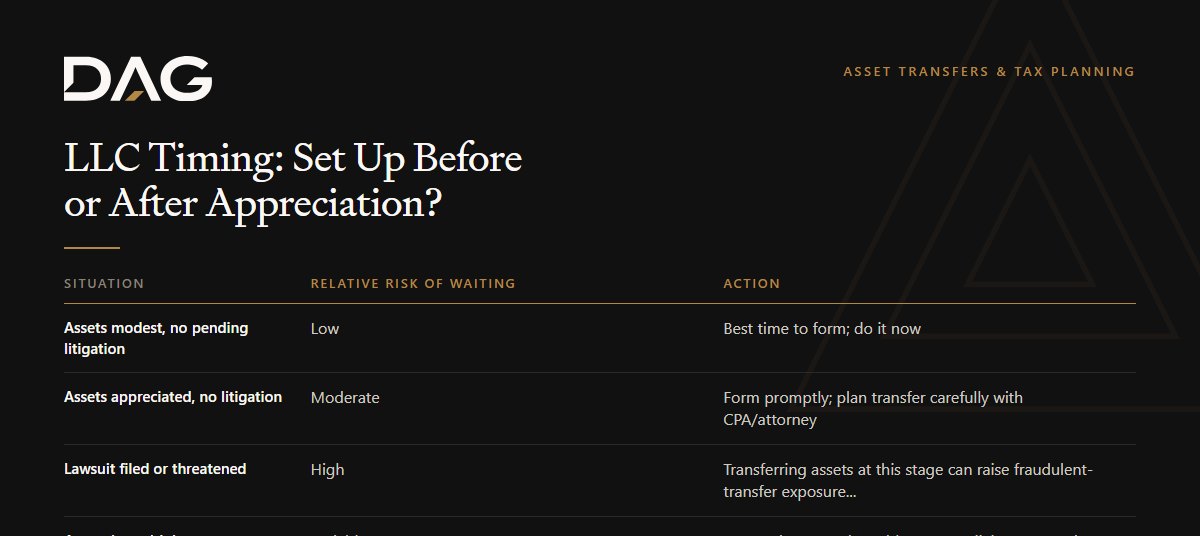
| Situation | Relative risk of waiting | Action |
|---|---|---|
| Assets modest, no pending litigation | Low | Best time to form; do it now |
| Assets appreciated, no litigation | Moderate | Form promptly; plan transfer carefully with CPA/attorney |
| Lawsuit filed or threatened | High | Transferring assets at this stage can raise fraudulent-transfer exposure; legal counsel should review before any transfer |
| Assets in multiple wallets/exchanges | Variable | Structuring may also address custodial concentration risk |
This table is illustrative and educational, not legal advice. Specific facts determine the correct approach; consult qualified legal and tax counsel before transferring any appreciated assets.
Related Questions
Can I transfer appreciated crypto into an LLC without triggering a taxable event?
In some cases, yes. Under IRC §721, contributions to a partnership (including a multi-member LLC taxed as a partnership) may be tax-free if structured correctly. Single-member LLCs disregarded for tax purposes have different rules. The details depend on the asset, the LLC's tax classification, and how the transfer is documented. A CPA familiar with digital assets should review the transaction before it occurs.
Does an LLC actually protect crypto from personal lawsuits?
An LLC can provide meaningful liability separation when it is properly formed, maintained, and funded, before any claim arises. Protection is not absolute: courts can pierce the veil if the LLC is not treated as a separate entity (commingled funds, no operating agreement, no separate accounts). Wyoming LLC asset protection for crypto depends on following the formalities consistently.
What records does a crypto LLC need to keep to support the contribution?
At minimum: a signed operating agreement, documentation of the asset's fair market value on the date of contribution, a record of the wallet or exchange transfer, and an updated capital account ledger reflecting the contribution. See what records a crypto LLC should keep for a more complete list.
Is a Wyoming LLC the right structure for crypto asset protection?
Wyoming is a common choice because it offers strong charging-order protection, recognizes digital asset LLCs by statute, and has no state income tax. Whether it is right depends on where you live, how you hold the assets, and how the LLC will be taxed. See Wyoming LLC vs Delaware LLC for crypto for a side-by-side comparison.
What happens if I need to move crypto into an LLC after appreciation has already occurred?
It is still possible, but requires careful planning. Your attorney should analyze fraudulent transfer exposure under applicable state law. Your CPA should confirm the tax treatment of the transfer. Valuation documentation becomes more important. DAG coordinates this kind of multi-discipline planning for clients who need to structure holdings after the fact.
Sources
- Internal Revenue Code §721, nonrecognition of gain or loss on contribution to a partnership: https://www.irs.gov/pub/irs-drop/rr-04-48.pdf
- Uniform Voidable Transactions Act (2014), Uniform Law Commission: https://www.uniformlaws.org/committees/community-home?CommunityKey=1d0371b5-5e49-4196-8e8a-ac10f9e02c81
- Wyoming Stat. §17-29-114 (LLC charging order protection)
- Wyoming Stat. §34-29-101 et seq. (Digital Asset LLC provisions)
- IRS Notice 2014-21 (virtual currency as property for federal tax purposes): https://www.irs.gov/pub/irs-drop/n-14-21.pdf
Compliance Note
This article is for educational purposes only and does not constitute legal, tax, or investment advice. LLC formation, asset transfers, and tax treatment depend on individual facts and applicable state and federal law. Consult a qualified attorney and CPA before transferring any assets into an entity structure. DAG provides wealth coordination services; it does not provide legal representation or tax preparation. Investment advisory services are offered through DAG Wealth, a registered investment adviser.
For coordinated entity structuring, tax planning, and digital asset custody, contact DAG Wealth to discuss your situation before circumstances force the decision. Registration does not imply a certain level of skill or training.