
A digital asset LLC can deduct ordinary and necessary business expenses under IRC §162, but only when the LLC operates as a trade or business rather than a passive investor. Qualifying expenses may include hardware wallets, security devices, trading and tax software, data subscriptions, professional education, business travel, a dedicated home office, and qualifying vehicles. Consult a CPA for your structure.
What Makes an Expense Deductible Through a Digital Asset LLC?
Under IRC §162, a trade or business may deduct expenses that are (1) ordinary, common in the industry, and (2) necessary, appropriate and helpful to the business. For a crypto tax reporting for LLCs context, that distinction matters: a trading LLC that actively generates income is more likely to satisfy the §162 trade-or-business test than a passive holding entity, which the IRS may classify as an investor rather than a business. An investor entity generally deducts fewer expenses and faces stricter limitations under §212.
The entity must also be real: its own bank account, actual records, and legitimate investment activity. An LLC formed solely to reclassify personal expenses is a compliance liability, not a tax strategy. Substantiation rules sit alongside the broader crypto tax records practices every digital asset entity should maintain.
Which Specific Expenses Can the LLC Deduct?
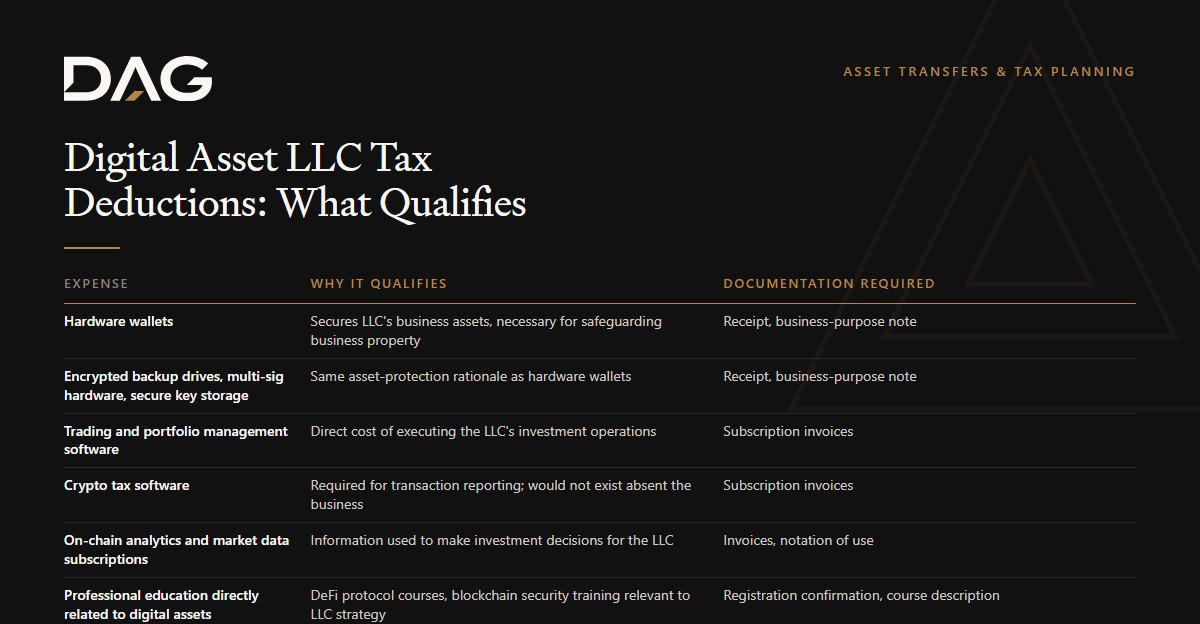
The table below maps expense categories to their deductibility logic and documentation requirements.
| Expense | Why It Qualifies | Documentation Required |
|---|---|---|
| Hardware wallets | Secures LLC's business assets, necessary for safeguarding business property | Receipt, business-purpose note |
| Encrypted backup drives, multi-sig hardware, secure key storage | Same asset-protection rationale as hardware wallets | Receipt, business-purpose note |
| Trading and portfolio management software | Direct cost of executing the LLC's investment operations | Subscription invoices |
| Crypto tax software | Required for transaction reporting; would not exist absent the business | Subscription invoices |
| On-chain analytics and market data subscriptions | Information used to make investment decisions for the LLC | Invoices, notation of use |
| Professional education directly related to digital assets | DeFi protocol courses, blockchain security training relevant to LLC strategy | Registration confirmation, course description |
| Industry conferences, registration, travel, hotel, meals | Business knowledge directly applicable to LLC operations | Itinerary, receipts, business purpose |
| Business travel (advisor meetings, due diligence) | Necessary for managing the LLC's portfolio | Itinerary, receipts, mileage log |
| Dedicated home office (exclusive business use only) | Pro-rata share of rent/mortgage interest, utilities, insurance, internet | Square footage calculation, total home expense records |
| Business-use phone portion | Prorated business vs. personal use | Usage log or carrier records |
| Qualifying vehicles (GVWR >6,000 lbs). Section 179 | Accelerated depreciation on vehicles used for business purposes | Mileage log showing business % |
What Is the Business-vs-Investor Distinction and Why Does It Matter?
The IRS distinguishes between a trade or business (§162) and an investor (§212). A business-classified entity can deduct the full range of ordinary and necessary expenses. An investor entity is limited to investment-related expenses. Under prior law these were miscellaneous itemized deductions subject to a 2%-of-AGI floor, but the Tax Cuts and Jobs Act suspended that category for tax years 2018 through 2025, meaning investor-level §212 expenses were generally non-deductible during that window. Whether the suspension lapses, is extended, or is made permanent for 2026 and later depends on then-current law, so confirm the rule for your filing year.
For a digital asset LLC to qualify as a trade or business, the manager's activity must be regular, continuous, and primarily for income rather than long-term appreciation. High-frequency trading activity supports the business classification; buy-and-hold alone generally does not. The specific tax treatment also depends on whether the LLC is taxed as a sole proprietorship, partnership, or S corporation, each of which handles deductions differently. The threshold question of whether to hold crypto personally, in an LLC, or in a trust shapes which expenses are even available to deduct.
How Does Section 179 Work for Vehicles Over 6,000 Pounds?
IRC §179 allows a business to expense (rather than depreciate over years) the cost of qualifying property, including vehicles with a gross vehicle weight rating (GVWR) above 6,000 pounds, up to the annual §179 limit (adjusted annually for inflation).
The critical requirement is actual business use. The deduction is prorated to the percentage of miles driven for business. A vehicle used 30% for business yields a 30% deduction, not 100%. Claiming 100% business use on a vehicle also used for personal transportation is a known audit trigger. Mileage logs showing date, destination, business purpose, and miles for each trip are the required substantiation.
What Expenses Do Not Qualify?
- Personal expenses recast as business costs (gym memberships, family meals, personal vacations with a single brief business meeting)
- General business education not connected to digital asset operations
- Degree programs
- Vehicles where business use is not documented
- Expenses paid personally and not reimbursed through the LLC under a formal accountable plan
What Documentation Standards Apply?
The IRS can request substantiation years after filing. For each expense, maintain:
- Receipt showing date, vendor, and amount
- Business-purpose notation (what was purchased and why it was necessary for LLC operations)
- For travel: itinerary, receipts per category, clear business purpose for each trip
- For vehicles: a contemporaneous mileage log (not reconstructed after the fact)
- For home office: floor-plan or square-footage calculation, total home-expense records for the year
Weak documentation, especially reconstructed after an IRS inquiry, rarely survives audit.
Related Questions
Can a digital asset LLC deduct hardware wallet purchases?
Yes, if the wallet secures assets held by the LLC as business property. A hardware wallet protecting the LLC's crypto holdings is an ordinary and necessary business expense under §162, analogous to security equipment for any business. Keep the receipt and document that the wallet is used for LLC assets, not personal holdings.
What is the difference between a business deduction and an investment expense for crypto LLCs?
A business deduction (§162) applies when the LLC qualifies as a trade or business, regular, continuous activity conducted for income. An investment expense (§212) applies to passive investor entities. The classification determines which expenses are deductible and at what limit. An LLC's tax treatment depends on its structure and activity level; a tax professional should confirm which category applies.
Does Section 179 apply to hardware and software bought through a digital asset LLC?
Yes. Beyond vehicles, §179 covers business personal property including computers, servers, and certain off-the-shelf software. Hardware wallets and trading workstations used for LLC operations may qualify. The asset must be placed in service during the tax year and used predominantly for business. Check the current-year §179 limit with a CPA, as it adjusts annually.
Is a home office deductible if I manage my crypto LLC from home?
It can be, under strict conditions. The space must be used regularly and exclusively for LLC business, no dual-purpose rooms. The deductible portion equals the business-use percentage of actual home expenses (rent or mortgage interest, utilities, insurance, internet). Document the square footage calculation and retain home expense records for the year.
Can the LLC deduct conference travel and continuing education?
Yes, if the education or event is directly related to the LLC's digital asset operations. Travel to a DeFi conference or blockchain security training with clear application to LLC strategy qualifies. General business courses unrelated to digital assets, degree programs, or trips where business is incidental to personal travel do not.
Sources
- IRC §162. Trade or Business Expenses: https://www.law.cornell.edu/uscode/text/26/162
- IRC §179. Election to Expense Certain Depreciable Business Assets: https://www.law.cornell.edu/uscode/text/26/179
- IRC §212. Expenses for Production of Income: https://www.law.cornell.edu/uscode/text/26/212
- IRS Publication 463. Travel, Gift, and Car Expenses: https://www.irs.gov/publications/p463
- IRS Publication 587. Business Use of Your Home: https://www.irs.gov/publications/p587
- IRS Publication 946. How to Depreciate Property (§179): https://www.irs.gov/publications/p946
- IRS Topic 704. Depreciation: https://www.irs.gov/taxtopics/tc704
Compliance Note
This page is for educational purposes only and does not constitute legal, tax, or investment advice. Tax treatment depends on your specific entity structure, activity level, filing elections, and applicable tax year. The business-vs-investor distinction under IRC §162 vs §212 requires professional analysis. Consult a qualified CPA or tax attorney before claiming deductions through a digital asset LLC. DAG coordinates tax strategy as part of broader family office services but does not provide standalone tax preparation.