
Crypto portfolio rebalancing is the practice of bringing holdings back toward target weights after price moves push them out of line. For high-net-worth investors, the hard part is not the math but the taxes: selling appreciated crypto to rebalance can be a taxable event. Most rebalancing decisions therefore weigh drift, risk, and tax cost together. This is educational and not investment advice.
What Is Portfolio Rebalancing in Crypto?
Rebalancing means adjusting positions back toward a chosen allocation. If a target is 60% Bitcoin and 40% everything else, and Bitcoin rallies to 80% of the portfolio, the portfolio now carries more concentration and risk than intended. Rebalancing trims the overweight position and adds to the underweight ones to restore the plan.
In crypto the effect is amplified because volatility is high, so weights drift fast and far. The same volatility that makes rebalancing useful for managing risk also makes it expensive to execute, because trimming a winner that has appreciated sharply can realize a large capital gain.
This page is written for the investor deciding whether and how to rebalance their own holdings. The operational, compliance-driven version of this question, run inside an advisory firm across many client accounts, is a different topic; see crypto model portfolios for financial advisors for that perspective.
When Should HNW Investors Rebalance?
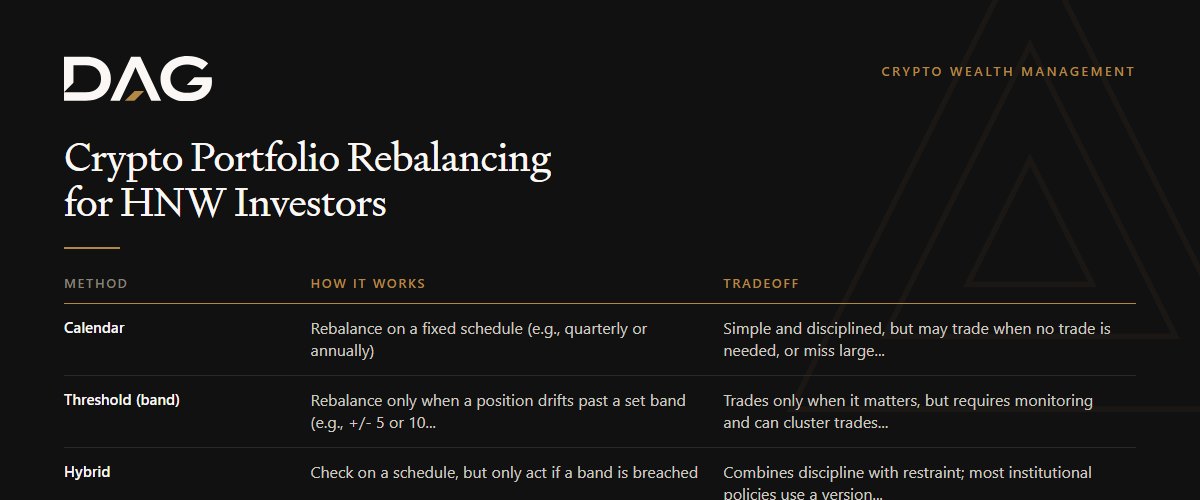
There is no single correct trigger. Three common approaches, each with tradeoffs:
| Method | How it works | Tradeoff |
|---|---|---|
| Calendar | Rebalance on a fixed schedule (e.g., quarterly or annually) | Simple and disciplined, but may trade when no trade is needed, or miss large mid-period drift |
| Threshold (band) | Rebalance only when a position drifts past a set band (e.g., +/- 5 or 10 percentage points) | Trades only when it matters, but requires monitoring and can cluster trades in volatile periods |
| Hybrid | Check on a schedule, but only act if a band is breached | Combines discipline with restraint; most institutional policies use a version of this |
For HNW investors, wider bands often make sense in crypto because narrow bands force frequent, taxable trades in a highly volatile asset. The right band depends on risk tolerance, the size of the position, and tax exposure, which is a personal decision best made with a tax professional and fiduciary adviser.
Tax-Aware Rebalancing
Because the IRS generally treats digital assets as property, selling to rebalance realizes a gain or loss. The tax bill, not the trade, is usually the binding constraint for HNW holders. Techniques that can reduce the tax cost of staying balanced:
- Rebalance with new cash. Direct new contributions to underweight positions instead of selling overweight ones. This shifts weights without realizing gains.
- Use the longer holding period. Assets held more than one year are generally taxed at long-term capital-gains rates, lower than short-term. Sequencing sales to favor long-term lots can lower the cost of a rebalance.
- Specific-identification lot selection. Selecting which tax lots to sell can let you realize lower-gain (or loss) lots first. See specific identification for crypto.
- Pair with tax-loss harvesting. Offsetting gains from trimming winners with realized losses elsewhere can reduce the net taxable amount; see crypto tax-loss harvesting for high-net-worth investors.
- Rebalance inside tax-advantaged or entity structures where trades may not trigger personal-level tax, where available and appropriate.
None of these eliminate tax; they manage timing and rate. Outcomes depend entirely on your facts and current law, so confirm specifics with a qualified tax professional.
Rebalancing and Concentration Risk
Rebalancing is one tool for a larger problem: a single token dominating net worth. A disciplined rebalancing policy is often paired with a broader plan for reducing concentration over time without triggering an avoidable tax shock. The related crypto concentration risk management and crypto diversification strategy guides cover that wider context, including non-sale tools such as borrowing against a position rather than selling it.
Related Questions
How often should I rebalance a crypto portfolio?
There is no universal answer. Many investors use a threshold (band) approach, acting only when an asset drifts past a set range, sometimes checked on a quarterly schedule. In crypto, wider bands are common because narrow ones force frequent taxable trades in a volatile market. The right cadence depends on your risk tolerance and tax situation, and should be set with a fiduciary adviser.
Does rebalancing crypto trigger taxes?
Generally yes, if you sell. The IRS treats digital assets as property, so selling an overweight position to rebalance can realize a capital gain. Rebalancing with new cash, harvesting losses, and choosing tax lots carefully can reduce, but not eliminate, the tax cost. Consult a tax professional for your facts.
Is rebalancing the same as diversifying?
No. Diversifying changes the targets themselves (adding asset types, custodians, or structures). Rebalancing restores an existing target after prices have drifted. The two are often used together, especially when reducing a concentrated position over time.
How is HNW rebalancing different from what an advisor does across accounts?
An investor rebalances one portfolio against personal goals and tax lots. An advisory firm rebalances standardized model portfolios across many client accounts under compliance and trade-ordering rules. The principles overlap, but the constraints differ; see crypto model portfolios for financial advisors.
For where rebalancing fits in the overall plan, see the crypto wealth management hub. If you are weighing how to hold the assets you rebalance, onshore vs offshore crypto structures covers the structuring decision.
Sources
- IRS: Digital assets (irs.gov/filing/digital-assets)
- IRS Topic No. 409, Capital Gains and Losses (irs.gov)
- IRS Form 8949 and Schedule D, and their instructions
Compliance Note
This page is educational and is not investment, tax, or legal advice. No allocation, rebalancing band, or technique is suitable for everyone, and none removes market, custody, or tax risk; figures and rates change, so verify current law. Rebalancing decisions should be made with a qualified tax professional and a fiduciary adviser. Investment advisory services are provided through DAG Wealth. Registration does not imply a certain level of skill or training.