
The buy-borrow-die strategy is a way high-net-worth digital asset holders may access liquidity without selling appreciated Bitcoin or Ethereum. Instead of selling and realizing capital gains, you pledge assets as collateral for a credit line or borrow against life insurance cash value, so the holdings can stay invested while you draw on the loan proceeds.
What Is the Buy-Borrow-Die Strategy?
Buy-borrow-die is a wealth-transfer and liquidity technique built on a straightforward observation: assets are worth more on your balance sheet than they are after you sell them and pay taxes. The strategy has three phases:
- Buy, acquire and hold appreciating assets (Bitcoin, Ethereum, real estate, equity)
- Borrow, pledge those assets as collateral to access credit without a taxable sale
- Die, under current law (IRC §1014, subject to legislative change), assets generally receive a stepped-up cost basis at death and heirs inherit at fair market value; with appropriate planning, the debt is settled from the estate while the unrealized gain may pass without being recognized
For digital asset holders, the primary borrowing mechanisms are:
- Crypto-collateralized credit lines, institutional lenders and custodians extend credit against Bitcoin or Ethereum pledged as collateral. No sale occurs, so no taxable event is triggered at the time of borrowing. The asset continues to appreciate (or decline) on your balance sheet.
- Life insurance cash value (infinite banking), permanent life insurance policies accumulate tax-deferred cash value. Policyholders can borrow against that cash value, generally without surrendering the death benefit or triggering a taxable event as long as the policy remains in force. Policy loans are generally not treated as income.
Both tools share the same core logic: borrow rather than sell; let the asset keep compounding.
How Does Crypto Collateral Lending Work?
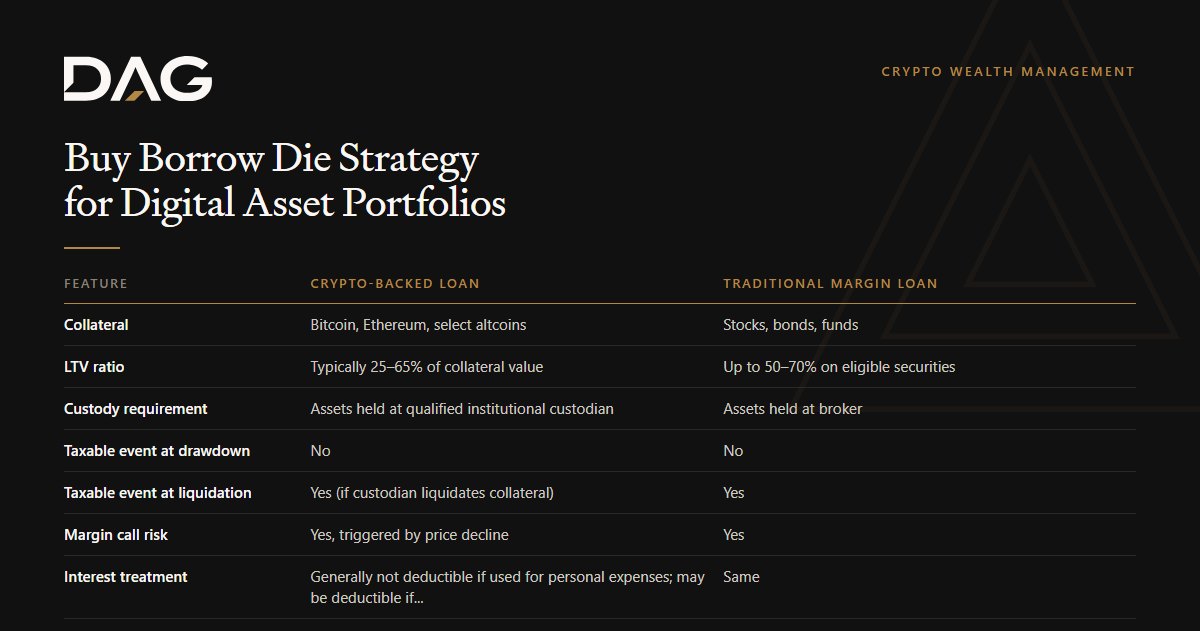
| Feature | Crypto-Backed Loan | Traditional Margin Loan |
|---|---|---|
| Collateral | Bitcoin, Ethereum, select altcoins | Stocks, bonds, funds |
| LTV ratio | Typically 25–65% of collateral value | Up to 50–70% on eligible securities |
| Custody requirement | Assets held at qualified institutional custodian | Assets held at broker |
| Taxable event at drawdown | No | No |
| Taxable event at liquidation | Yes (if custodian liquidates collateral) | Yes |
| Margin call risk | Yes, triggered by price decline | Yes |
| Interest treatment | Generally not deductible if used for personal expenses; may be deductible if proceeds fund investments (consult a tax adviser) | Same |
Key mechanics: you retain beneficial ownership of the pledged assets. Interest accrues on amounts drawn. If the collateral value drops below the lender's maintenance threshold, you may need to post additional collateral or repay a portion, this is the primary execution risk in a volatile asset class.
Working with a digital asset wealth advisor who understands both crypto custody and lending structures reduces the chance of margin calls disrupting a broader wealth plan.
What Is Infinite Banking and How Does It Apply to Crypto Wealth?
Infinite banking refers to using the cash value inside a whole life or indexed universal life (IUL) insurance policy as a self-directed credit facility. The mechanism:
- Premiums build cash value inside the policy, growing tax-deferred
- The policyholder borrows against that cash value, not from it; the full cash value continues compounding while the loan is outstanding
- Loan repayment is flexible; unpaid loan balances are deducted from the death benefit at death
- Policy loans are generally not treated as taxable income while the policy stays in force; cash value growth is tax-deferred; the death benefit is generally income-tax free to heirs. A lapse or surrender can make previously untaxed amounts taxable, see the policy risk below.
For someone holding concentrated crypto positions, infinite banking provides a stable, non-correlated liquidity source. When Bitcoin prices are depressed and a crypto-collateralized loan would require posting substantial additional collateral, a life insurance policy's cash value is unaffected by crypto volatility.
The two strategies are often layered: a crypto-backed line of credit addresses opportunistic near-term needs; life insurance cash value provides a durable, low-volatility liquidity buffer for longer horizons.
Suitability note: permanent life insurance products carry complexity and cost. Premium financing strategies and high-premium IUL structures require careful analysis of policy projections, carrier creditworthiness, and tax treatment. These products are appropriate for some high-net-worth situations and not others. This page is educational only, it is not a recommendation to purchase any specific product.
What Coordination Does a Structured Buy-Borrow-Die Plan Require?
Executing this strategy across a large digital asset portfolio is not a single-product decision. It requires coordinating:
- Custody, pledged crypto must be held at an institutional custodian acceptable to the lender. Self-custodied assets held on hardware wallets or personal wallets generally cannot serve as loan collateral without first transferring to a qualified custodian. See crypto-backed loans for high-net-worth investors for custodian considerations.
- Concentration risk, holding a large, undiversified Bitcoin or Ethereum position as collateral concentrates both price risk and collateral risk. A margin call on a concentrated position can force a liquidation at the worst time. Crypto concentration risk management addresses how to structure a position that can bear collateral requirements without forcing a sale.
- Tax coordination, loan proceeds are generally not treated as income. Loan interest may or may not be deductible depending on use. At death, the step-up basis rule (IRC §1014, under current law and subject to legislative change) generally resets the cost basis, the "die" step the strategy relies on. A CPA familiar with digital assets should model the estate picture alongside the borrowing structure. Crypto tax planning for HNW investors covers the tax mechanics in more detail.
- Estate structure, if assets are held inside a trust or LLC (common for asset protection and succession purposes), the lending documentation must accommodate the entity as the borrower. Estate planning counsel should review lien placement and beneficiary designations.
- Fiduciary investment oversight, an SEC-registered investment adviser operating under a fiduciary standard (not a suitability standard) should oversee the overall portfolio strategy, including how the borrowed proceeds are invested. The advisory layer ensures that debt is not layered onto the portfolio in ways that work against the client's financial plan.
DAG coordinates these elements across custody, tax, estate, and advisory disciplines. The investment advisory layer is provided by DAG Wealth, an SEC-registered investment adviser operating under a fiduciary duty.
What Are the Risks of Buy-Borrow-Die for Crypto Holders?
Margin call and forced liquidation. If crypto prices fall sharply, lenders may require additional collateral or repayment. A forced sale of collateral to cover a margin call is a taxable event, exactly what the strategy is designed to avoid. Loan-to-value ratios should be conservative relative to the asset's historical drawdown profile. Bitcoin has declined 80%+ from peaks in multiple cycles.
Regulatory and lender uncertainty. Institutional crypto lending is less standardized than securities-backed lending. Lender terms, available LTV ratios, and interest rates vary significantly. Some lenders have suspended or restricted crypto-backed lending following market disruptions. Lender due diligence is essential.
Estate complexity. If the borrower dies with outstanding loans, the debt reduces the estate's net value transferred to heirs. Life insurance death benefits can be structured to retire the debt, but this requires coordinated planning, not an afterthought.
Permanent life insurance policy risk. Cash value projections are illustrations, not guarantees. If a policy underperforms illustrated assumptions, the cash value available for borrowing may be lower than expected. Policy lapse, triggered by unpaid loan balances exceeding cash value, would convert the outstanding loan balance into taxable income.
Interest accumulation. Borrowing has a cost. If asset appreciation does not outpace interest expense, the net result of borrowing can be negative.
Related Questions
Does borrowing against Bitcoin trigger capital gains tax?
No. Taking a loan secured by Bitcoin is not a taxable disposition. You retain ownership of the asset; the loan proceeds are not income. Capital gains tax would only be triggered if the lender liquidates the collateral, for example, to satisfy a margin call. Structuring LTV conservatively and monitoring collateral ratios reduces but does not eliminate that risk.
Can crypto held in a trust or LLC serve as collateral for a loan?
Generally yes, but lender requirements vary. The entity (trust or LLC) typically must be the named borrower, and the lender will review the operating agreement or trust document, beneficiary designations, and entity structure before extending credit. Some lenders restrict collateral to assets held in individual accounts. Confirm with your lender and estate counsel before transferring assets.
How does the stepped-up basis work for Bitcoin at death?
Under IRC §1014, as the law currently stands, heirs generally inherit assets at fair market value on the date of death rather than the decedent's original cost basis. If you bought Bitcoin at $5,000 and it is worth $100,000 at your death, your heir's basis would generally be $100,000, and the embedded gain may pass without being recognized as income. Loans outstanding at death are settled from the estate, but the step-up generally applies regardless of whether debt was outstanding. This is a current-law treatment that is subject to legislative change; consult a qualified tax adviser.
What is the difference between a crypto-backed loan and selling and rebuying?
Selling triggers capital gains tax on appreciation. A loan does not. Rebuying after a sale resets cost basis at the higher price, which is partially beneficial for future step-up purposes but eliminates the deferred gain benefit in the near term. For a holder with a very low cost basis and a long investment horizon, avoiding the sale preserves both the unrealized gain and continued compounding. Compare the after-tax proceeds of a sale with the cost of borrowing before deciding. See bitcoin-backed loan vs selling bitcoin for a direct comparison.
Is infinite banking appropriate for every high-net-worth crypto holder?
No. Permanent life insurance is complex, has front-loaded costs, and requires consistent premium payments over a multi-year period before the cash value accumulates to a meaningful liquidity buffer. For someone with an urgent near-term liquidity need, a crypto-backed line of credit is generally more appropriate. Life insurance cash value works best as a long-horizon, non-correlated liquidity layer. Suitability depends on health, insurability, premium capacity, and existing insurance coverage.
Sources
- IRC §1014. Basis of property acquired from a decedent: https://www.law.cornell.edu/uscode/text/26/1014
- IRC §72. Annuities; certain proceeds of endowment and life insurance contracts (tax treatment of policy loans): https://www.law.cornell.edu/uscode/text/26/72
- IRS Publication 550. Investment Income and Expenses (deductibility of investment interest): https://www.irs.gov/publications/p550
- SEC. Investment Advisers Act of 1940, fiduciary duty: https://www.sec.gov/divisions/investment/iard/iacornerstone.htm
- FINRA. Margin: Borrowing Money to Pay for Stocks: https://www.finra.org/investors/learn-to-invest/advanced-investing/margin-borrowing-money-pay-stocks
Compliance Note
This page is published by Digital Ascension Group (DAG) for educational purposes only. It does not constitute legal, tax, investment, or insurance advice. Investment advisory services are provided by DAG Wealth, an SEC-registered investment adviser. Registration does not imply a particular level of skill or training. Insurance products are offered through licensed insurance professionals; suitability and availability vary by individual circumstances and jurisdiction. The buy-borrow-die strategy, crypto-collateralized lending, and permanent life insurance products carry material risks including but not limited to margin calls, lender policy changes, policy lapse, and tax law changes. Past performance of any asset is not indicative of future results. Consult qualified legal, tax, and financial professionals before implementing any strategy described here.