
Short Answer
In the crypto wealth manager vs crypto broker comparison, a broker generally helps you buy, sell, and access digital assets, while a wealth manager coordinates the wider picture: how much exposure to hold, where assets are custodied, how transactions are reported, how keys are handled, and how crypto fits the family balance sheet. Most high-net-worth holders need both roles.
Why This Matters
Trading access is useful, but high-net-worth crypto holders usually need more than execution. A portfolio that a spouse, trustee, family office, CPA, attorney, and custodian can all review requires structure, not just a place to place orders. A broker may be one provider in that ecosystem. The wealth management question is how the whole ecosystem fits together, which is the core of crypto wealth management for serious balances.
How It Works
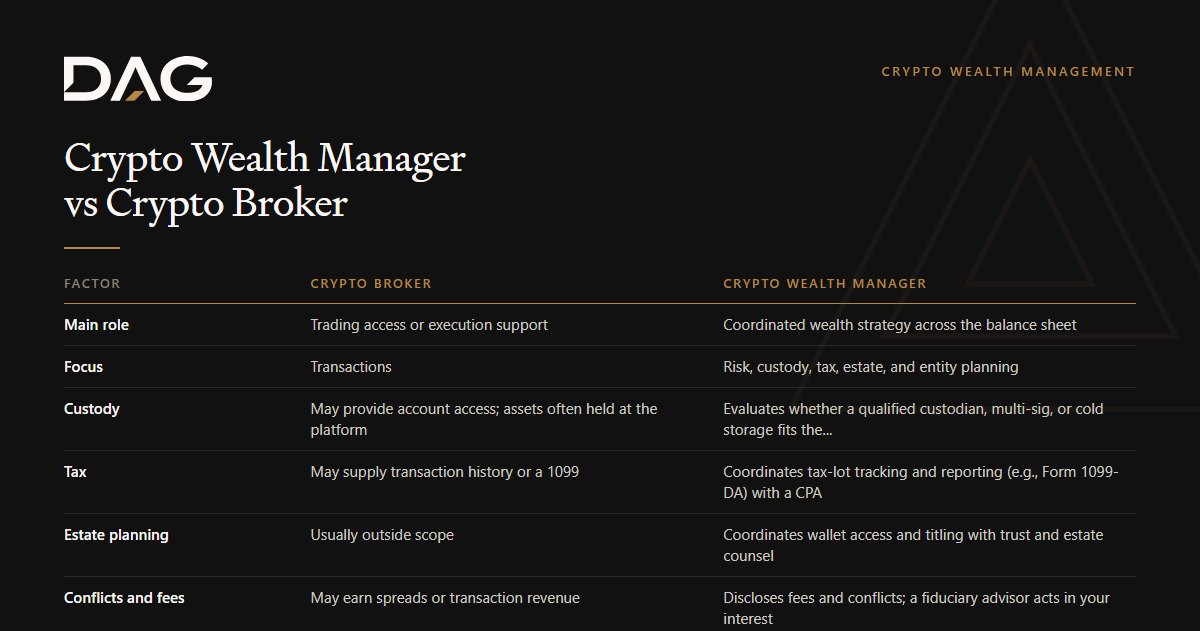
The two roles are distinct service categories. The comparison below maps where each one generally focuses. These are typical distinctions, not universal rules, and any specific provider should be checked against its own disclosures and registration status.
| Factor | Crypto Broker | Crypto Wealth Manager |
|---|---|---|
| Main role | Trading access or execution support | Coordinated wealth strategy across the balance sheet |
| Focus | Transactions | Risk, custody, tax, estate, and entity planning |
| Custody | May provide account access; assets often held at the platform | Evaluates whether a qualified custodian, multi-sig, or cold storage fits the plan |
| Tax | May supply transaction history or a 1099 | Coordinates tax-lot tracking and reporting (e.g., Form 1099-DA) with a CPA |
| Estate planning | Usually outside scope | Coordinates wallet access and titling with trust and estate counsel |
| Conflicts and fees | May earn spreads or transaction revenue | Discloses fees and conflicts; a fiduciary advisor acts in your interest |
| Family office fit | Limited | More relevant for multi-party governance |
Evidence Standard
This comparison reflects service-category differences, not a claim about any specific client outcome. Neither role removes market, custody, or tax risk. Any named competitor comparison should be reviewed against current public materials, and registration status alone does not guarantee skill or results.
When a Broker May Be Enough
- You already know what you want to trade and mainly need execution support.
- Your crypto is small relative to your total wealth.
- You do not currently need estate, tax, custody, or family governance coordination.
When a Broker May Not Be Enough
A broker relationship may not answer structural questions: who controls the wallets, how assets are titled, what happens to keys after death, whether tax lots are documented, or how digital assets sit inside trust and entity planning. These are the questions that matter most when protecting crypto wealth over the long term, and they sit at the center of the crypto wealth management hub.
Related Questions
Can someone use both a broker and a wealth manager?
Generally, yes. A broker, exchange, custodian, and wealth manager can each play a different role. The key point is that someone needs responsibility for the full structure, not just the trades. Confirm how the pieces are coordinated before relying on any one of them.
Is a crypto wealth manager always an investment adviser?
Not necessarily. Investment advisory services are regulated and must be provided through an appropriately registered entity, which you can verify on Form ADV. Some firms also coordinate non-advisory family office, tax, legal, or operational services, so it depends on the facts of each engagement.
What should high-net-worth crypto holders ask before choosing?
Ask who handles custody, who the qualified custodian is, how tax reporting works, how estate and entity structure are addressed, who holds investment discretion, how fees and conflicts are disclosed, and what the firm's regulatory status is. The criteria overlap heavily with how to choose a crypto wealth manager.
Bottom Line
A broker helps with access. A crypto wealth manager helps with structure. Wealthy digital asset holders often need both, but they are not the same job, and no provider on either side can eliminate market, custody, or tax risk. Consult a qualified professional before acting.
Sources
Compliance Note
This article is for general educational purposes and is not legal, tax, or investment advice. Service categories, registration status, and obligations vary by provider.