
Crypto regulations by jurisdiction vary widely: the UK's FCA runs a registration-and-promotions regime, Canada's CSA and provincial regulators treat most crypto platforms as securities or derivatives dealers, Australia's ASIC applies existing financial-services licensing, and the EU's MiCA is a single bespoke crypto framework across all member states. This page compares the four at a high level for cross-border holders.
Note: This page is a general regulatory overview, not legal or investment advice. Crypto rules in every jurisdiction below are changing quickly and the specifics depend on the activity and the entity. Digital Ascension Group is US-registered and is not licensed or authorised in the UK, Canada, Australia, or the EU. Verify current rules with locally licensed counsel before acting.
What Does "Regulated by Jurisdiction" Actually Mean for Crypto?
Crypto regulation generally answers three separate questions in each country: who may operate a crypto business (licensing and registration of exchanges and custodians), how crypto may be marketed to retail investors (financial-promotions rules), and how a given token is classified (commodity, security, e-money, or a bespoke crypto category). Different countries answer these in different orders and through different agencies.
That difference matters for a cross-border holder because the regulator that governs your exchange, your adviser, or your token is determined by where each sits, not by where you live. A US person using a UK exchange is dealing with an FCA-registered firm, while their US tax duties continue unchanged. Regulation (who can offer the product) and taxation (who taxes the gain) are separate analyses; the tax side is covered in crypto tax treaty implications for the US, UK, Canada, and Germany.
This overview is part of DAG's international crypto wealth coverage. For the UK in depth, including HMRC tax treatment, not just regulation, see crypto regulations for UK investors.
How Do the Four Regimes Compare?
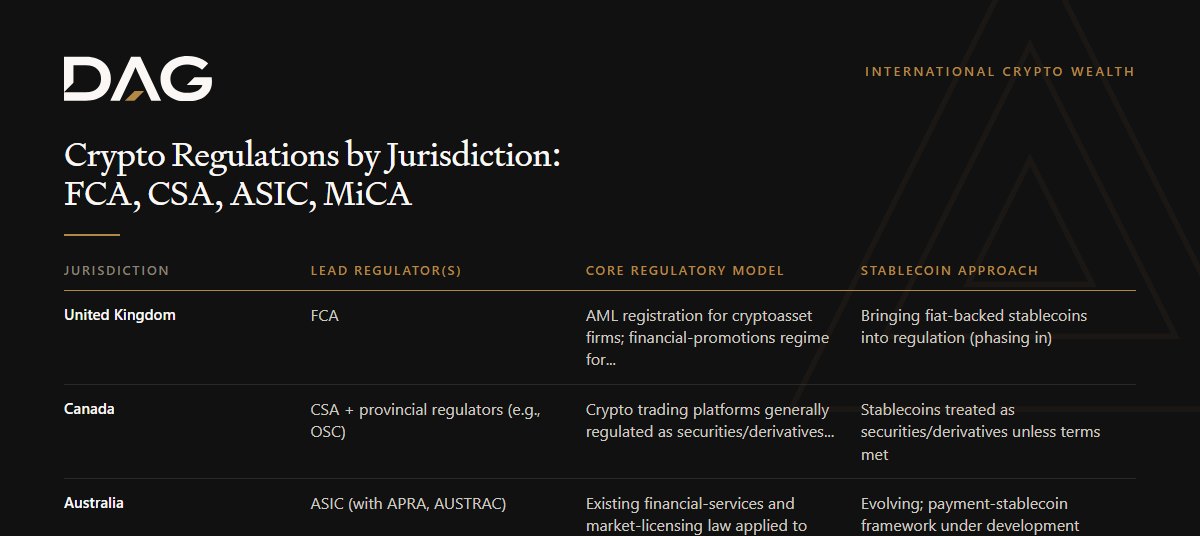
The four regimes take structurally different approaches. The table summarizes the regulator and the core model; details follow.
| Jurisdiction | Lead regulator(s) | Core regulatory model | Stablecoin approach |
|---|---|---|---|
| United Kingdom | FCA | AML registration for cryptoasset firms; financial-promotions regime for marketing; broader regime expanding | Bringing fiat-backed stablecoins into regulation (phasing in) |
| Canada | CSA + provincial regulators (e.g., OSC) | Crypto trading platforms generally regulated as securities/derivatives dealers; pre-registration undertakings | Stablecoins treated as securities/derivatives unless terms met |
| Australia | ASIC (with APRA, AUSTRAC) | Existing financial-services and market-licensing law applied to crypto that is a financial product; reforms underway | Evolving; payment-stablecoin framework under development |
| European Union | ESMA + EBA + national authorities, under MiCA | Single harmonized crypto-asset framework (MiCA) across all member states | Dedicated regime for asset-referenced and e-money tokens |
The headline contrast: the EU built a single purpose-made law (MiCA) that applies the same way across 27 states, while the UK, Canada, and Australia largely extend existing frameworks (AML/promotions, securities law, financial-services licensing) to crypto, with bespoke reforms layered on. That makes the EU the most uniform and the others more fact-dependent.
What Are the Key Features of Each Regime?
United Kingdom (FCA)
Cryptoasset firms operating in the UK must register with the FCA for anti-money-laundering supervision. Since 2023, the FCA's financial-promotions regime also governs how crypto is marketed to UK consumers, requiring clear risk warnings and, in most cases, a cooling-off period for new retail customers. The government has signalled a broader regulatory perimeter that would bring more crypto activities (including certain stablecoins and custody) under FCA authorisation; the timetable is still being finalised, so verify the current scope. The FCA repeatedly warns that most crypto is unregulated for consumer-protection purposes and that consumers may lose all their money.
Canada (CSA and provincial regulators)
Canada regulates at the provincial level, coordinated through the Canadian Securities Administrators (CSA). Most crypto trading platforms serving Canadians are treated as dealers subject to securities or derivatives law and must file pre-registration undertakings and ultimately register, often with the Ontario Securities Commission (OSC) as principal regulator. The CSA has issued staff notices restricting leverage, certain stablecoins, and the listing of "value-referenced crypto assets" unless conditions are met. Activity that looks like trading a security or derivative pulls in the full provincial securities regime.
Australia (ASIC)
Australia applies its existing financial-services framework: if a crypto asset is a "financial product," dealing in or advising on it generally requires an Australian Financial Services Licence, and operating a market requires a market licence, with ASIC as the conduct regulator. AUSTRAC handles AML/CTF registration for digital-currency exchanges, and APRA supervises prudential matters. Australia has been developing a dedicated framework for crypto platforms and payment stablecoins; the reforms are in progress, so confirm the current licensing requirements before relying on any single description.
European Union (MiCA)
The Markets in Crypto-Assets Regulation (MiCA) is a single EU-wide framework. It creates authorisation requirements for crypto-asset service providers (CASPs), exchanges, custodians, and others, with a "passport" allowing an authorised provider to operate across all member states. MiCA sets dedicated rules for asset-referenced tokens and e-money tokens (its two stablecoin categories), including reserve and issuer requirements, and is administered with ESMA and the EBA alongside national competent authorities. MiCA's provisions phased in across 2024-2025; verify which obligations are fully in force for a given activity.
What Should a Cross-Border Holder Take From This?
Three practical points. First, the regulator that matters is the one governing the firm and the token, not your home address, choose platforms and custodians whose licensing you can verify. Second, regulatory status does not change your tax position: a regulated EU exchange does not make a US person's gains untaxed, and a US person keeps US worldwide-tax and reporting duties everywhere. Third, "unregulated" in a consumer-protection sense (common for spot crypto) is not the same as "illegal", it usually means no compensation scheme if the firm fails.
For how a US-registered firm can and cannot serve clients across these jurisdictions, see whether non-US residents in the UK, Canada, Australia, Europe, or Dubai can use these services.
Related Questions
Is crypto regulated the same way across the EU under MiCA?
Largely yes. MiCA is a single regulation that applies across all EU member states, with a passporting system so an authorised crypto-asset service provider can operate EU-wide. National authorities still handle local authorisation and supervision, and some provisions phased in over 2024-2025, so confirm which rules are fully in force for a specific activity with EU counsel.
Does FCA or ASIC registration mean my crypto is protected?
Generally not in the way bank deposits are. FCA registration of a cryptoasset firm is primarily for anti-money-laundering purposes, and both the FCA and ASIC warn that most spot crypto sits outside consumer-protection and compensation schemes. Registration tells you the firm met certain obligations; it does not guarantee you get your money back if it fails. Verify a firm's specific permissions on the regulator's register.
Do these foreign rules change my US tax obligations on crypto?
No. Regulation and taxation are separate. A US person is generally taxed on worldwide crypto gains and has US reporting duties regardless of where the exchange is regulated or how the token is classified abroad. See crypto tax treaty implications and confirm with a US cross-border tax professional.
Sources
- FCA, Cryptoassets, consumer and firm guidance, https://www.fca.org.uk/consumers/crypto-assets
- Canadian Securities Administrators (CSA), crypto asset trading platforms staff notices, https://www.securities-administrators.ca/
- ASIC, Crypto-assets guidance, https://asic.gov.au/
- European Union, Markets in Crypto-Assets Regulation (MiCA), Regulation (EU) 2023/1114, https://eur-lex.europa.eu/eli/reg/2023/1114/oj
- ESMA, Markets in Crypto-Assets Regulation (MiCA) overview, https://www.esma.europa.eu/esmas-activities/digital-finance-and-innovation/markets-crypto-assets-regulation-mica
Compliance Note
This page is for educational purposes only. It is a high-level regulatory overview, not legal, investment, or compliance advice, and it does not establish an advisory relationship. Crypto regulation in the UK, Canada, Australia, and the EU is changing rapidly, and the rules that apply depend on the specific activity, asset, and entity. Digital Ascension Group, including its US-based investment adviser affiliate DAG Wealth, is US-registered and is not licensed or authorised by the FCA, the CSA or any Canadian provincial regulator, ASIC, or any EU competent authority, and does not provide regulated advice in those jurisdictions. Confirm current requirements with locally licensed counsel before acting. Registration does not imply a certain level of skill or training.