
Crypto tax treaty implications turn on two questions: which country gets to tax a crypto gain, and which country counts you as a resident when both claim you. US income-tax treaties with the UK, Canada, and Germany generally assign capital gains to the seller's country of residence and use a tie-breaker test to settle dual residency. None of the three treaties names crypto, so the treatment is inferred.
Note: This page is general educational information, not US or foreign tax advice. Tax treaties interact with each country's domestic law and your specific facts. Digital Ascension Group is US-registered and is not licensed to give tax or legal advice in foreign jurisdictions. A US person remains taxed on worldwide income regardless of any treaty. Confirm current treaty text and protocols with cross-border tax counsel before acting.
What Is a Tax Treaty and Why Does It Matter for Crypto?
A tax treaty (also called an income-tax convention) is a bilateral agreement that decides which of two countries may tax a given type of income, and provides relief from being taxed twice on the same income. The US has such treaties with the United Kingdom, Canada, and Germany.
Treaties do not impose tax. Each country's own law decides whether crypto is taxable; the treaty only allocates the right to tax between the two countries and sets out how double taxation is relieved (usually a foreign tax credit). For a US citizen or green-card holder, a treaty rarely reduces US tax at all, because of the "saving clause" discussed below.
Crypto is not mentioned in any of these treaties. They were written before digital assets existed and have not been amended to address them. So the analysis proceeds by analogy: a crypto disposal is generally treated as a sale of property producing a capital gain, and the treaty's capital-gains article is applied to it. That analogy is widely used but not authoritative, which is why treaty positions on crypto should be confirmed with counsel.
This page sits inside DAG's international crypto wealth coverage. For the US-side reporting that runs alongside any treaty analysis, see US expat crypto tax.
How Do Treaties Allocate Taxing Rights on Capital Gains?
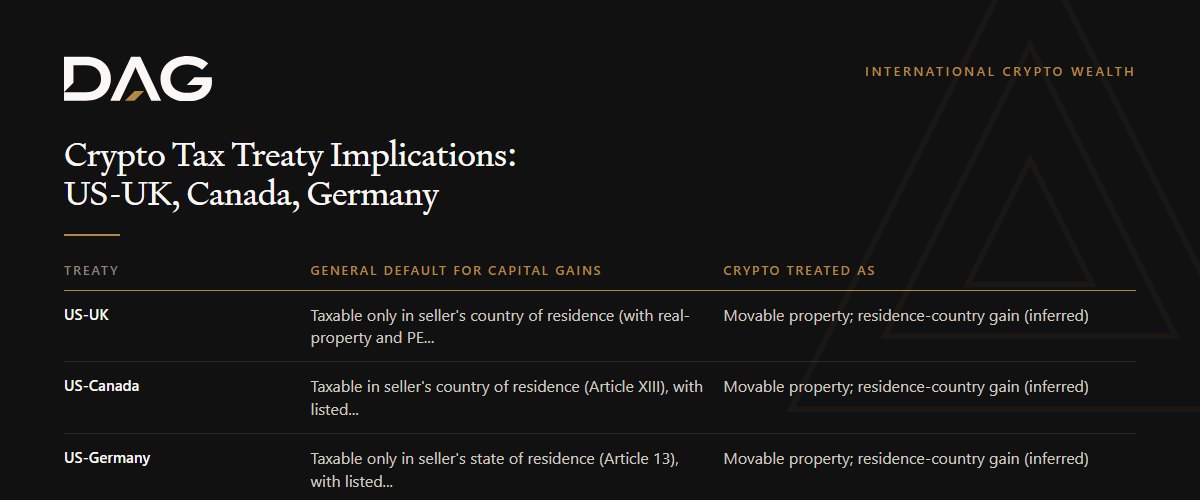
The capital-gains article in the US Model treaty, and in the UK, Canada, and Germany treaties, follows a common default: gains from the sale of property are taxable only in the country where the seller is resident, with specific exceptions (mainly for real property and business-permanent-establishment assets). Crypto, treated as movable personal property, generally falls under the residence-country default rather than an exception.
In plain terms, if the treaty residence-country rule applies and you are resident in one country, that country has the primary right to tax the gain, and the other country is expected to step back or give credit.
| Treaty | General default for capital gains | Crypto treated as |
|---|---|---|
| US-UK | Taxable only in seller's country of residence (with real-property and PE exceptions) | Movable property; residence-country gain (inferred) |
| US-Canada | Taxable in seller's country of residence (Article XIII), with listed exceptions | Movable property; residence-country gain (inferred) |
| US-Germany | Taxable only in seller's state of residence (Article 13), with listed exceptions | Movable property; residence-country gain (inferred) |
Two large caveats sit on top of this table. First, the saving clause: US treaties reserve the right of the US to tax its citizens and residents as if the treaty did not exist. So a US citizen living in London still pays US tax on a crypto gain; the treaty mainly governs the other country's claim and the credit mechanics. Second, each country's domestic holding-period and characterization rules still apply, which is where the German one-year rule below becomes important.
How Do Residency Tie-Breakers Work?
When both countries' domestic rules say you are a resident, the treaty's "tie-breaker" article decides which country wins for treaty purposes. The treaties with the UK, Canada, and Germany use the same ordered cascade for individuals, applied in sequence until one country prevails:
- Permanent home, the country where you have a permanent home available to you.
- Centre of vital interests, if you have a home in both, the country with which your personal and economic ties are closer.
- Habitual abode, if that is unclear, the country where you habitually live.
- Nationality, if still tied, the country of which you are a national.
- Mutual agreement, if still unresolved, the two tax authorities decide by agreement.
The tie-breaker decides treaty residence, which then drives who has the primary right to tax a crypto gain. But for a US citizen the saving clause means the US can still tax the gain regardless of where the tie-breaker lands. Claiming treaty residence in the other country is typically reported to the IRS on Form 8833, and getting it wrong has penalties. This is squarely a job for cross-border counsel, which is why DAG coordinates rather than advises in foreign jurisdictions. See legal considerations for international crypto holders in the UK and Canada for the related entity and reporting issues.
What Is the Treaty-Specific Crypto Treatment in Each Country?
The treaty allocates rights; each country's domestic law decides the actual rate and characterization. The three differ sharply.
US-UK
The UK taxes crypto disposals as capital gains (HMRC treats crypto as property), with staking and mining generally taxed as income. The treaty's residence rule means a UK-resident, non-US person selling crypto is generally taxable in the UK, not the US. A US citizen in the UK is taxed by both and uses foreign tax credits to avoid double taxation. The UK detail lives in crypto regulations for UK investors.
US-Canada
Canada taxes capital gains by including a portion of the gain in income (the long-standing inclusion rate is 50%; a proposed increase to two-thirds was not enacted). Under Article XIII, a Canadian resident's crypto gain is generally taxable in Canada. A US citizen resident in Canada faces both systems and relies on credits. The Canadian mechanics are covered in Canada's capital-gains inclusion rate.
US-Germany
Germany has a distinctive rule: crypto held by an individual as a private asset for more than one year is generally tax-free on disposal; sold within one year, the gain is taxed as a private sale at ordinary rates (above a small annual exemption). The treaty assigns the gain to the residence state, so a German resident's qualifying long-held crypto can be tax-free in Germany. A US citizen in Germany gets no such break from the US side because of the saving clause and the absence of a US one-year-exemption equivalent. The German one-year figure is illustrative of the rule as long understood; verify the current threshold and exemption amount with German counsel before relying on it.
Related Questions
Does a tax treaty stop the US from taxing my crypto gains if I move abroad?
Generally, no. US income-tax treaties contain a saving clause that lets the US tax its citizens and green-card holders as if the treaty did not apply. The treaty mainly controls the other country's right to tax and provides a foreign tax credit to relieve double taxation. A US person abroad still reports worldwide crypto gains to the IRS. Confirm with a US cross-border tax professional.
Which country taxes my crypto gain if I am resident in two countries?
The treaty tie-breaker decides treaty residence, in order: permanent home, centre of vital interests, habitual abode, nationality, then mutual agreement. Whichever country wins generally gets the primary right to tax the gain. For US citizens, the saving clause can still pull the gain into the US return. This is a fact-specific call for cross-border counsel.
Is long-held crypto really tax-free in Germany under the treaty?
The tax-free outcome comes from German domestic law (private assets held over one year), not the treaty itself; the treaty allocates the gain to Germany as the residence state. The rule does not help a US citizen, who is still taxed by the US under the saving clause. Treat the one-year rule and exemption figures as illustrative and verify current German law with German counsel.
Sources
- IRS, United States Income Tax Treaties. A to Z, https://www.irs.gov/businesses/international-businesses/united-states-income-tax-treaties-a-to-z
- IRS, "The Taxation of Capital Gains of Nonresident Alien Students, Scholars and Employees of Foreign Governments" and treaty technical explanations (US-UK, US-Canada, US-Germany conventions and protocols), verify current treaty text and protocols on irs.gov and treasury.gov
- HMRC Cryptoassets Manual (CRYPTO), https://www.gov.uk/hmrc-internal-manuals/cryptoassets-manual
- Canada Revenue Agency, Capital gains, https://www.canada.ca/en/revenue-agency/services/tax/individuals/topics/about-your-tax-return/tax-return/completing-a-tax-return/personal-income/line-12700-capital-gains.html
- German Federal Ministry of Finance (BMF) guidance on the income tax treatment of crypto assets, verify current BMF circular with German counsel
Compliance Note
This page is for educational purposes only. It does not constitute legal or tax advice and does not establish an advisory relationship. Tax treaties are complex, interact with each country's domestic law, and are periodically amended by protocol; none of the treaties discussed names crypto, so the treatment described is inferred and may be challenged. US persons are generally taxed on worldwide income regardless of any treaty. Digital Ascension Group, including its US-based investment adviser affiliate DAG Wealth, is US-registered and is not licensed to provide tax or legal advice in the United Kingdom, Canada, Germany, or any other foreign jurisdiction. Treaty positions, residency tie-breakers, and crypto characterization should be confirmed with qualified cross-border tax counsel in each relevant jurisdiction before acting. Registration does not imply a certain level of skill or training.