
Wire-transfer limits for large crypto-to-fiat conversions are set by your bank and the exchange, not by a single legal cap, and a six-figure-plus wire ($500k and up) routinely draws extra scrutiny: source-of-funds documentation, a currency transaction report (CTR) for cash above the threshold, and possible suspicious-activity review. Correspondent banks in the payment chain can each add friction. Planning the documentation in advance is what keeps a large conversion moving.
What Happens on a Large Crypto-to-Fiat Wire
When you sell crypto on an exchange and wire the dollar proceeds to your bank, several institutions touch the payment. The exchange applies its own withdrawal and wire limits and its compliance review. Your receiving bank applies its limits and its AML monitoring. Between them, one or more correspondent banks may route the funds, and each can hold a payment for review. None of this is unique to crypto, but crypto-sourced funds tend to attract closer attention because the source is harder for a bank to see at a glance.
Two reporting mechanics often come up. A currency transaction report (CTR) is filed by a financial institution for cash transactions above a federal threshold; it is automatic and routine, not an accusation. A suspicious activity report (SAR) is filed when activity meets the bank's suspicion criteria, and the bank cannot tell you it filed one. Expecting these and documenting your funds cleanly is the normal path; trying to keep a transfer below a reporting threshold by splitting it is structuring, a federal crime, and the wrong approach.
This page sits under the crypto banking hub. If a wire or account is held during this process, see what to do when a bank freezes or closes a crypto-business account.
Where the Limits and Friction Actually Come From
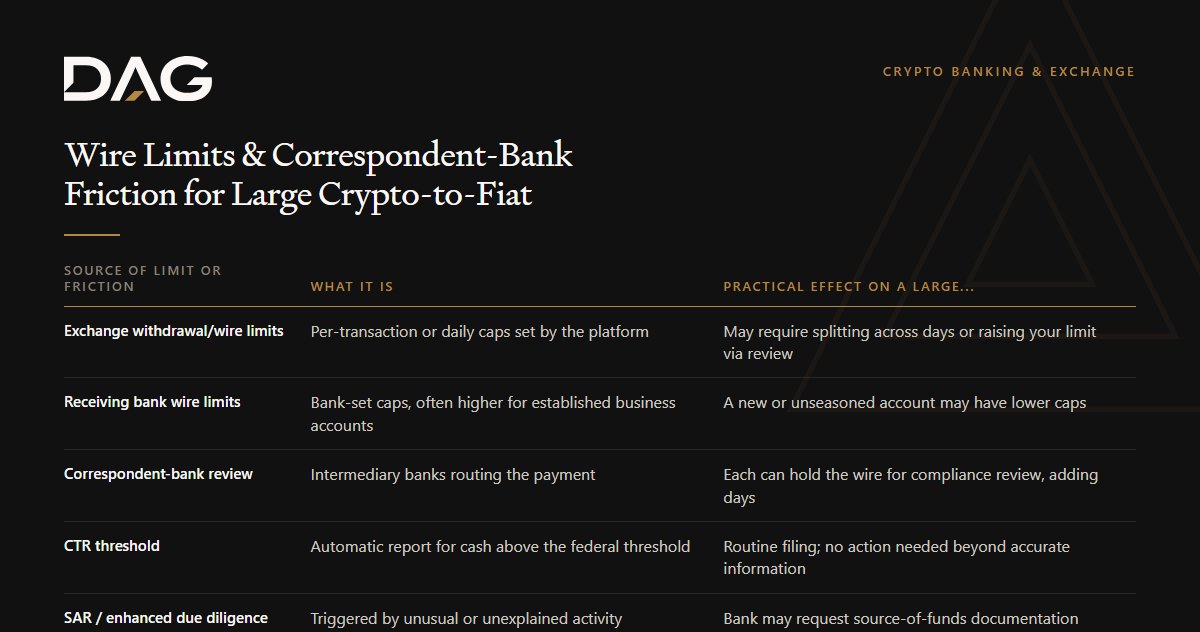
| Source of limit or friction | What it is | Practical effect on a large conversion |
|---|---|---|
| Exchange withdrawal/wire limits | Per-transaction or daily caps set by the platform | May require splitting across days or raising your limit via review |
| Receiving bank wire limits | Bank-set caps, often higher for established business accounts | A new or unseasoned account may have lower caps |
| Correspondent-bank review | Intermediary banks routing the payment | Each can hold the wire for compliance review, adding days |
| CTR threshold | Automatic report for cash above the federal threshold | Routine filing; no action needed beyond accurate information |
| SAR / enhanced due diligence | Triggered by unusual or unexplained activity | Bank may request source-of-funds documentation before releasing |
| Source-of-funds request | Bank asks you to substantiate where the money came from | The single biggest determinant of whether a large wire clears smoothly |
Specific dollar thresholds, fees, and caps vary by institution and change over time; treat any figure as illustrative and verify the current numbers with your bank and exchange.
Source-of-Funds Documentation: The Core of It
For a $500k+ conversion, the question a bank most wants answered is "where did this come from?" Having the answer documented before the wire moves prevents most delays. A typical package includes:
- Exchange account statements showing the sale and the cost basis history of the position.
- A clear trail from acquisition to sale: when and how the crypto was acquired, transfer records between wallets and the exchange, and any prior tax reporting.
- Entity records if the account is in an LLC or trust, formation documents and the operating agreement, consistent with how exchanges verify business entities.
- Tax documentation tying the gain to your reporting, which connects to broader crypto tax planning for HNW investors.
For very large or market-moving positions, conversions are sometimes routed through an OTC desk rather than an exchange order book to reduce slippage; that is an execution choice separate from the banking documentation, covered in OTC & block-trade liquidity for large token positions.
How to Reduce Friction Before You Sell
- Season the receiving account and raise wire limits in advance rather than on the day of the sale; see why do I need to season my bank accounts before price appreciation.
- Tell the bank a large incoming wire is coming and ask what documentation it will want. A heads-up to a relationship banker shortens review.
- Keep source-of-funds records assembled before initiating the conversion.
- Confirm the exchange's per-transaction and daily limits so the wire structure fits real, transparent transactions, not amounts chosen to stay under a reporting line.
Related Questions
Is there a legal maximum on a crypto-to-fiat wire?
There is no single federal cap on the size of a wire. Limits come from your bank and the exchange, and large transfers trigger reporting (such as a CTR for cash above the threshold) and review, not prohibition. A well-documented large wire generally clears; the constraint is documentation and institutional limits, not a legal ceiling.
Why does my large wire get held for days?
Correspondent banks and your receiving bank each run AML monitoring, and a large crypto-sourced wire can prompt a source-of-funds request or enhanced due diligence. Providing documentation promptly and pre-notifying the bank usually resolves the hold. A SAR, if filed, will not be disclosed to you.
Should I split a large conversion into smaller wires?
Not to avoid a reporting threshold, deliberately breaking up transactions to stay under a CTR or reporting line is structuring, a federal crime. Splitting across days for legitimate reasons such as exchange limits or market execution is different and should reflect real operational constraints, with the full activity transparent and documented.
Sources
- FinCEN: Currency Transaction Report (CTR) requirements. https://www.fincen.gov/resources/filing-information
- FinCEN: Bank Secrecy Act requirements. https://www.fincen.gov/resources/statutes-regulations/bank-secrecy-act
- Federal law on structuring transactions to evade reporting (31 U.S.C. § 5324). https://www.govinfo.gov/app/details/USCODE-2021-title31/USCODE-2021-title31-subtitleIV-chap53-subchapII-sec5324
Compliance Note
This article is for educational purposes only and does not constitute legal, tax, banking, or investment advice. Dollar thresholds, wire limits, and fees are illustrative, change over time, and must be verified with your bank and exchange. CTR and SAR filings and AML monitoring are normal parts of regulated finance, described here so a reader can prepare documentation, never as something to evade. Structuring transactions to avoid reporting thresholds is a federal crime. Large conversions are never guaranteed to clear on any timeline. Advisory services are provided by DAG Wealth, an SEC-registered investment adviser. Consult a qualified professional about your specific facts. Registration does not imply a certain level of skill or training.